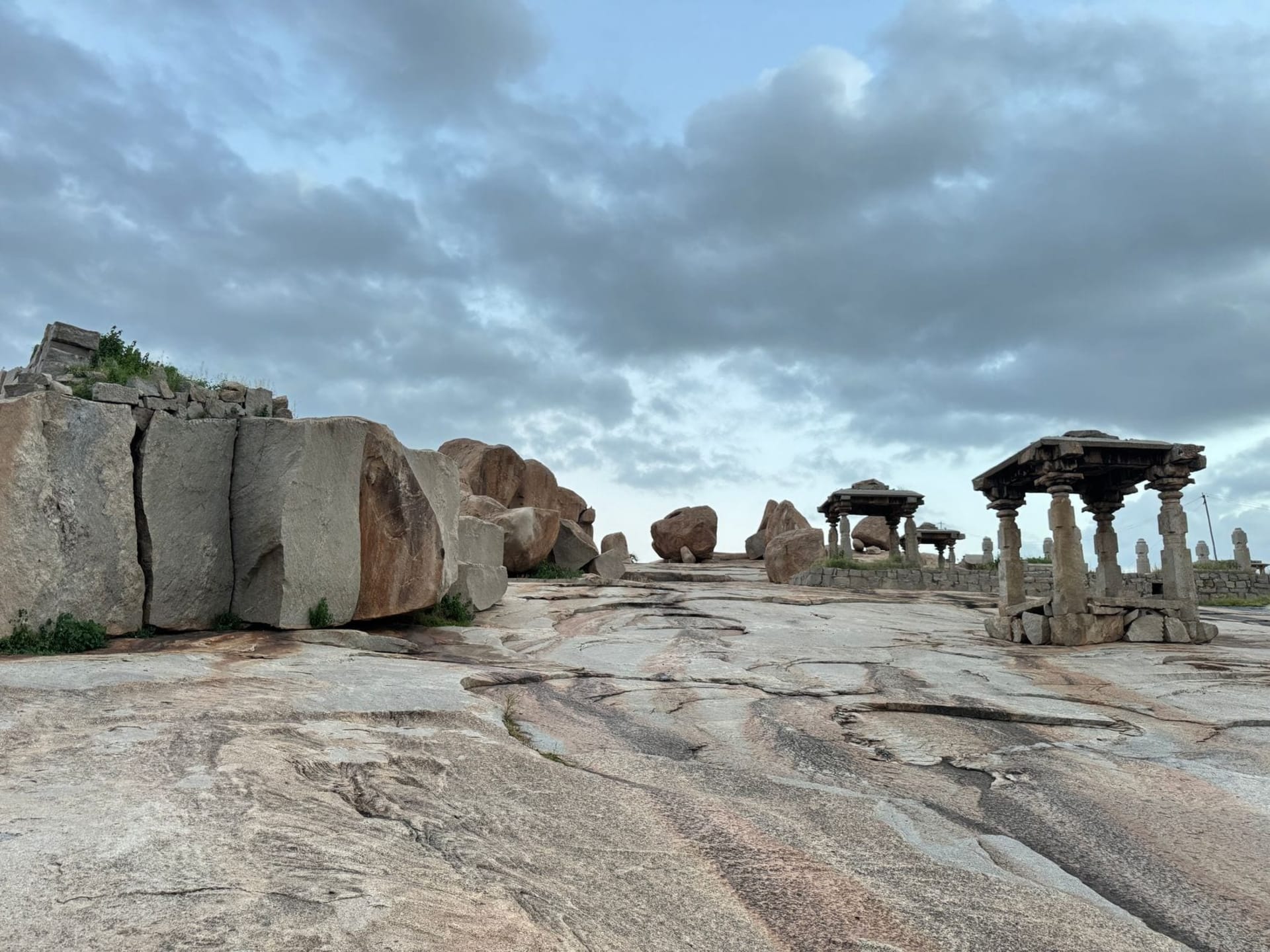
Hampi Boulderscape
"Hampi's granite boulders are so precisely stacked by geology that you keep suspecting an ancient architect."
Vijayanagara Empire ruins scattered among surreal granite boulders on a river bend in Karnataka.
I arrived in Hampi by overnight bus from Bangalore, stepping off into the pale six o’clock light with dust already in my throat and the smell of woodsmoke drifting from somewhere behind the banana groves. The auto-rickshaw driver who took me across the coracle ferry — a round woven basket of a boat that spins lazily on the Tungabhadra — said nothing the entire crossing. He didn’t need to. The boulders said everything.
A Landscape That Shouldn’t Exist
Nothing fully prepares you for the scale of the granite. These are not pretty rocks. They are vast, orange-ochre formations the size of apartment buildings, balanced on one another with the casual confidence of something that has been doing this for six hundred million years. Geologists call it a monadnock landscape. I kept calling it impossible. Lia, who has more patience for wonder than I do, sat on a flat boulder near the Vitthala Temple complex and just laughed — the quiet kind, the kind that means she has nothing useful to add.
The Vitthala Temple itself, with its famous stone chariot frozen in the courtyard, is overrun by noon. We went at seven in the morning. The carved wheels of the chariot still hold traces of pigment in the grooves, and in that early light the whole structure looked less like a monument and more like something interrupted mid-thought.
The Village Side of the River
Most travelers stay in Hampi Bazaar, the strip running west from the Virupaksha Temple. We crossed to Virupapur Gaddi on the north bank, where guesthouses cling to the boulders and dogs sleep on warm stone all afternoon. The pace there is different — slower, almost indolent in the heat. We ate thali at a rooftop place near the Sanapur Lake road: rice, sambar, a dry coconut chutney, and a pickle so sharp it made my eyes water in a way I appreciated.
The unexpected discovery came on our third afternoon. Following a goat path east of the Anjaneya Hill, we found a cluster of ruined pavilions that appeared on no map we had. Carved bracket figures, mostly intact, looked out over a dry rice field. No one else was there. A crow landed on a capital and regarded us briefly before leaving.
Light and Stone
The boulders change completely at dusk. What reads as burnt orange at midday goes deep red, almost purple, in the last twenty minutes before the sun drops behind the Hemakuta Hill. That is the hour to be moving through the ruins, when the stone seems to hold the heat like something living.
When to go: October through February, when temperatures are bearable and the post-monsoon green still clings to the valley. Avoid March onward — the granite radiates heat like a griddle by April.