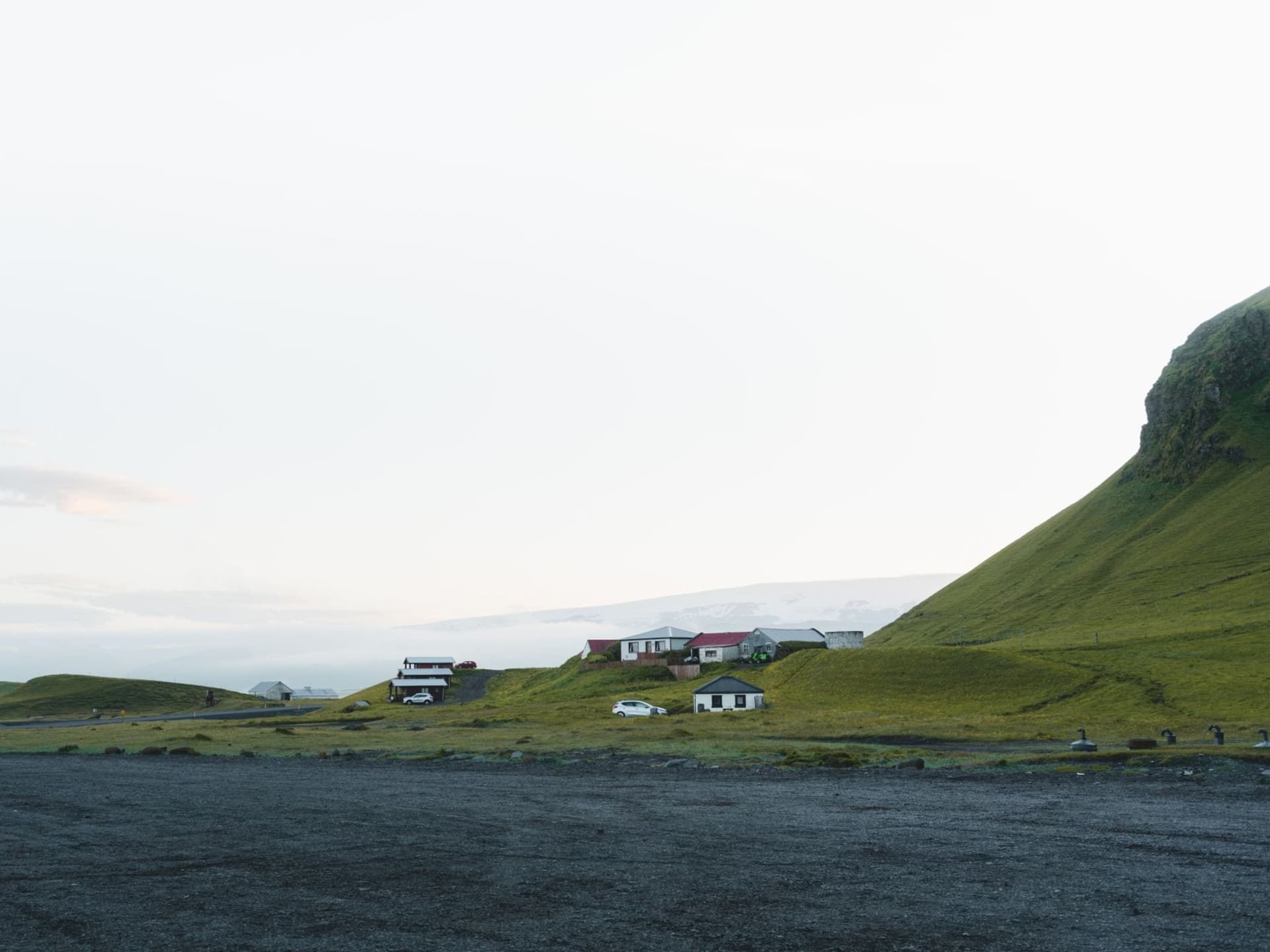
Westman Islands
"The Westman Islands are a lesson in what it means to call a volcanic island home."
A volcanic archipelago where a 1973 eruption buried half a town and the locals returned to rebuild beside the still-smoking lava.
There are places that wear their history quietly, in the weathering of stone or the angle of old streets. The Westman Islands — Vestmannaeyjar — wear theirs in black lava fields that still smell faintly of sulfur on warm days, in houses whose neighbors were swallowed whole in a single January night in 1973, in the particular resilience of a people who evacuated in the dark and came back to dig their chimneys out of ash.
The ferry from Landeyjahöfn takes about forty minutes. I stood at the bow watching Heimaey — the only inhabited island in the archipelago — sharpen into view: the Eldfell crater rust-red against a pewter sky, the harbor town compact and colorful below it, fishing boats knocking against the dock. It looked improbably cheerful for a place that nearly ceased to exist.
What the Lava Left Behind
The eruption of Eldfell began without warning at two in the morning on January 23rd. Within hours, the entire population — about five thousand people — had been evacuated by fishing boat. By the time it ended five months later, three hundred homes were buried under meters of lava and ash. The new land added to the island’s eastern edge was still too hot to walk on.
Walking through the Eldheimar museum, which was built around the excavated remains of a house on Gerviberabraut, I kept stopping at the small things — a ceramic pot mid-shelf, a child’s boot sole — and feeling the particular vertigo of interrupted domesticity. Outside, a lava field begins where a street ends, just past a yellow wall that somehow survived. I spent a long time at that wall.
Puffins, Cliffs, and Lia’s Fear of Heights
Heimaey’s sea cliffs are extraordinary — volcanic columns dropping sheer into the North Atlantic, with hundreds of thousands of Atlantic puffins nesting in the grass just back from the edge. Lia, who does not share my enthusiasm for standing near drop-offs, waited on a rock while I crept forward on my stomach to watch a puffin land with a beak full of sand eels, utterly unbothered by my presence. The wind smelled of cold salt and bird and something ancient.
What genuinely surprised me was the restaurant scene. I’d expected a small fishing town with limited options. Instead, at Einsi Kaldi on Bárustígur, I ate the freshest langoustine of my life — split, grilled, finished with butter and dill — watching the harbor through a fogged window while the kitchen radio played something in Icelandic I couldn’t understand but found oddly comforting.
When to go: May through August offers the best access to puffin colonies and more predictable ferry crossings. July coincides with the Þjóðhátíð festival, a massive outdoor celebration that draws Icelanders from across the country — book accommodation months ahead if you want to attend.