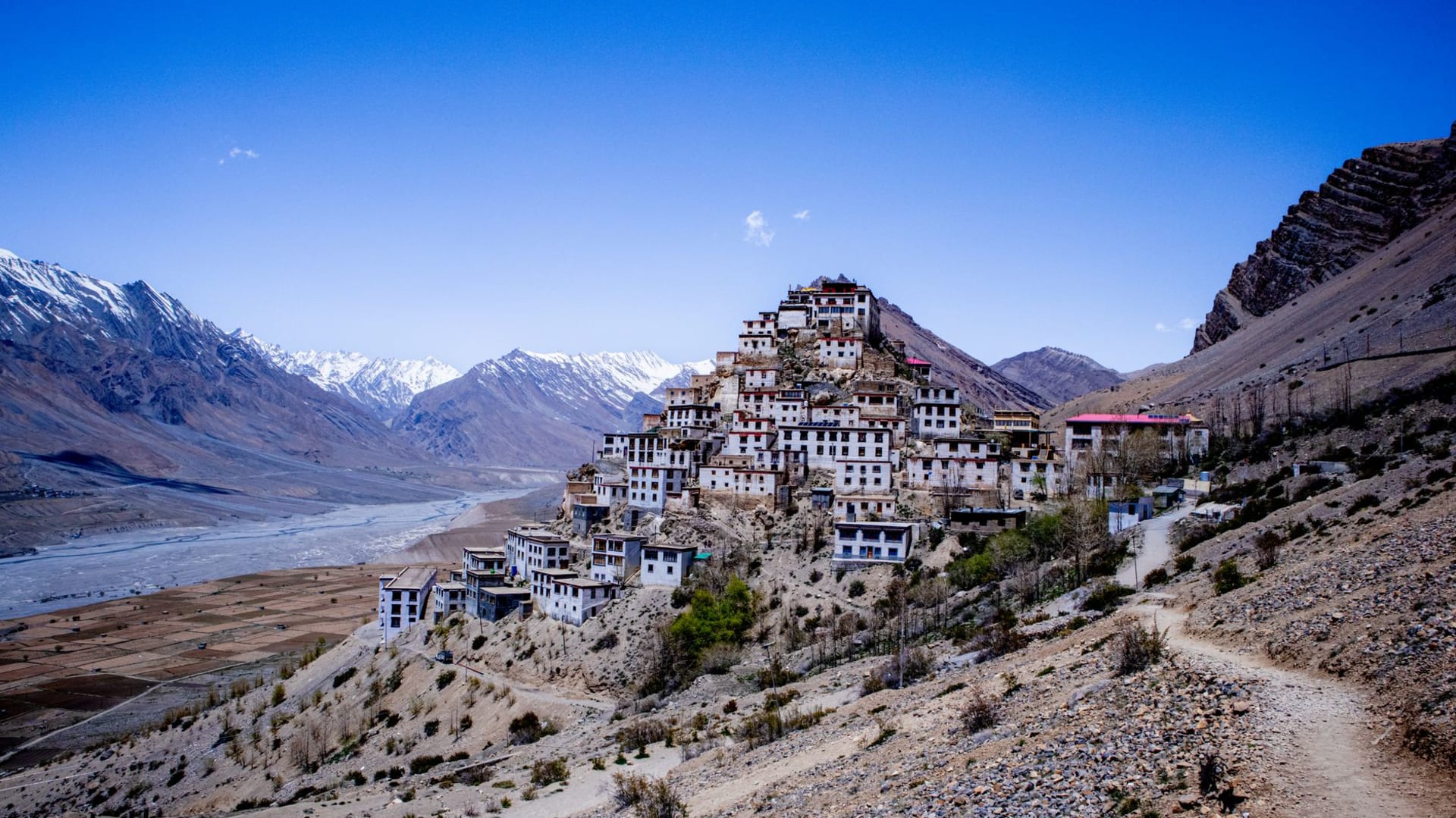
The first time I saw Key Monastery it was from the road, maybe three kilometres away, and I made the driver stop the jeep so I could look at it properly. It rises from a rocky spur at 4166 metres — tiers of whitewashed and ochre walls climbing each other in a way that seems less like architecture and more like an argument that has gotten out of hand. The valley below it is so wide and empty that the monastery seems to be making some kind of categorical claim on the landscape. This is the most photographed monastery in Spiti, and I understand why: no photograph has ever made me feel I didn’t need to come and see it myself.
Getting there from Kaza takes about forty-five minutes on a road that improves and worsens in alternating stretches. The monastery appears and disappears around corners as you climb. When you arrive at the base and start up the steep path through the village of Key — a scatter of houses and kitchen gardens occupying the slope below the main complex — the scale of the building starts to resolve itself. It is bigger than it looks from the road. It is also older than it looks from anywhere: founded in the 11th century, rebuilt after Mongol raids and earthquakes, most recently restored after serious earthquake damage in 1975. The current buildings are a palimpsest of centuries rather than a single period’s work, which gives the place a layered quality — walls of different colours and textures butting against each other, doorways at unexpected heights, corridors that seem to change direction mid-thought.

Inside, the assembly hall holds a collection of thangkas, weapons from raids that history doesn’t fully record, and butter lamps whose light turns everything amber. A monk in his twenties — one of the three hundred who study here — showed me a room where ancient manuscripts are stored in wooden cabinets lacquered red and gold. He was from Manali, he said, and had been here four years. Did he miss the lower altitude? He smiled and said he missed his mother’s cooking more than the oxygen. We drank butter tea in a small side room while a group of student monks outside rehearsed chants, their voices rising and falling in a rhythm that seemed to have no beginning or end.
The roof of the monastery is its best room. From the flat terrace at the top, the Spiti Valley opens in every direction: the river a thread of silver in the valley floor, the road a pale line on the opposite slope, the peaks ranked behind each other in diminishing shades of grey-blue until the last ones blur into sky. A prayer flag mast stands at the corner of the terrace, and the flags snap and crack in the wind that comes through every day by noon without fail. One of the older monks told me the wind is considered auspicious — that the flags send prayers into the air every time they move. I watched them for a while, the morning light hitting the valley at an angle that turned the river to gold, and thought that if you designed a view to make someone believe in something, this would be close to the optimal design.

The monastery guesthouse is a possibility I recommend. Basic beds, shared bathroom, a kitchen that serves simple meals. Waking before dawn and watching the sunrise turn the opposite ridges pink and orange from a rooftop where monks are already at their morning prayers is the kind of experience that rewrites a trip. Bring enough layers — nights at this altitude, even in July, are seriously cold.
When to go: July to September is the main window, when the road from Manali is passable. Early July can still see some mud and landslides on the Rohtang approach. The Gustor Festival, held at Key Monastery in October or November (date varies by Tibetan calendar), features masked dances and is one of the great spectacles of Spitian Buddhist culture — worth planning around if you can reach the valley before the passes close.