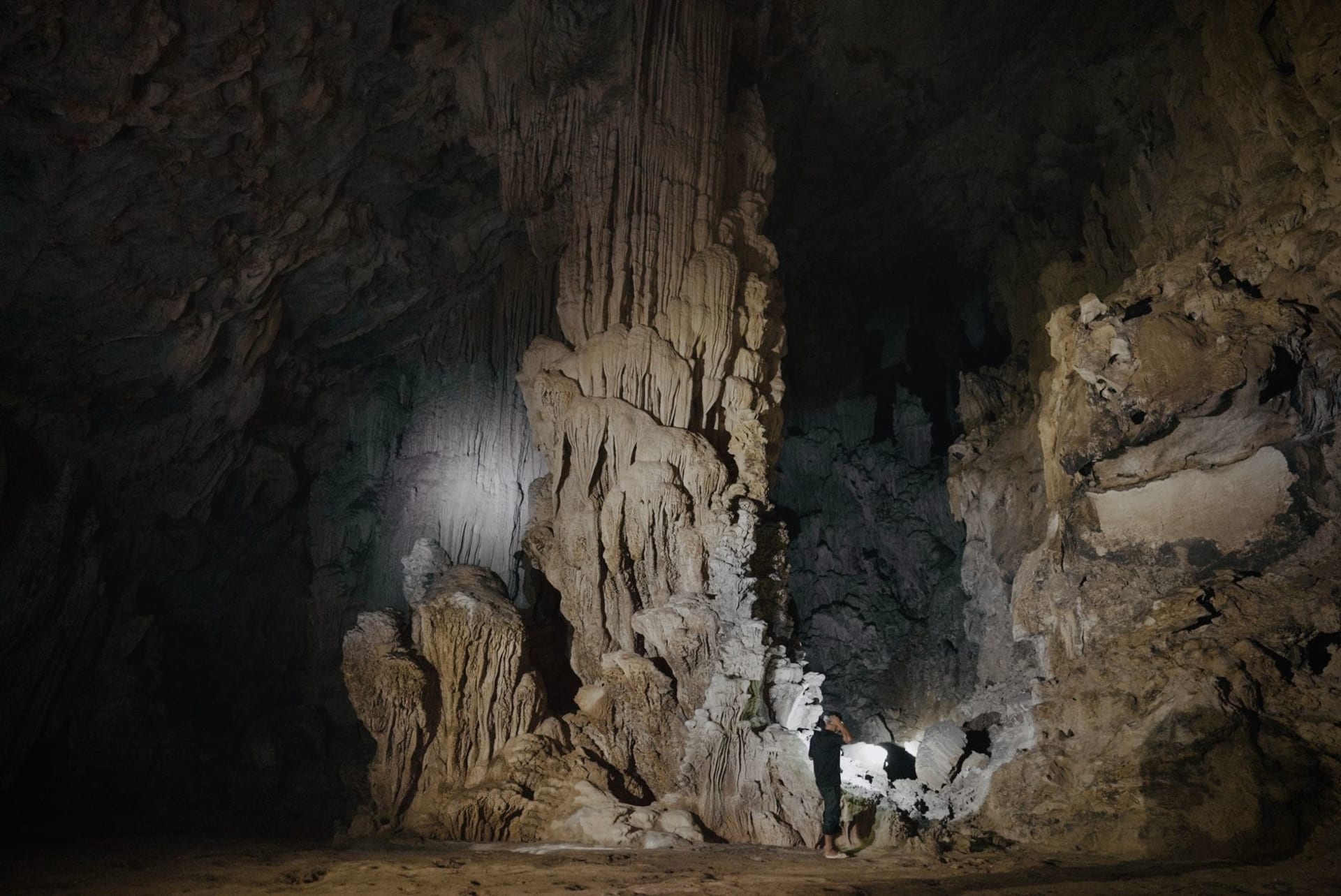
Dau Go Cave
"Seven centuries ago this cave held the weapons that turned back an empire. It holds this information very lightly."
The name means “cave of wooden stakes.” In 1288, the Vietnamese general Trần Hưng Đạo used this cave to store the sharpened timber poles that his forces then drove into the bed of the Bạch Đằng River, positioning them below the waterline to be concealed by the tide. When the Mongol fleet of Kublai Khan advanced upriver on the ebb tide, the exposed stakes tore through the hulls of three hundred vessels. The Mongol invasion of Vietnam ended there, in that river, with materials stored here. The cave has carried this story since before tourism, before UNESCO, before Vietnam was a country in the form it takes today.
I came to Đầu Gỗ on a morning when low cloud was sitting on the bay and the limestone was the color of old pewter. The cave entrance is high on a karst face, reached by a stairway carved into the rock — sixty-odd steps that leave you slightly breathless not from effort but from the verticality, the drop to the water visible each time you look left. Inside, the cave opens in stages: a foyer, then a passage, then the main chamber, which is large and irregular and full of formations that generations of guides have named after people, animals, and landscapes. A tree. A turtle. A map of Vietnam. I stopped trying to see these things after the second chamber and just looked at the cave.

The stalactites here are older-looking than Sửng Sốt’s — more weathered, darker at the base where centuries of humidity have stained them, the mineral deposits running in long vertical streaks that look almost like brushwork. The cave has been known to Western visitors since the nineteenth century: French explorers named it “Grotte des Merveilles,” cave of wonders, and the double naming has left it with a slightly schizophrenic identity in the guide literature. It is neither fully translated nor fully local. The original name — the practical name, the name that remembers what the cave was actually used for — is Đầu Gỗ, and that’s the name that matters.

I thought about the soldiers moving wooden stakes through this space in the dark of the thirteenth century — the sound it would have made, the number of trips required for enough poles to change the course of a battle, the scale of the logistics involved. The cave becomes strange to move through with that image in mind. It is not geological spectacle but infrastructure. A warehouse. A place that served a purpose and then returned to being what it was before.
When to go: Đầu Gỗ is on the standard Hạ Long Bay cruise circuit and is best visited early — before nine AM when the day excursion boats from Hạ Long City arrive. The cave is accessible year-round, and the interior temperature holds around 20°C regardless of season outside.