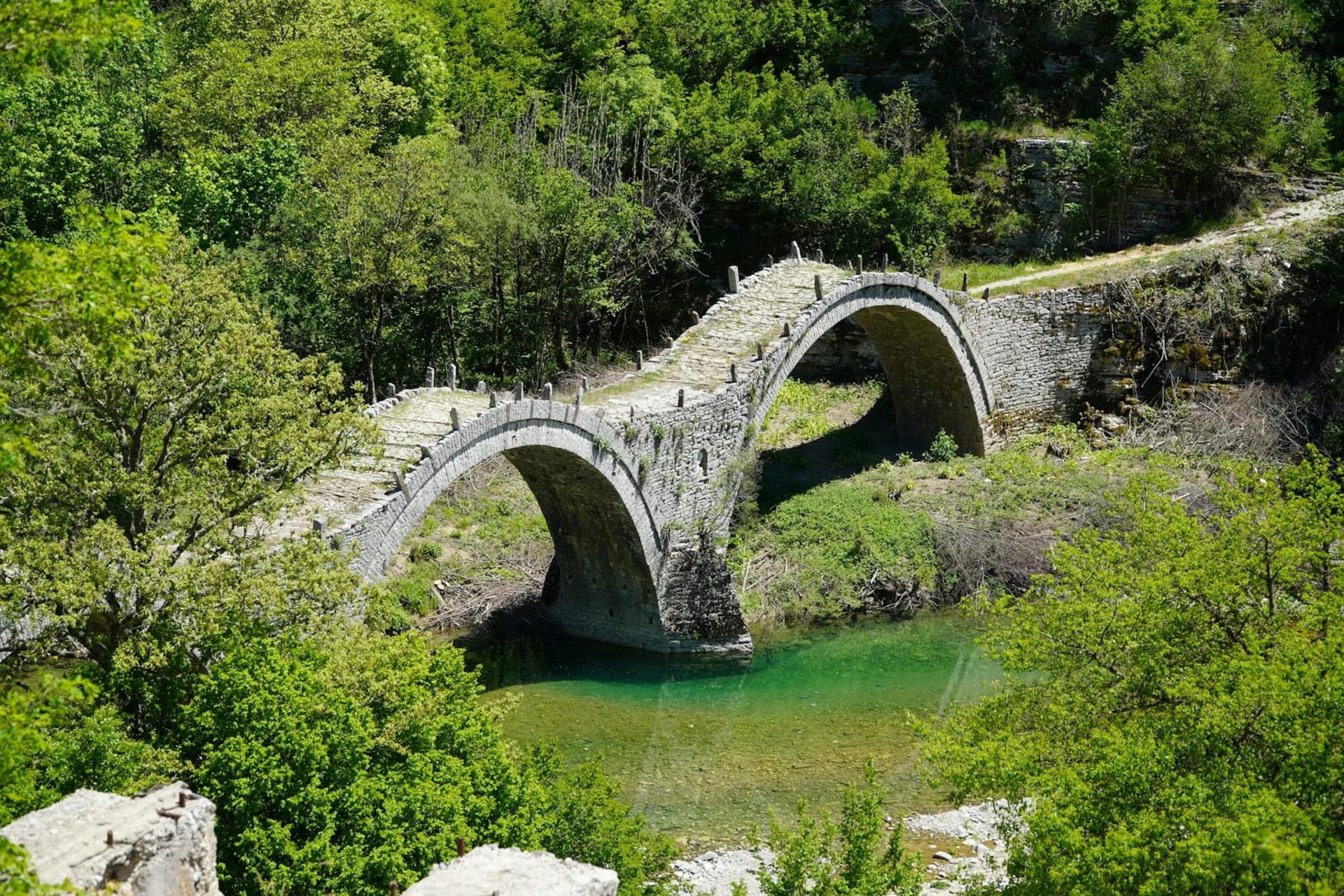
Forty-six stone villages connected by Ottoman arched bridges in the Pindus mountains of Epirus, above the Vikos Gorge.
We arrived in Monodendri at dusk, when the light was the color of old honey and the stone houses looked like they had simply grown out of the mountain. Not built — grown. Every wall, every rooftile, every flagstone path threading between courtyards is cut from the same grey-green slate the Pindus has been shedding for millennia. The villages don’t announce themselves. They materialize.
The Stone That Holds Everything
Zagori is forty-six villages, but most people see three or four, and most people are probably right. The roads between them are narrow and theatrical, switchbacking through beech and oak forest so dense that the sky arrives in patches. We based ourselves in Papingo — the upper village, Megalo Papingo, where the plateia holds a single kafeneion, two cats, and a view of the Towers of Astraka that made Lia put her coffee down and just stare.
The food in these mountains is not delicate. At the kafeneion in Vitsa — a village so quiet I checked twice that it was still inhabited — we ate kokoretsi off a spit that had clearly been turning since before we were born, and a bean soup called fasolada that tasted of wood smoke and winter. The bread came without asking. The wine was local and slightly cloudy and I drank more of it than I intended.
The Gorge Does Not Negotiate
Vikos Gorge is the deepest gorge in the world relative to its width — a geological technicality the locals mention with the casual pride of people who have lived next to something extraordinary for so long it has become ordinary to them. We hiked the Voidomatis Springs trail from Vikos village, following the river where it surfaces from limestone at a temperature so cold it made my teeth ache. The canyon walls above us were vertical, almost offensive in their scale. I kept expecting the path to widen. It did not.
What I didn’t expect was the silence. Not the absence of sound — birds, water, wind through the pines — but the absence of human noise. No drones, no tour groups with amplified guides. Just the gorge doing what it has always done.
The Bridges
The Ottoman packhorse bridges — the most famous being the triple-arched Kokkorou bridge near Kipi — are the detail that stays with you. Single arches, triple arches, perfectly fitted without mortar, still carrying weight after three hundred years. I walked across Kokkorou twice just to feel the stone underfoot.
When to go: Late spring (May–June) for wildflowers and full rivers, or early October when the beech forests turn and the summer crowds have dissolved. Avoid August entirely — the gorge hikes become crowded and the heat is uncharacteristic for a place this high.