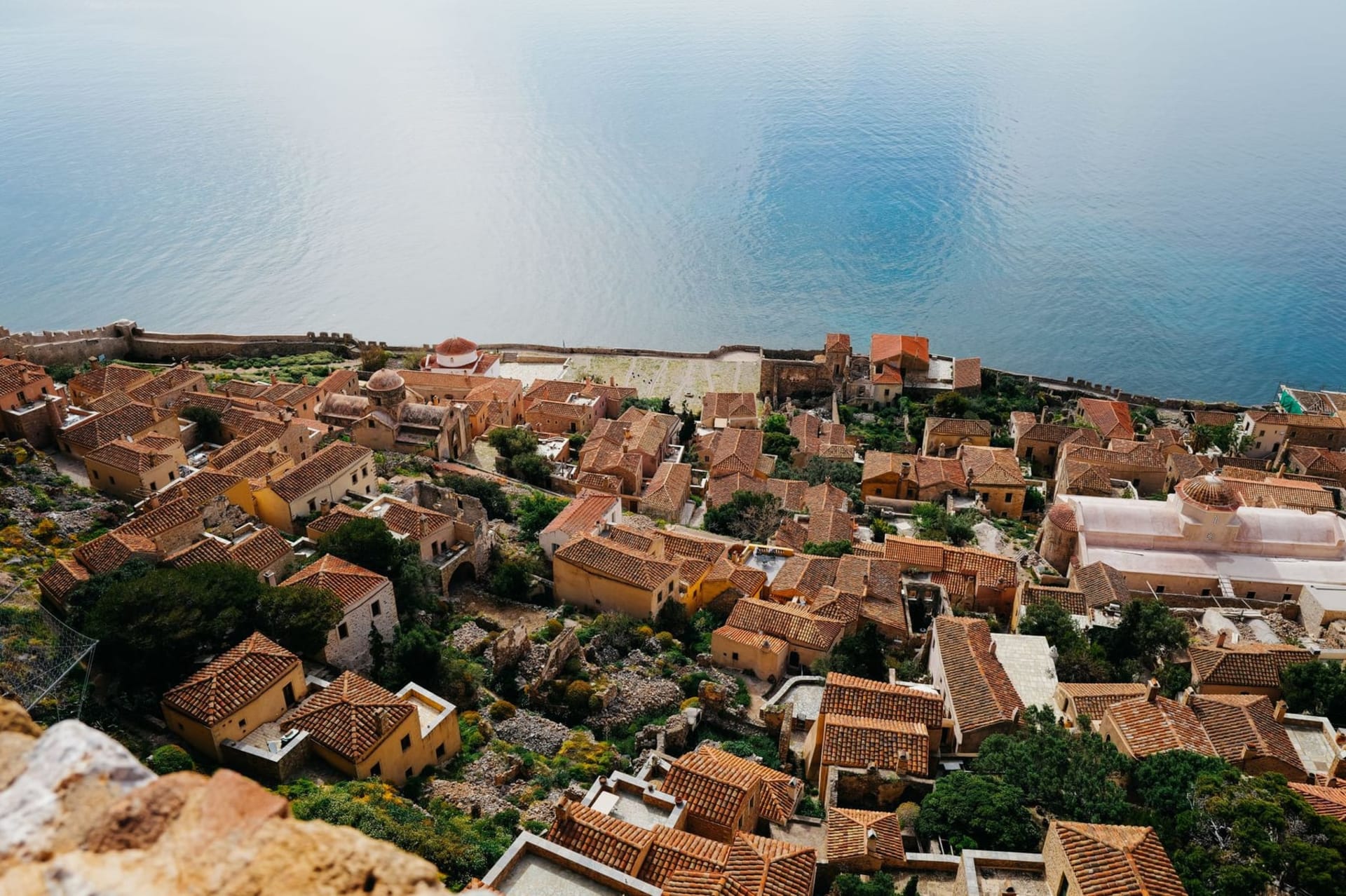
The Gibraltar of Greece: a medieval Byzantine town clinging to a massive sea rock, accessible only by a single causeway and worth every step.
There is only one way onto the rock, and the road is barely wide enough for a single car. A causeway, a gate, a tunnel cut through stone — and then suddenly you are inside a medieval world that the twentieth century mostly forgot to reach. No vehicles beyond the gate. No chain hotels. No street signs that would make any sense to a satellite. Just cobblestones, bougainvillea running riot over old walls, and the smell of the sea pressing in from both sides.
Inside the Lower Town
The lower town of Monemvasia is a single long street — Ritsos, named for the poet Yannis Ritsos who was born here and exiled elsewhere and always wrote about the rock with the longing of someone who understood captivity. The houses are built directly into the cliff, their back walls the living stone of the promontory itself. Walking it the first morning, I kept stopping to press my hand against doorways that had been worn smooth by five centuries of palms doing the same thing.
Lia found a kafeneion tucked into an alcove near the Porta Maggiore — no sign, four tables, an old man who brought us tiropita wrapped in paper and didn’t offer a menu because there wasn’t one. The coffee came in tiny cups and tasted of cardamom and seriousness. We ate slowly. No one hurried us along.
The Church of Christos Elkomenos
Climbing to the upper town was the unexpected part. I had read about the lower level, the famous kastro view, the boutique hotels in converted mansions. I had not expected the upper plateau to feel so completely abandoned — the ruins of the Byzantine upper citadel open to the sky, wild thyme growing between the flagstones, the Church of Christos Elkomenos sitting alone above the rooftops. Inside, the air was cool and smelled of stone and old candle wax. A single oil lamp burned in front of a blackened icon. Outside, the entire Lakonian Gulf spread out below in every direction, hazy and enormous and indifferent to all of it.
The surprise was the vertigo — not of height, but of time. Standing up there, I had the disorienting sense that the rock had been here before the sea and would remain after it.
Down by the Water at Dusk
Back at sea level, the light does something particular in the hour before sunset. It goes amber, then almost red, catching the honey-colored stone of the walls and turning everything briefly warm. We sat on the seawall with a carafe of Laconian wine — a Monemvasia winery blend, pale and slightly mineral — and watched the causeway traffic stop as a fisherman crossed on foot with a bucket.
When to go: April through early June, or September into October — the summer heat turns the rock into a solar furnace and the crowds double. Spring brings wildflowers on the upper plateau and water warm enough to swim from the rocks below the walls.