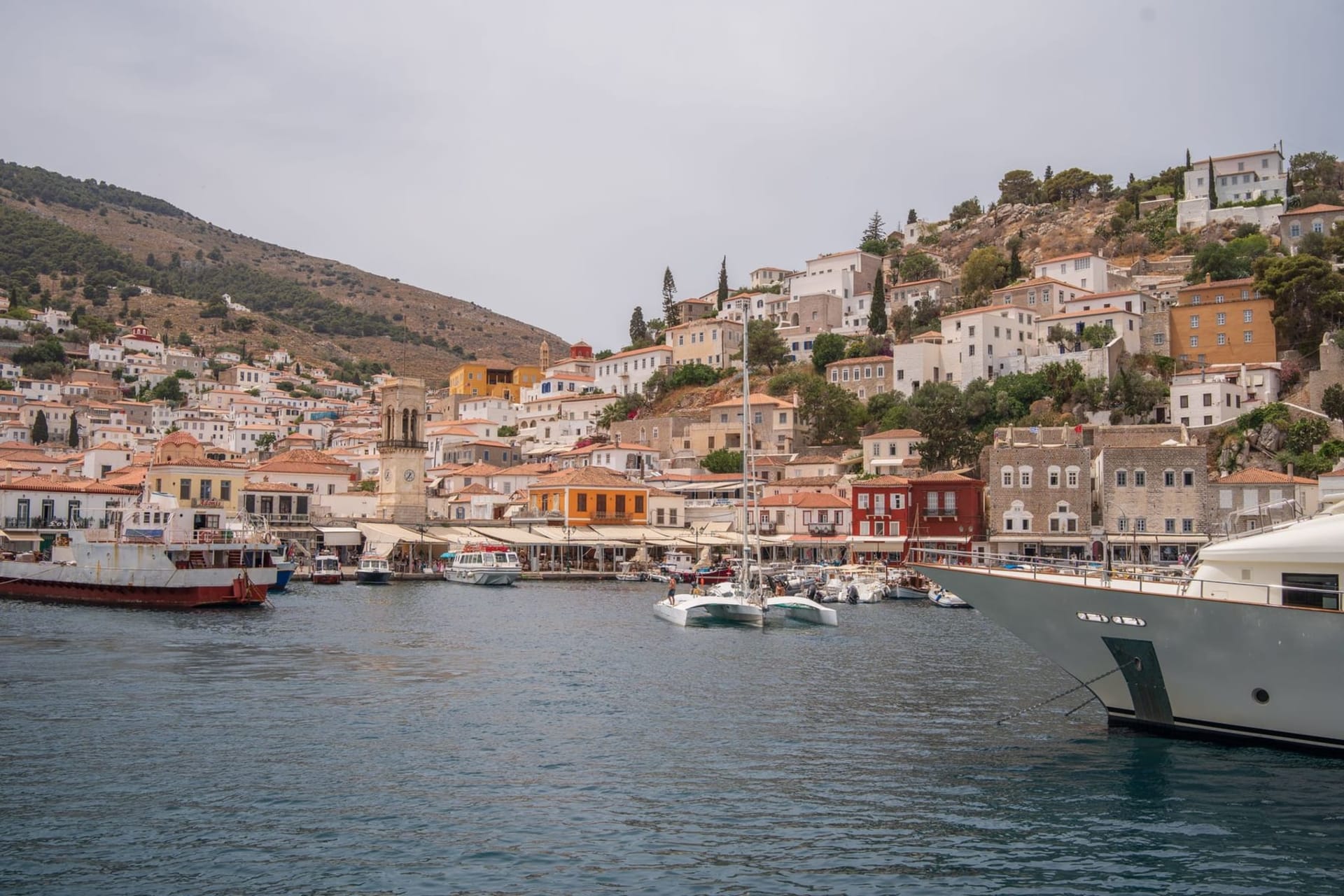
Hydra
"Hydra banned the engine and accidentally created the most serene island in the Aegean."
An island with no cars, no mopeds, and no noise — only donkeys, water taxis, and a Saronic harbor that inspired Leonard Cohen to live and write here.
The ferry from Piraeus takes ninety minutes, and by the time it rounds the headland and the harbor of Hydra Town opens up — stone mansions stacked on the hillside, the clock tower of the Dormition church catching the afternoon light — I had already noticed what was missing. No honking. No idle engine. Just the creak of the mooring ropes and the clatter of hooves on cobblestone as a donkey train passed behind the customs house carrying bottled water and crates of vegetables up to the higher neighborhoods.
Hydra outlawed motor vehicles in 1953. What followed, unintentionally, was the preservation of a way of moving through a place that the rest of Greece had traded away for asphalt and convenience.
The Harbor and the Mansions
The Hydra Town harbor is a horseshoe of pale stone, ringed by the archontika — the great 18th-century sea captain mansions built from the profits of running the British blockade during the Napoleonic wars. The Lazaros Koundouriotis Historical Mansion is the finest of them, its upper floors now a museum of costumes and Hellenic artifacts. Lia spent an hour in those rooms while I sat at a café table on the quay eating octapodi grilled over charcoal — the kind that arrives charred at the tips and tender through the center — watching the water taxis thread between the moored wooden caïques.
Leonard Cohen bought a house here in 1960 for fifteen hundred dollars, on a street called Episkopi, above the port. He wrote Bird on the Wire in that house, inspired by the actual birds perching on the telephone lines outside his window. I walked up there in the early evening, when the last of the day-trippers had taken the ferry back and the alleys were quiet enough to hear the sea.
The Island Above the Port
What surprised me — genuinely, because I had not read about it before arriving — was how far the island extends beyond the port and what you find when you leave the quay behind. The mule path to the monastery of Profitis Ilias climbs for two hours through scrub pine and wild thyme, past the abandoned convent of Agia Matrona, and ends at a ridge with a view that takes in the entire Saronic Gulf and, on a clear morning, the hills of the Peloponnese across the water. We went up at first light, Lia and I, and ate sesame bread from the bakery on Tombazi Street that opens at six. There was nobody else on the path. The donkeys were still stabled. The entire island smelled of thyme and pine resin warming in the sun.
The absence of engines doesn’t just make Hydra quiet. It makes the senses recalibrate entirely, so that small sounds — the bell on a donkey’s harness, the slap of a wave against a stone landing, a conversation drifting from an upstairs window — register with a clarity that feels almost medical.
When to go: Late May and early June before the summer crowds arrive, when the bougainvillea is still in full bloom and the harbor tavernas haven’t yet doubled their prices. Late September is equally good — the swimming remains warm, the light turns amber by four in the afternoon, and the island remembers itself.