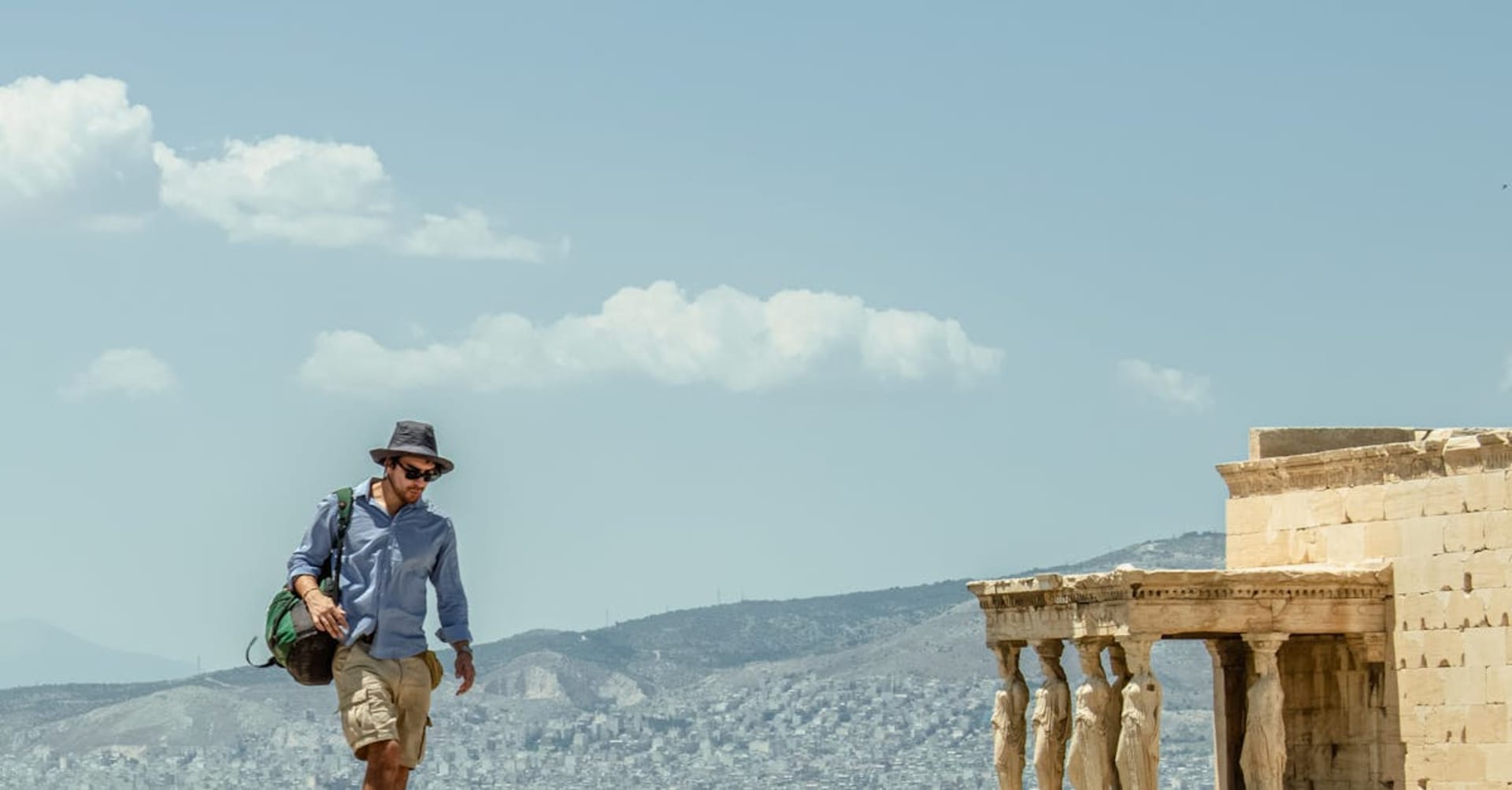
Athens is a place where you can stand on a fifth-century marble floor in the morning and eat street souvlaki at midnight, and both experiences feel equally essential. The Acropolis dominates everything — not just the skyline but the psyche. The Parthenon up close is smaller than you expect and more powerful than you imagined, its columns catching the light in ways that feel deliberate even after twenty-five centuries. I climbed up at seven in the morning, before the tour groups arrived, and for twenty minutes I had the thing nearly to myself — just me, the marble, and a security guard who was more interested in his coffee than in hurrying anyone along.
Below the sacred rock, the Plaka neighborhood winds through neoclassical houses painted in peeling pastels, with bougainvillea spilling over balconies and cats asleep on every available surface. I spent an entire afternoon here doing nothing productive — sitting at a table barely wide enough for two cups, drinking Greek coffee so thick the grounds formed a sediment you could read your fortune in, watching old men argue about football with the intensity most people reserve for religion. The Anafiotika quarter, tucked against the north slope of the Acropolis, is a Cycladic village transplanted into the capital — whitewashed houses built by stonemasons from the island of Anafi in the 1840s, so convincingly out of place that turning a corner feels like stepping through a portal.

The Central Market on Athinas Street is a sensory assault of hanging meats, stacked olives, and fishmongers shouting prices at nobody in particular. I went at dawn, when the butchers were still setting up and the fish stalls were arranging the morning catch on ice with a care that bordered on artistry — sardines fanned out in silver rows, octopus draped over counters like sculpture. The surrounding streets have some of the city’s best cheap food: tiny tavernas serving bowls of tripe soup to taxi drivers at six in the morning, bakeries pulling cheese pies from ovens that have not cooled since the 1950s.
For the city’s intellectual pulse, walk to Exarchia — Athens’ anarchist quarter, where the coffee is strong, the graffiti is political, and the bookshops stay open late. The neighbourhood has a reputation that is more interesting than dangerous: the plateia fills every evening with students and artists and people who seem to have read more books than is strictly necessary, and the tavernas serve food that is cheap, generous, and unapologetically Greek. I had the best moussaka of my life at a place with no sign and six tables, where the owner’s mother was cooking in the back and the wine came in a tin jug.

The Acropolis Museum deserves a visit before you climb the hill, not after — the context it provides transforms the ruins from beautiful stones into a narrative you can follow. The ground-floor gallery is built over an active excavation site visible through the glass floor, and the top-floor Parthenon Gallery reconstructs the frieze in natural light at the same orientation as the original, with gaps where the Elgin Marbles should be. The empty spaces are the most eloquent argument for their return that I have encountered.
At night, the rooftop bars of Psyrri and Monastiraki come into their own. You sit with a glass of tsipouro — the clear grape spirit that tastes like raki’s more refined cousin — and the Acropolis floats above the city, lit amber against the dark, looking exactly as ancient and eternal as it is. Athens is not a city that trades on charm. It trades on substance, on argument, on a four-thousand-year habit of believing that ideas matter more than aesthetics. But standing on a rooftop at midnight, watching the Parthenon glow, you realize it has both.

When to go: April to early June or September to October. July and August bring punishing heat that radiates off the marble and turns sightseeing into endurance sport. Late September is quietly ideal — the light is golden, the tourists thin, and the tavernas start serving the season’s new wine.