Osprey Reef
"There is a specific silence that exists in deep, open ocean and it is unlike any silence on land."
The crossing to Osprey Reef takes eight hours from Cairns in open ocean. The boat rounds the northern tip of the outer barrier and enters the Coral Sea, and suddenly there is nothing — no reef, no island, no colour variation in the water — just deep blue in every direction, the horizon identical on all sides. I have been on open ocean before but the Coral Sea in the early morning, with the light flat and the swell running in long even sets and no land visible in any quadrant, has a particular quality of genuine remoteness. The kind that is not threatening, exactly, but that rearranges your sense of your own scale. By the time Osprey Reef appears on the GPS and you start to see the colour change in the water as the atoll rises from the depths, you have been outside the normal frame of reference long enough that the return to shallow water feels like a gift.

Osprey Reef is an isolated coral atoll in the Coral Sea, roughly three hundred kilometres northeast of Cairns, sitting on a seamount that rises from a seabed more than two thousand metres below. The reef rim is roughly twenty kilometres in circumference, with a shallow lagoon inside and walls that drop vertically on the exterior — immediately, dramatically, into water that goes from turquoise to deep blue to near-black within a hundred metres of descent. The North Horn is the famous site: a coral promontory where the current brings nutrients and those nutrients bring fish and those fish bring the sharks. Whitetip reef sharks, grey reef sharks, silvertip sharks moving in slow circuits at the edge of the blue. And, less predictably but regularly, hammerheads — scalloped hammerheads in small groups, identifiable at a distance by the distinctive lateral movement of their heads and the way they angle through the water with a slightly different efficiency than the other sharks.
I watched all of this from the surface with a snorkel, floating in water that had no bottom I could see. The guides are clear that the North Horn shark feed, once a regular attraction here, has been discontinued — the practice of feeding wild sharks to produce predictable encounters is now understood as ecologically disruptive — but the sharks still come because the current and the food chain that the current drives were always the actual reason. You do not need a fish to be thrown in the water. The predator economy runs fine without one.

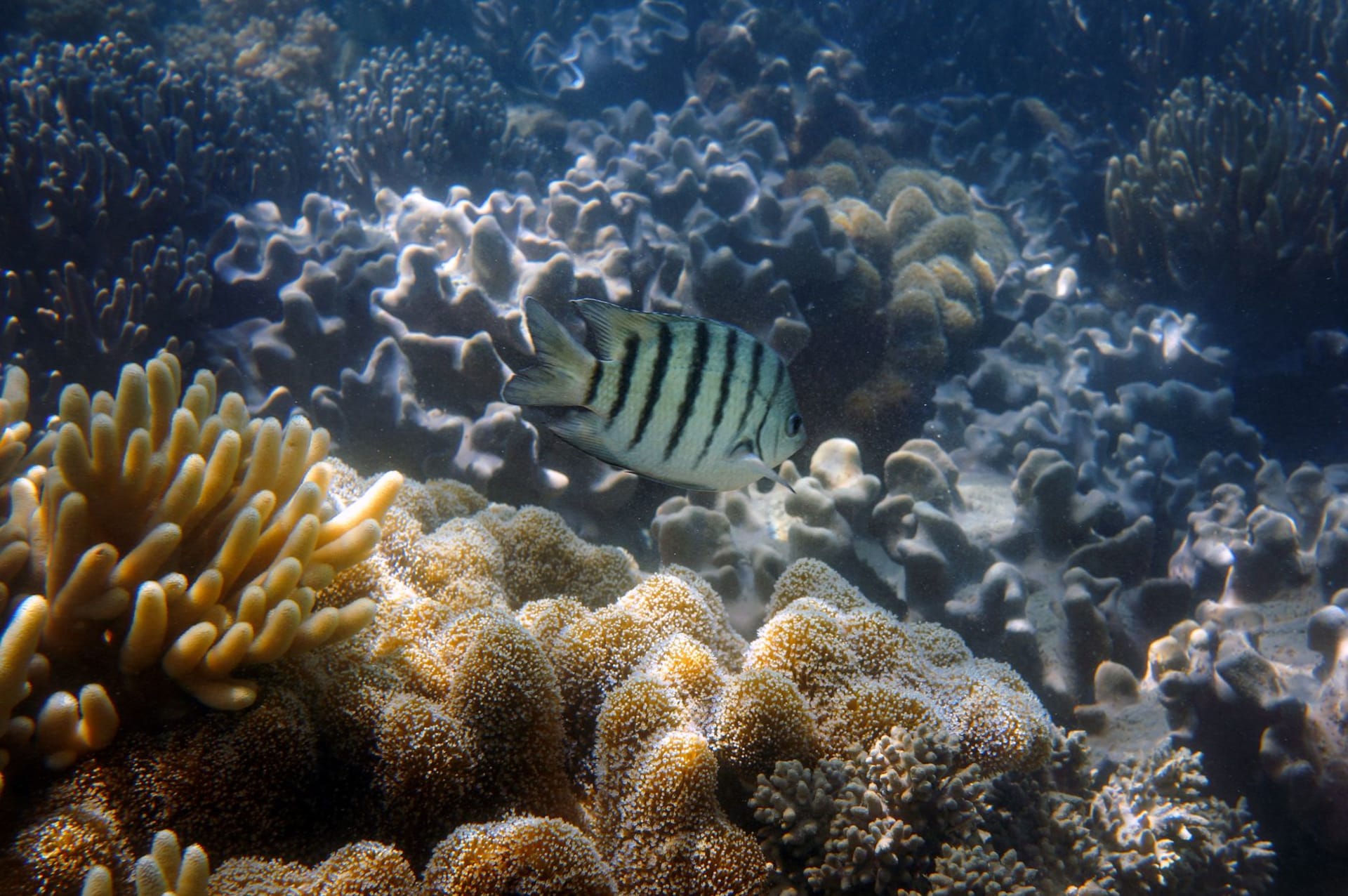
The lagoon inside the atoll is different — calm, shallow, the coral in good condition, the visibility such that you can see the sandy bottom in four metres of water so clearly you can count individual grains of sand. Reef fish in extraordinary density, particularly around the bommies on the northern lagoon edge. I spent a morning in here after the North Horn dives and the contrast — from the edge-of-the-world exposure of the outer wall to the protected, almost domestic calm of the lagoon — was one of the stranger transitions I have made in a short space of time.
When to go: Osprey Reef is accessible year-round for liveaboards that make the crossing, but conditions are most reliable from July through November. The crossing itself can be rough in the southern hemisphere’s autumn-winter if the Trade Winds are running hard; ask operators about sea conditions before booking. June through September offers the most consistent calm. The reef is entirely dependent on liveaboard access — there is no day-trip option and no accommodation on the atoll itself.