The castle that held millions before the Middle Passage — a site of reckoning and remembrance above the ocean.
There is a moment, standing at the Door of No Return, when the Atlantic stops being scenery. The wind comes in flat and warm off the water, carrying salt and something older, and the stone beneath your feet — worn smooth by centuries of footsteps moving only in one direction — holds a weight that no photograph has ever quite captured. I stood there for a long time. Lia stood beside me without speaking. We had been in Ghana for four days, moving through the warmth and noise of Accra, eating waakye from roadside stalls near Osu, learning to read the city’s rhythms. Cape Coast was always going to be different.
The Castle Above the Surf
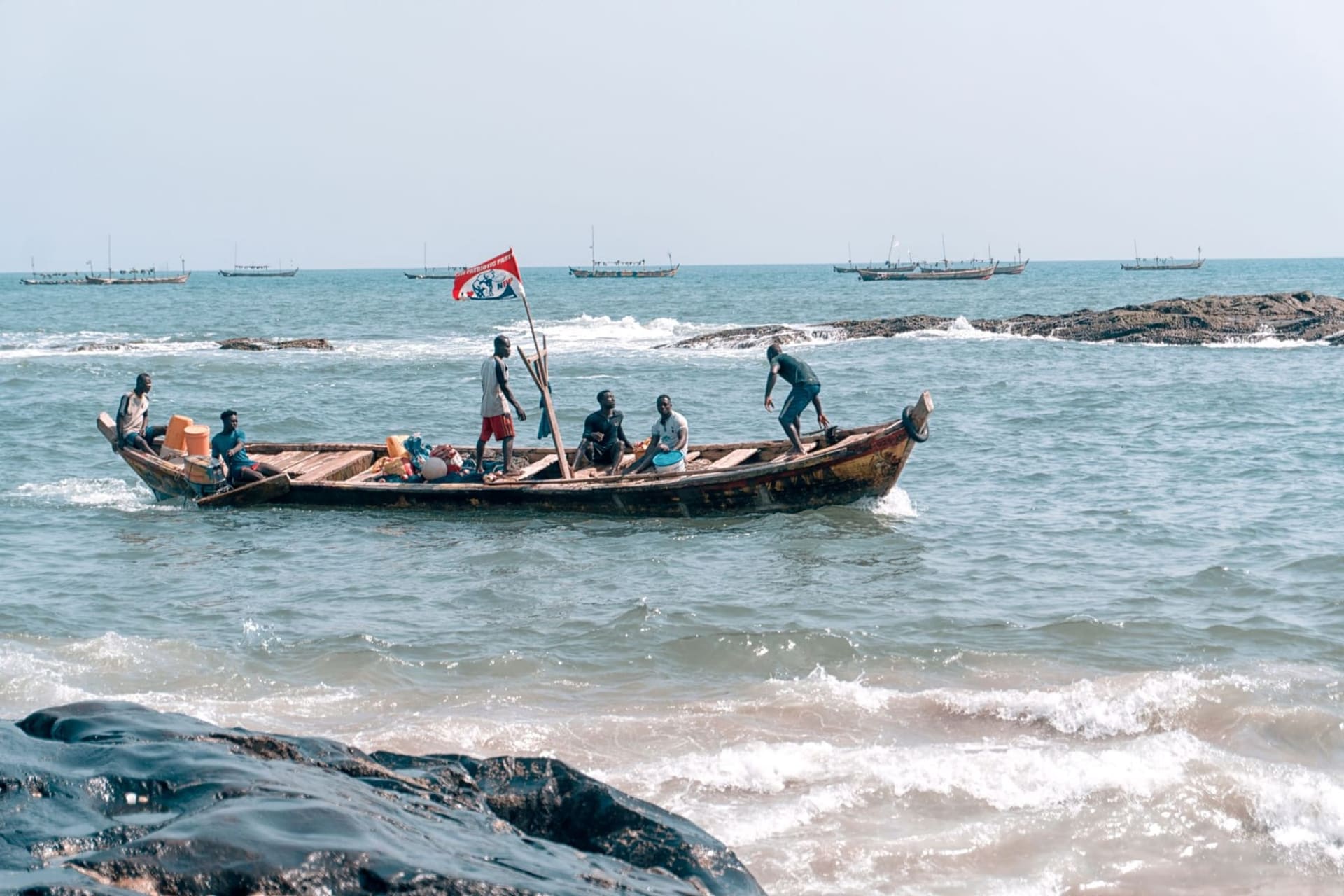
Cape Coast Castle sits on a headland at the western edge of town, its whitewash blinding in the midday sun. From Victoria Road you approach it almost accidentally — fishing boats hauled up on the sand, nets spread to dry, the smell of smoke and saltwater — and then the fortress rises above you, incongruous and immovable. The guided tour descends into the male slave dungeon: a low-ceilinged room meant to hold a few dozen men that routinely held hundreds, the stone floor worn concave, a small vent near the ceiling the only source of light or air. The guide spoke quietly. Nobody asked questions.
The Town Beyond the Walls
What surprised me was how alive Cape Coast is — how insistently, gracefully ordinary. Along Commercial Street the traffic is thick in the late afternoon, tro-tros announcing their routes from the lorry park, women selling kelewele from charcoal braziers, the plantain blackened and spiced with ginger. I had expected the town to exist in the shadow of the castle, subdued. Instead it carries its history the way the rest of Ghana carries everything: with presence and without apology. I found a small chop bar near the post office, ate a bowl of groundnut soup with enormous floating chunks of tilapia, and watched two schoolboys in uniforms argue cheerfully over a phone. The ordinary as its own form of insistence.
Kakum and the Forest Above
Thirty minutes north, Kakum National Park offers the unexpected counterpoint: canopy walkways suspended forty meters above the forest floor, the air suddenly cool and green and humming with insects. We went early, before the tour groups, and for twenty minutes had the walkways to ourselves — the forest canopy spreading in every direction, hornbills cutting between the trees, the castle and the ocean invisible below the horizon. Ghana holds its contradictions at close range.
When to go: November through March brings dry, manageable heat and clear skies along the coast — the best conditions for the castle and Kakum both. Avoid April through June, when heavy rains make the canopy walkways slick and the castle’s lower dungeons can feel suffocating with humidity.