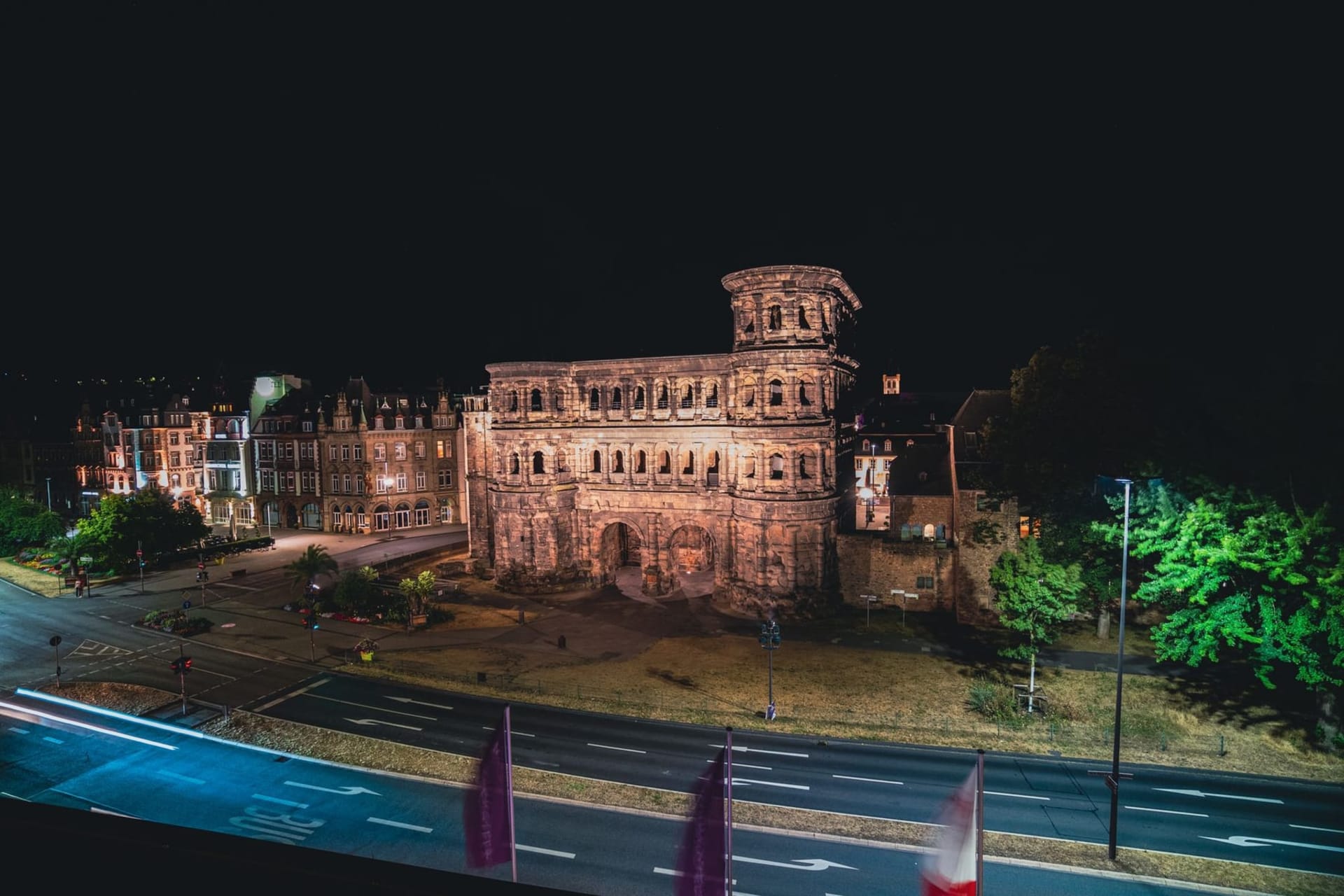
Germany's oldest city wears its Roman past on its sleeve — the Porta Nigra, amphitheatre, and imperial baths are simply the street furniture here.
I arrived in Trier expecting a museum city — the kind of place where history is cordoned off behind velvet ropes and laminated signs. What I found instead was a city that had simply absorbed two thousand years of occupation and moved on. Romans built here. Franks settled here. The city folded it all in and kept going. The past isn’t displayed in Trier. It’s load-bearing.
The Weight of the Porta Nigra
The Porta Nigra stopped me cold the first morning. Not because I hadn’t seen photos — I had — but because no photo prepares you for its scale or its particular darkness. The sandstone has blackened over centuries, giving the gate a bruised, almost organic look, as though it’s still absorbing the weather of every year it has stood. I circled it twice before I even thought about going inside, just to understand the mass of it. The second century feels close here, not distant. Simeonstraße, the pedestrian street that runs south from the gate, fills with market stalls and coffee-drinkers each morning, and the Porta Nigra looms at the end of it like punctuation you can’t ignore.
Ruins as Street Furniture
What struck Lia most was how the Romans had simply built everywhere — and how Trier had built around them rather than over them. The Kaiserthermen, the imperial baths, sit in a quiet park near the Mosel, their brick arches open to the sky, accessible without ceremony. We wandered through the underground heating channels on a Tuesday afternoon with almost no one else around. The amphitheatre, carved into the hillside at the edge of the Olewig wine district, was full of sparrows rather than tourists when we visited. It felt genuinely inhabited — by pigeons and joggers and schoolchildren eating lunch on the tiers.
The unexpected discovery came at the Rheinisches Landesmuseum: a Roman mosaic floor depicting a chariot race in such complete, vivid detail that I stood in front of it for longer than I care to admit. The blue of the horses’ veins. The tension in the drivers’ arms. It had been buried under a house for fifteen centuries.
Riesling and the Mosel Light
Trier sits on the Mosel, and the river gives the city a particular quality of afternoon light — low, diffuse, reflected. In the Olewig neighbourhood, the hillside vineyards begin practically at the city limits, and the wine bars along Zurmaiener Straße serve local Riesling by the glass that is dry and mineral and nothing like what gets exported. I drank it cold with a plate of Trierer Mostert — the city’s sharp, grainy mustard — on dark bread, watching the light go orange over the Mosel bridge.
When to go: Late April through June for mild weather and uncrowded monuments, or September during the Mosel wine harvest when the hillside vineyards are at their most alive. July and August draw crowds to the Roman sites; the city still rewards patience, but mornings become essential.