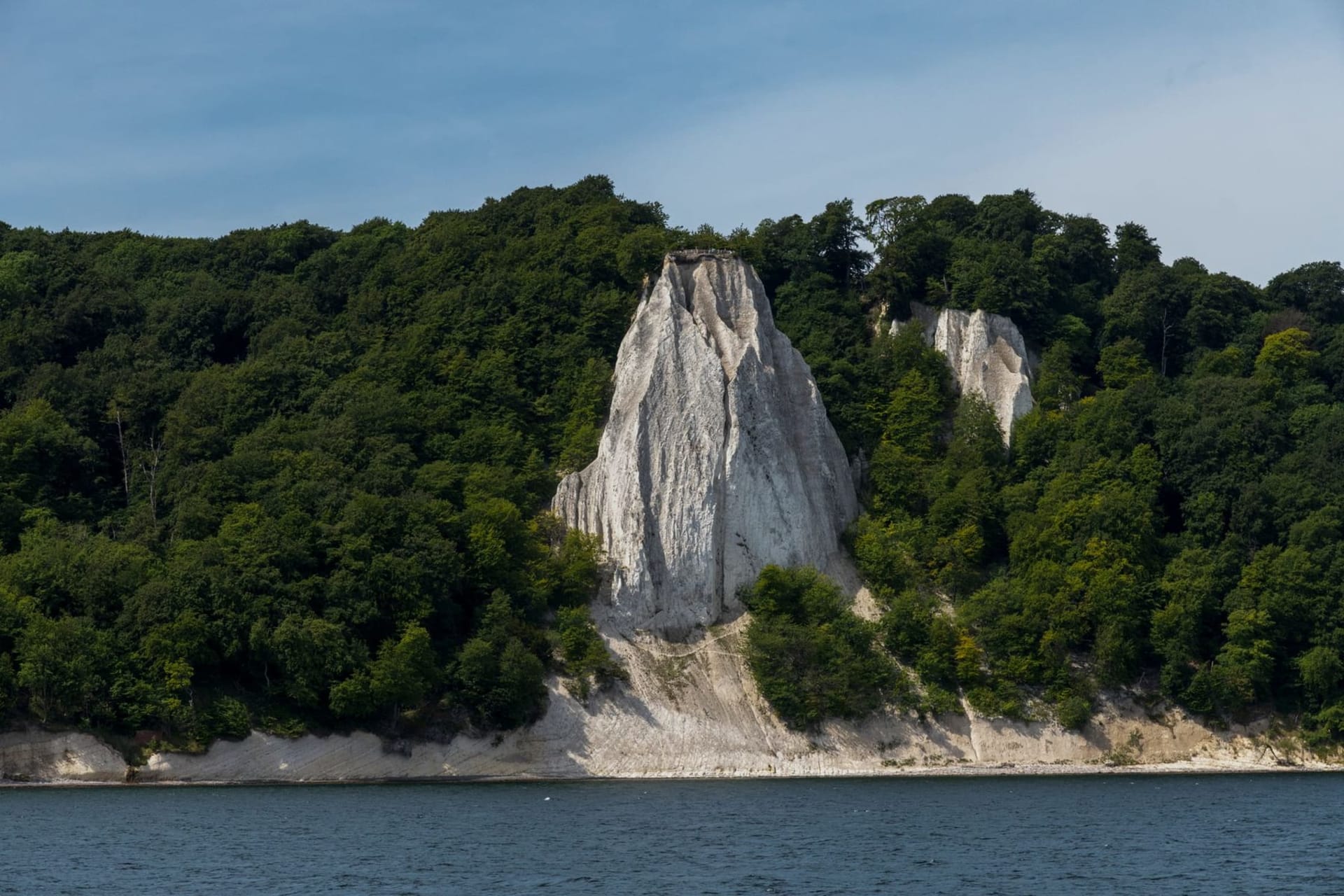
Baltic island chalk cliffs rising 100 metres from the sea in the Jasmund National Park, painted by Caspar David Friedrich.
There is a painting I have known since university — Friedrich’s Chalk Cliffs on Rügen, 1818, two figures peering over a white precipice into an impossibly blue void. I always assumed it was idealized. The kind of landscape painters invent to make mortality feel poetic. I was wrong.
The Cliffs at Königsstuhl
The trail from Sassnitz runs through beech forest so dense and cathedral-quiet that the Baltic announces itself before it appears — a cold salt pressure in the air, a brightening through the canopy. Then the ground simply ends. The chalk drops a hundred metres in a single vertical movement, bone-white against water the color of slate and pewter. The scale does something to the body. Lia grabbed my arm without saying anything, and I understood.
Königsstuhl — the King’s Chair — is the highest point on the island at 117 metres, and from its viewpoint the curvature of the coast reveals itself in both directions, chalk headlands dissolving into haze. The path along the cliff edge, the Hochuferweg, winds for several kilometres through the national park and is almost entirely free of anything modern. The beeches here are old enough to have watched Friedrich sketch. Their roots grip the chalk right at the edge, exposed and determined.
Sassnitz and the Ferry Smell
The town of Sassnitz below the cliffs is small and unhurried — a working port that still smells of diesel and catch. We ate Matjes herring at a plastic table on the harbour, the fish cured soft and sharp, served with sliced apple and onion that cut through the brine. It cost almost nothing. The ferry terminal at the far end of the quay sends boats toward Scandinavia, and there is something pleasantly melancholy about watching them go.
What I did not expect was the beech forest in fog. We walked the Hochuferweg on our second morning after overnight rain, and the trees had pulled the cloud down into themselves. The white trunks disappeared upward into grey. The chalk cliffs, glimpsed through gaps in the foliage, floated like something not quite attached to the earth. Friedrich was not painting imagination. He was painting exactly this.
Getting the Light Right
The cliffs face roughly north and west, which means late afternoon delivers the best illumination — the chalk goes amber near golden hour, the sea darkens to indigo. Mornings after rain produce the fog effects that make the forest feel ancient and slightly disorienting, which I recommend if you can tolerate damp boots.
When to go: May through early June for the beech leaves at their most vivid green against the white chalk, or October for autumn color and dramatically thin crowds — the summer months bring enough visitors to the Königsstuhl viewpoint that solitude requires an early start.