Bamberg
"Bamberg smells of smoked beer and wood smoke — the most honest welcome in Germany."
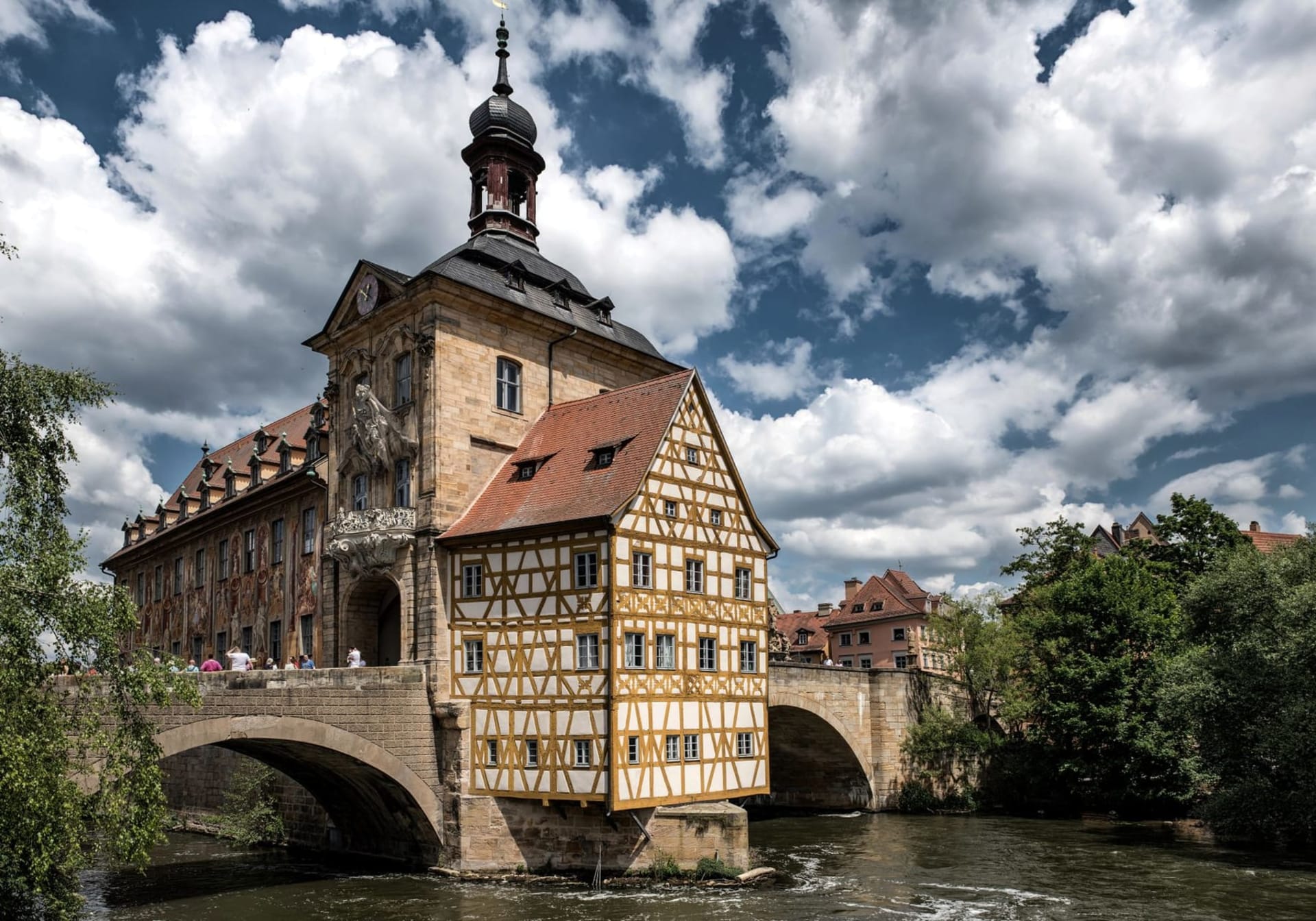
A UNESCO-listed Franconian city of seven hills, smoking chimney breweries, and a town hall improbably balanced on an island in the Regnitz river.
I stepped off the regional train from Nuremberg and smelled Bamberg before I saw it. Not the usual station smell of diesel and floor cleaner — something older, woodier. The schlenkerla smokehouse brewery sits barely four minutes from the platform, and on still mornings the smoke off its malting fires drifts through the entire lower town like incense.
Seven Hills, One Island
Bamberg arranges itself the way medieval cities forgot to: across seven hills straddling the Regnitz, with the Dom — the four-towered Romanesque cathedral — visible from almost every approach. We arrived on an October afternoon when the light over the river was already going amber by three o’clock, catching the painted facade of the Altes Rathaus, the old town hall that the city’s medieval bishops forced citizens to build on a man-made island in the middle of the water because neither side of the river would yield land for it. It is the most stubborn building I have ever seen, and somehow the most beautiful.
Lia stood on the Obere Brücke looking down at the green Regnitz current splitting around the island’s stone footings and said it looked like someone had moored a ship in the middle of the city and forgotten to untie it. She was not wrong.
The Rauchbier Revelation
The thing no photograph prepares you for is the taste of Schlenkerla Rauchbier. I had read that it was smoked, that the barley malt is dried over burning beechwood. That sounds like a recipe for something unpleasant. It is not. The beer that arrives in a half-litre ceramic-handled mug in the low oak-panelled Gasthof on Dominikanerstraße tastes like a campfire that somehow became edible — smoky, dark, bracingly dry, with a sweetness at the finish that rounds everything out. I ordered a second one largely out of disbelief that something this specific existed.
Bamberg has nine working breweries for a city of around seventy thousand people. The Sandstraße on a Thursday evening hums with locals who seem entirely unbothered by the fact that they live somewhere extraordinary.
What Surprised Me on Domberg Hill
The unexpected thing was the stillness on Domberg, the cathedral hill, after dark. The tourists thin out fast in Bamberg — it draws far fewer than Rothenburg or Regensburg — and by nine at night the Domplatz was almost empty. We walked along the Domstraße past the Alte Hofhaltung, the old bishops’ residence with its late-Gothic courtyard, and the only sound was water from the fountain and our own footsteps on the cobblestones. In a continent full of cities that have been loved to exhaustion, Bamberg still has silence to offer.
When to go: Late September through early November is ideal — the summer crowds have thinned, the Franconian light is spectacular, and the cold is exactly right for a third Rauchbier. Avoid the last week of December if you want the city to yourself; the Christmas market on Maximiliansplatz pulls significant crowds.