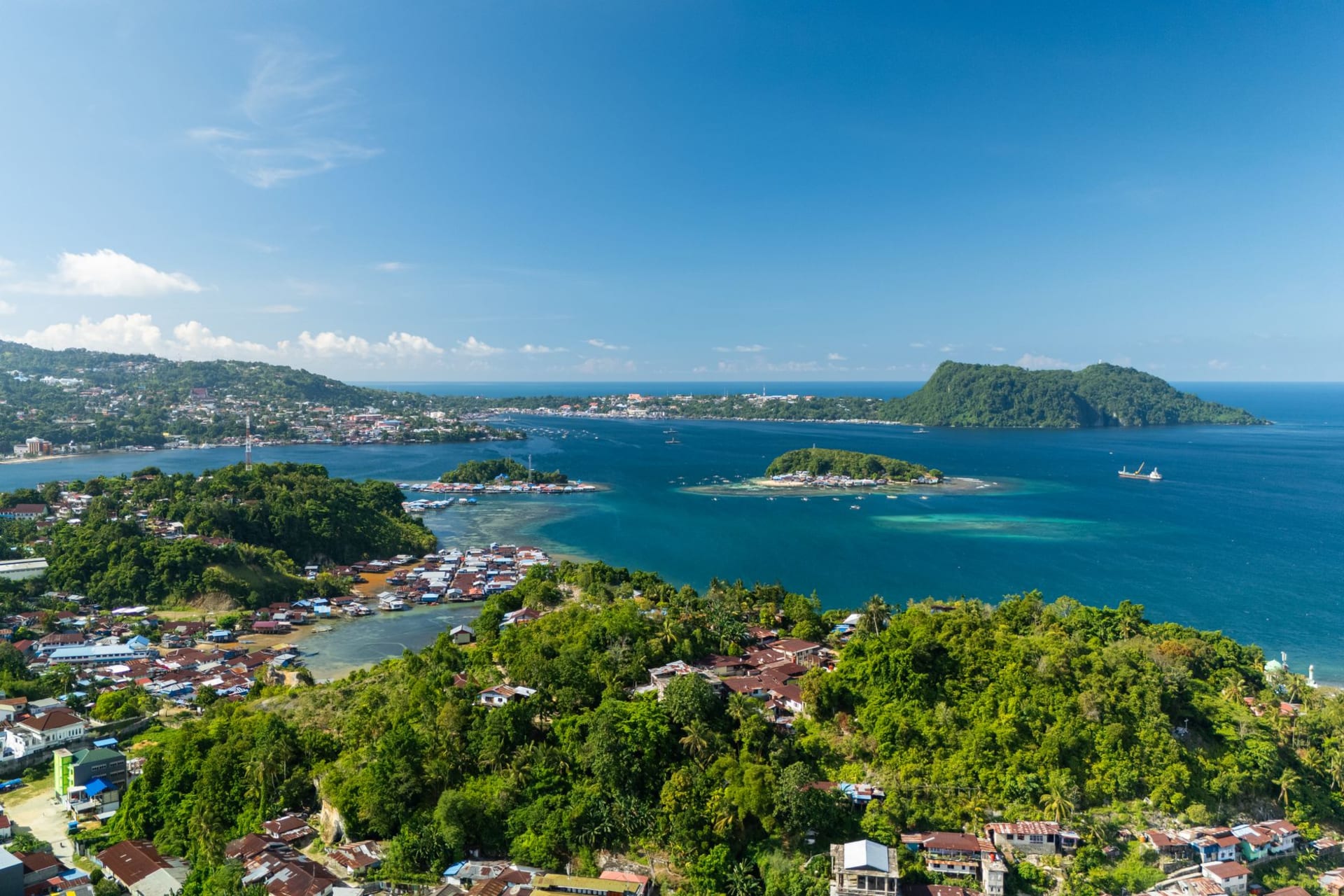
Riung
"Seventeen islands in a bay nobody talks about. The silence in that water felt almost earned."
Getting to Riung is the kind of project that filters the casual visitor. The road north from Bajawa cuts through mountains and then drops toward the Flores Sea through a landscape of dry scrubland and lontar palms, the temperature rising ten degrees in the last hour of the descent. There is no airport. There is no ferry connection. You arrive by road — three hours from Bajawa on a surface that varies between rough and interesting — and you arrive feeling like you have traveled somewhere rather than relocated.
The village sits on the north coast of Flores facing a bay that contains, depending on how you count them, seventeen islands. They are small — some are tiny, just a limestone outcrop draped in fig trees — and they are protected as the Tujuh Belas Pulau Marine Park. The park infrastructure is minimal. The boats that take you out are wooden and painted in chipped reds and blues and are driven by local fishermen who double as guides with varying degrees of enthusiasm. I hired one named Alex who had been taking tourists around the islands for twelve years and had the laconic authority of someone who knows exactly where the good stuff is and sees no particular reason to hurry toward it.

The snorkeling on the reef flats between the islands is the thing that surprises you. I had been to Komodo, which has world-class diving, and I expected Riung to be a lesser version. It isn’t. The reef is a different character entirely — shallower, quieter, the coral formations dense and healthy in a way that comes from not being heavily dived. Parrotfish the size of my forearm worked the reef edges. A Napoleon wrasse moved through with the indolent authority of something that has never had reason to be afraid. On one flat section of sand between two coral heads, a large cuttlefish sat and watched me with its unsettling rectangle pupils, changing color in slow pulses — brown, then cream, then a ripple of iridescence — while I floated above it trying not to breathe too loudly.
There is also a colony of fruit bats on one of the larger islands — thousands of them, roosting in the trees during the day in dark clumps that you can hear before you see, a low chittering that thickens as you approach. At dusk they leave in a stream that takes minutes to clear, a dark river of wings heading inland over the bay. I sat in the boat watching until the last of them had gone and the sky was properly dark.

In Riung village I ate at a single warung that had no menu — you were served whatever there was, which was grilled fish and rice and kangkung in garlic and a small bowl of watery sambal that improved everything it touched. The owner’s husband was a fisherman and the fish had been caught that morning and you could taste it. This is not the kind of restaurant you take a photo of. It is the kind you remember ten years later when someone serves you fish that doesn’t taste like this.
When to go: April through October is the dry season on the north coast and the sea is calm and clear. The bay is sheltered enough that even in the wet season the islands are reachable on most days, but road access from Bajawa can be muddy and slow after heavy rain. Come in the shoulder months — May or September — for the emptiest experience.