
Kirkjubøur
"The cathedral at Kirkjubøur was never finished — and that somehow makes it feel more honest about what was attempted here."
The medieval heart of the Faroes — a roofless cathedral that was never finished, and a farmhouse continuously inhabited for over nine hundred years.

The road south from Tórshavn ends, eventually, at Kirkjubøur. Not because the geography stops but because there is no reason to go further once you have arrived here. For several centuries this was the most important settlement in the Faroe Islands: a bishop’s seat, a centre of Norse learning and religious authority, a place where the medieval world of the North Atlantic tried to build something permanent and lasted long enough to leave remarkable ruins. What remains asks you to think carefully about what permanence means.
Magnus Cathedral — Magnuskirkjan — stands on the slope above the sea, roofless, the red sandstone walls intact to a height of several meters, the arched windows framing sky and the distant hills of Sandoy across the sound. Construction began in the thirteenth century and was never completed, halted by plague or poverty or the political dissolution of the bishopric, depending on which account you read. The result is a ruin that has never been a finished building — not a thing that fell but a thing that was always going to be left — and there is something about that particular kind of incompleteness that gave me a quiet feeling I could not entirely name as I walked through the unroofed nave with the light falling between the walls.
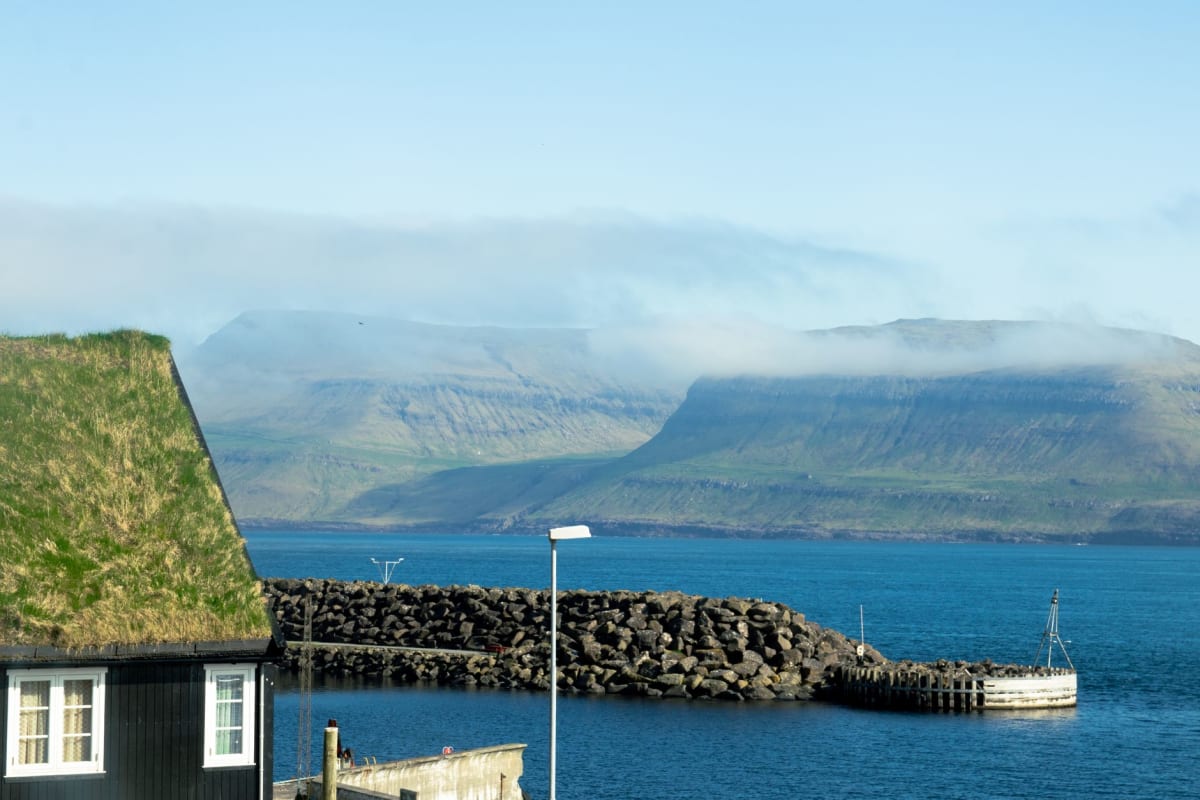
Next to the ruins stands Roykstovan — the Faroese word for smokehouse, which is what the ground floor once was — a farmhouse continuously inhabited for over nine hundred years. The same family has lived here across that span. I spoke with the man at the door, who told me without particular drama in his voice that the beams in the main room dated from the eleventh century, possibly from driftwood timbers, possibly from dismantled Viking ships. He had the calm manner of someone who has explained something unbelievable so many times that he no longer finds it useful to make it sound remarkable. Inside, the room smelled of wood and salt and something considerably older, and the low ceiling beams were exactly as dark as you would expect nine centuries of wood smoke and salt air to make them.

The walk along the shore from the parking area passes old boat houses, stone walls that disappear into the grass, and a series of lesser ruins whose specific functions have been partially forgotten. The sea here is calmer than on the exposed west coast — the sound between Streymoy and Sandoy has a different quality, quieter, the horizon clean on clear days. I spent an afternoon in June and found the light different at every hour: flat and grey in the morning, then briefly golden, then white as cloud moved in. The ruins changed with each shift — more dramatic, then more tender, then simply old, which is what they are and which is, in the end, enough.
When to go: Kirkjubøur is only about fifteen kilometres from Tórshavn and accessible year-round. The farmhouse is open for tours from late spring through early autumn, with variable hours — call ahead before making the trip specifically for the interior. It rewards a slow afternoon: walk the shore first, sit with the cathedral ruins, and drive back to the capital in time for a late dinner.
Keep exploring
More from Faroe Islands
 faroe-islands
Klaksvík
The Faroes' working second city occupies a fjord valley on Borðoy island — trawlers, a modern church with a Viking font, and a quieter energy than the capital.
Explore faroe-islands
Mykines
The westernmost island in the Faroes where puffins nest at arm's reach and the ocean below feels like the last solid thing before the world runs out.
Explore faroe-islands
Saksun
A handful of turf-roofed farmhouses at the head of a hidden tidal lagoon, hemmed by green cliffs and waterfalls, where the whole valley feels sealed off from the rest of the world.
Explore faroe-islands
Sørvágsvatn
The lake that appears to float above the Atlantic — not a photography trick but a geographic fact so extreme it feels like a challenge to physics.
Explore faroe-islands
Tórshavn
Europe's smallest capital is a harbor town of painted wooden houses where a Viking-age parliament still sits on a turf-roofed peninsula.
Explore faroe-islands
Vestmanna
A working northwest-coast port town where boat tours thread through sea caves beneath vertical cliffs colonised by tens of thousands of seabirds.
Explore