Americas
Falkland Islands
"I came for the penguins and stayed for the silence. There is no traffic here."
I flew into Stanley on a small prop plane from Punta Arenas, banking low over brown hills and a coastline that looked like someone had torn the edge off the world. The town revealed itself in pieces — coloured corrugated-iron rooftops, a single main street, a cathedral that seemed over-scaled for the 2,000 people who live here. The wind hit me the moment I stepped off the plane and didn’t stop for the entire eight days I was there. In the Falklands, wind is not weather. It is the landscape.
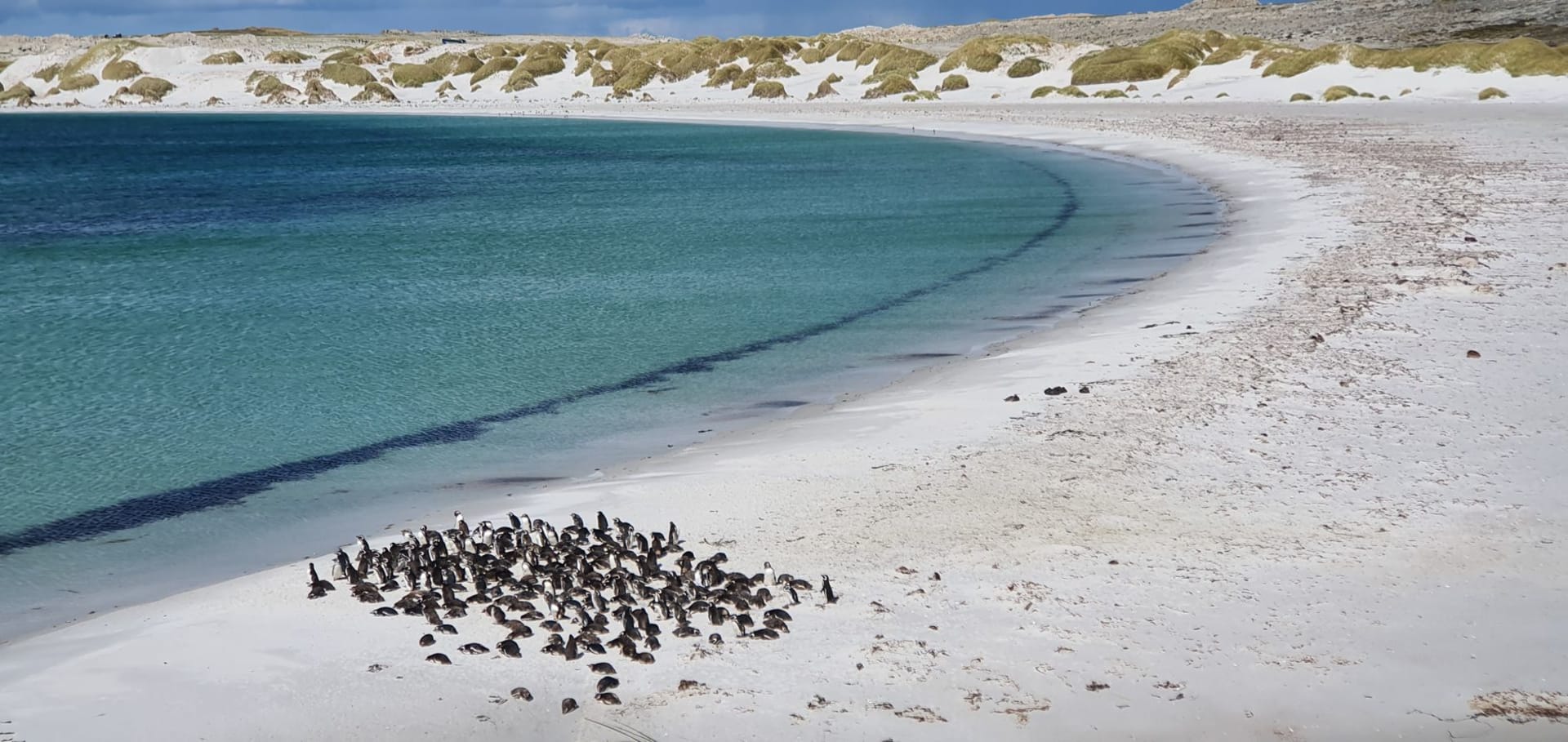
What no photograph captures is the scale of the wildlife. I had seen penguin colonies before — a few hundred birds, a polite shuffle across a beach. Volunteer Point changed my frame of reference entirely. We drove two hours on a dirt track that required a 4x4 and a certain tolerance for rattled teeth, and then we crested a dune and below us were ten thousand king penguins. They were utterly indifferent to our presence. Chicks the size of footballs, covered in brown fluff, stood in creches guarded by adults. Gentoo penguins porpoised through the shallows and rockhopper penguins scaled cliffs that made me dizzy to look at. The whole colony smelled like an anchovy factory, and it was one of the most extraordinary places I have ever stood. Back in Stanley that evening, I ate lamb stew at a kitchen table run out of someone’s house — proper home cooking, no menu, whatever the cook felt like making — and I thought about how rarely travel delivers exactly what it promises. The Falklands delivers more.
The interior is vast and almost entirely empty. We hired a Land Rover and drove west across Camp — which is what the islanders call everything outside Stanley — through land that looked like the Hebrides crossed with Patagonia. No fences, no signposts, just tussock grass flattening in the wind and the occasional sheep. At the settlement of Carcass Island, accessed by a short ferry crossing, the farmhouse served afternoon tea on a picnic table while striated caracaras stole biscuits from our plates and black-browed albatrosses cruised overhead. It was absurd and perfect.
When to go: October through March is the austral summer, when the weather is least brutal (though “mild” is relative — expect wind and cold regardless) and wildlife is most active. King penguin chicks are best seen in January and February. December gives the longest days, with near-perpetual light that makes sleep difficult and evening walks impossibly beautiful.
What most guides get wrong: They treat the Falklands as a cruise ship stop — a few hours at Volunteer Point, a quick walk around Stanley, a tick on the list. That is not the Falklands. The islands reveal themselves slowly, in the silence between gusts, on the long drives across Camp, around farm tables where the same families have been sheepherding for five generations. You need at least a week, ideally two, and you need to get off the pavement. The accommodation is limited and books early — plan six months ahead, not two.