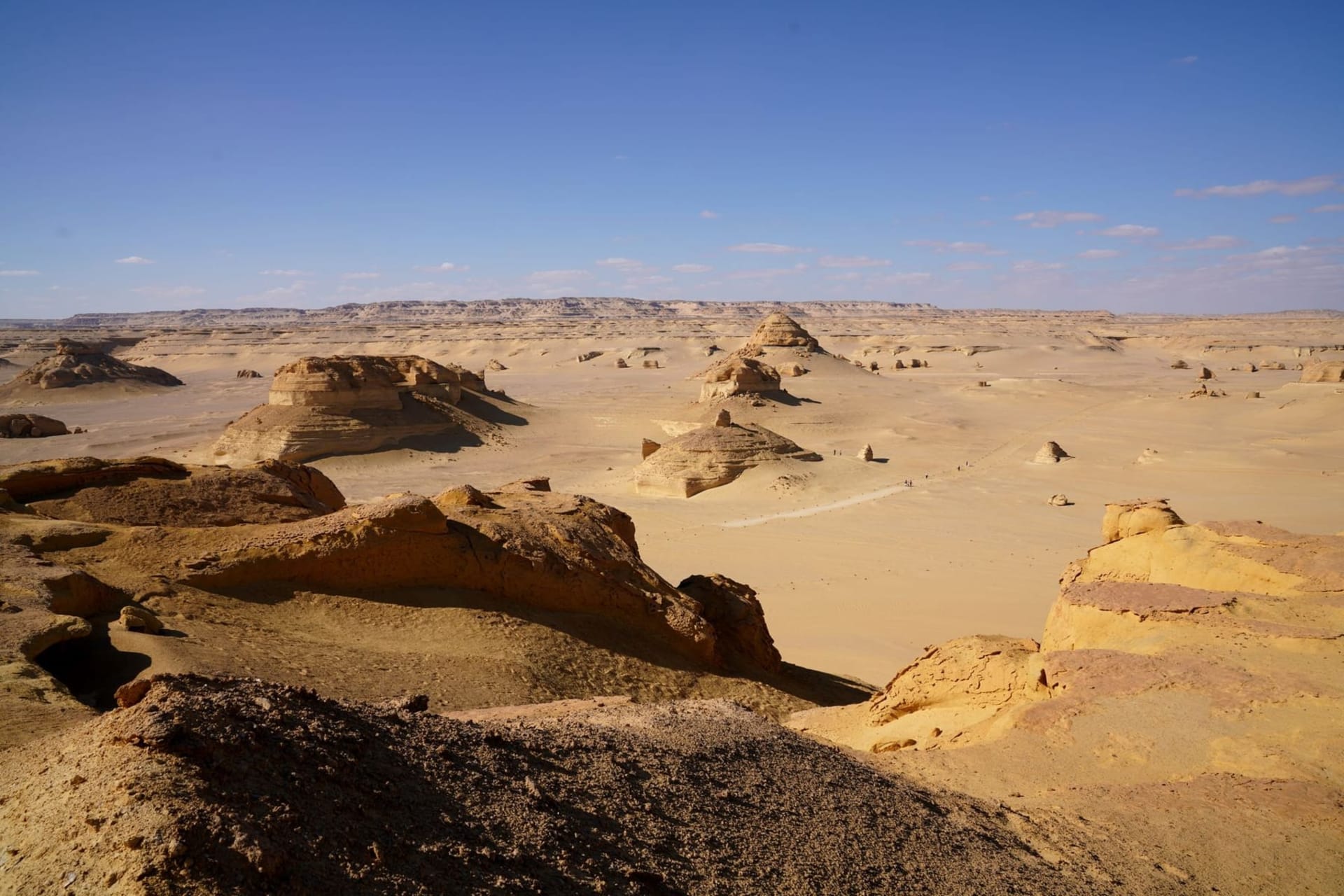
Surreal chalk formations rise like frozen waves from the sand — one of Earth's most alien landscapes.
The jeep dropped us at the edge of the Farafra Depression as the sun was going down, and for a long moment neither Lia nor I said anything. There are places that short-circuit language, and the White Desert — Sahara el-Beyda — is one of them. Chalk formations the height of two-storey buildings rose from the flat basin floor in shapes that had no business existing on this planet: mushrooms, thumbs, sleeping animals, abstract columns worn smooth by thousands of years of wind-carried sand. In the amber light of dusk they glowed faintly orange, then pink, then a cold bone-white as the sun finally dropped.
Into the Chalk Forest
We had come up from Bahariya Oasis, four hours south through the Black Desert — a different madness altogether, volcanic rocks dusted with iron oxide turning the landscape the color of a bruise — before the terrain shifted without warning to this lunar chalk plain. Our guide, Hassan, pointed out formations by nickname as he drove: the Rabbit, the Chicken, the Sphinx. Local names accumulated over decades of Bedouin camps and tourist circuits. None of them captured what the shapes actually looked like, which was fine; these formations refused to be adequately named.
That first night we slept under a sky so thick with stars it felt structural, like a ceiling you could press a hand against. The silence was total except for the low shift of sand against limestone and, once, what Hassan said was a fennec moving somewhere out in the dark.
The Light at Dawn
I woke before five and walked out among the formations alone. This was the unexpected thing: in darkness the White Desert is eerie, almost threatening in its strangeness. But in the grey pre-dawn, with no colour yet in the sky, the chalk turned the colour of old linen and the whole landscape became tender. Soft. I found a formation shaped exactly like a breaking wave, frozen mid-curl, and sat at its base drinking thermos coffee until the sun arrived and turned everything gold again.
Lia found me there an hour later and didn’t ask what I’d been doing. Some silences between us work that way.
Eating at the Edge of Nothing
Lunch that day came from a cooler Hassan had packed out of Bahariya: flatbread still warm from the morning, ful medames with cumin and olive oil, a thermos of sweet black tea. We ate sitting in the shadow of a chalk mushroom the size of a small house. There are no restaurants in the White Desert proper, no villages, no infrastructure of any kind — just the formations, the sand, and whatever you’ve thought to bring.
The ful was the best I’d had in Egypt, which might have been the hunger and the silence and the surreal backdrop conspiring. Or maybe Hassan’s aunt, who’d packed it, simply knew what she was doing.
When to go: October through March, when daytime temperatures stay manageable and nights are cold but bearable in a sleeping bag. Summer heat in the Farafra basin is genuinely dangerous for camping.