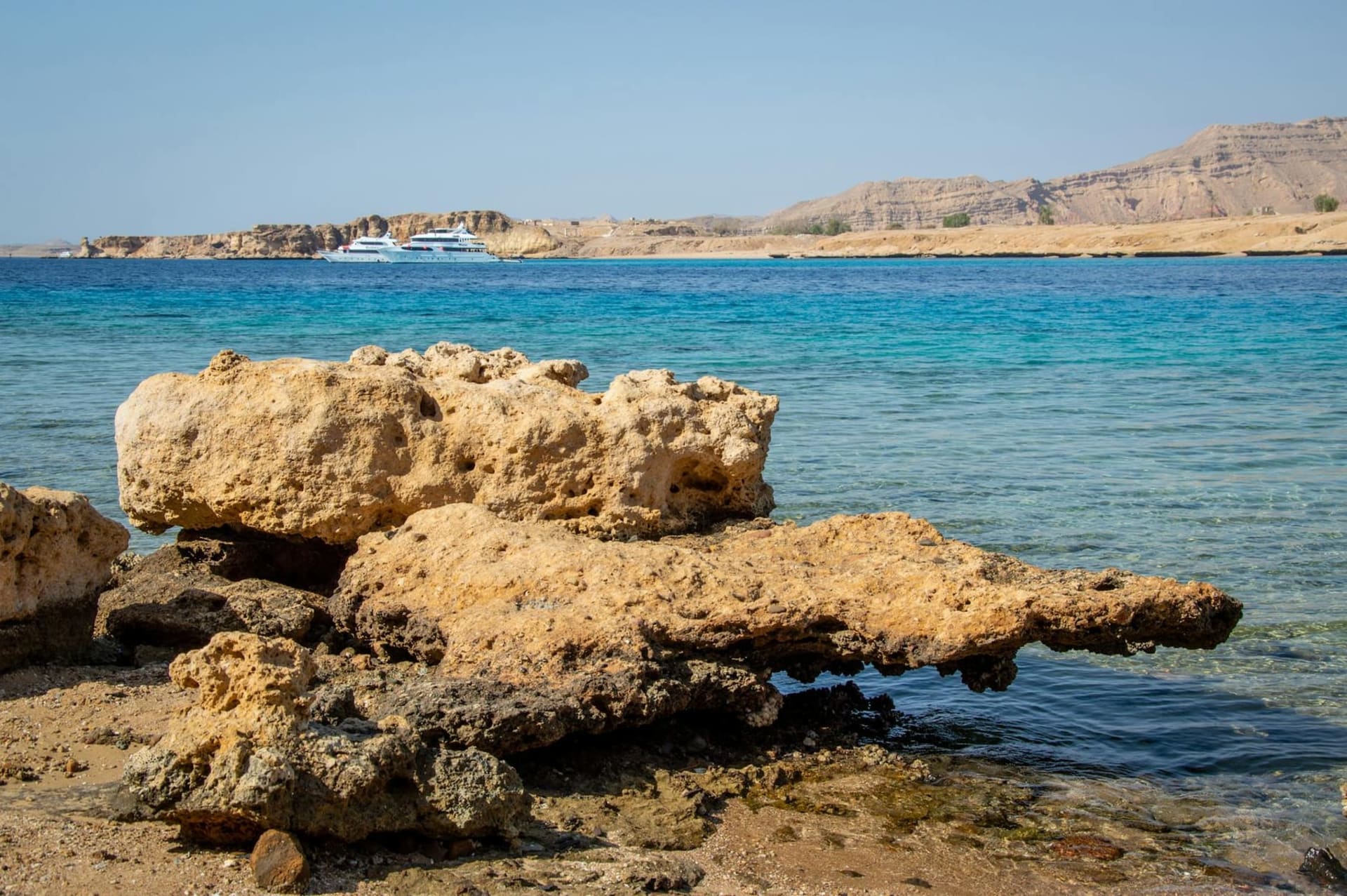
Where the Red Sea meets the Gulf of Aqaba in a swirl of coral gardens and crystal-clear drop-offs.
There is a signpost at the southern tip of the Sinai Peninsula that marks the exact point where the Red Sea becomes the Gulf of Aqaba. I stood in front of it on a Thursday morning in November, the wind coming off the water hard enough to lean into, and felt the particular embarrassment of a person who has traveled far to see something that cannot be fully looked at — only entered.
The Confluence
We drove south from Sharm el-Sheikh on the road that cuts through the national park, past the white-salt flats of the Malaha lagoon where flamingos stand so still they look installed. The road ends at a parking area and then there is only sand and limestone and the two bodies of water pressing against each other in colors that shouldn’t coexist — the Red Sea running turquoise-green, the Gulf cutting dark indigo just meters away. Lia stood at the edge where the currents meet and said it looked like a map that hadn’t finished rendering. She was right.
The phenomenon has a name — the halocline — but the name doesn’t prepare you for watching two swells traveling toward each other and simply stopping, as if each respects some invisible boundary the other has drawn.
Beneath the Surface
We hired masks and fins from the kiosk near the Shark Observatory — a concrete platform cantilevered over the drop-off where the reef wall plunges sixty meters without warning. I have snorkeled reefs in the Caribbean, in Thailand, in the Maldives. None of them prepared me for Ras Mohammed. The coral here is intact in a way that feels almost historical: staghorn thickets undamaged, giant clams opening and closing with an unhurried confidence, a Napoleon wrasse the size of a small dog drifting past without acknowledging me at all.
The unexpected thing was the silence. Underwater there is always some ambient hiss and pop of reef life, but at the wall, in the open column of water above the drop-off, there is a depth-silence that registers in the chest rather than the ears. I surfaced to find Lia already back on the rocks, writing something in her notebook, salt drying white on her shoulders.
Practical Margins
The park is technically a day trip from Sharm — forty kilometers, easy road — but the quality of light in the early morning, before the tour buses arrive from the resort hotels, justifies the effort of leaving by seven. We had the Shark Observatory platform entirely to ourselves for the better part of an hour. By ten-thirty it was crowded.
When to go: October through April offers the most comfortable temperatures and the best underwater visibility, with water staying warm enough for extended snorkeling; avoid July and August when heat is extreme and tourist volumes peak.