
Luxor is ancient Thebes, and the density of what survives here is almost unreasonable. For roughly five hundred years, this stretch of the Nile was the religious and political center of the most powerful civilization on earth, and the pharaohs spent those centuries building, carving, and gilding with an intensity that left both banks saturated with monuments. Other cities have a ruin or two. Luxor has so many that farmers still occasionally turn up carved stone while plowing their fields. It is less a city with temples than a temple complex with a city growing between the cracks.
Karnak Temple
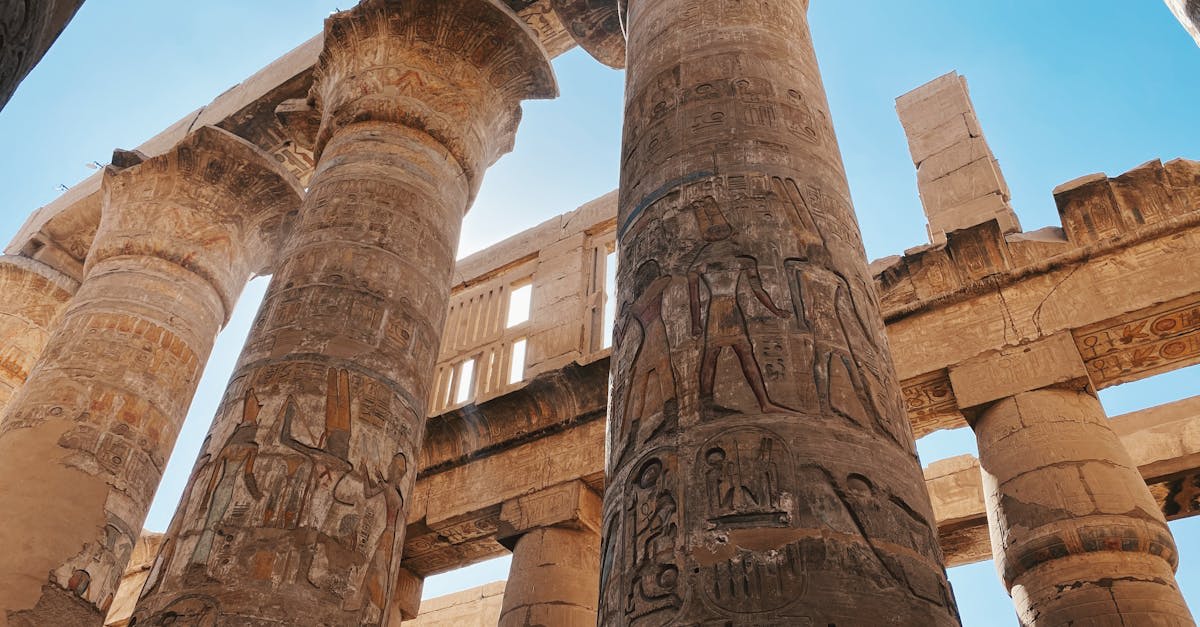
Karnak is not a single temple but a sprawling sacred city, built and expanded over two thousand years by successive pharaohs, each determined to outdo the last. The result covers over two hundred acres — larger than most European old towns — and the effect on arrival is genuinely disorienting. You enter through an avenue of ram-headed sphinxes and pass into the Great Hypostyle Hall, a forest of 134 sandstone columns, each one rising twenty meters and wide enough that six people linking arms cannot encircle the largest. Sunlight falls in shafts between them, illuminating hieroglyphs that still carry traces of their original paint — red, blue, yellow — colors that were vivid when Homer was writing the Iliad and that somehow refuse to fully fade.
Every surface tells a story. Battle scenes, offerings to Amun-Ra, lists of conquered peoples, prayers for the dead — the entire theology and military history of ancient Egypt carved into stone with a precision that modern tools would struggle to match. Come in the late afternoon, when the golden hour light catches the columns at an angle and the sandstone seems to glow from within. There is a sacred lake nearby where priests once purified themselves before dawn rituals, and sitting at its edge as the light changes is one of those moments that justifies the entire trip.
Luxor Temple at Night
Connected to Karnak by a recently excavated Avenue of Sphinxes — nearly three kilometers of stone guardians that once formed a processional route between the two temples — Luxor Temple is best experienced after dark. The Egyptian government has lit it beautifully, and walking among the colossal statues and papyrus-bundled columns under floodlight, with the modern town murmuring just beyond the walls, is one of those rare experiences where ancient and contemporary life overlap so completely that the boundary dissolves. Ramesses II’s seated colossi flank the entrance, impassive and enormous, while behind them the mosque of Abu al-Haggag sits perched on top of the temple walls — built centuries ago when the temple was buried in sand up to its columns, and kept in place even after excavation because the mosque itself had become historic.
The Valley of the Kings
Cross to the West Bank and the landscape changes entirely. The lush green of the Nile’s irrigated shore gives way abruptly to bare, sun-blasted limestone hills — the ancient Egyptians called this the land of the dead, and the terrain makes the name feel literal. The Valley of the Kings is tucked into these hills, a dry wadi chosen precisely because it was remote, hidden, and dominated by a natural pyramid-shaped peak the ancients believed was sacred.
Sixty-three tombs have been discovered here, cut deep into the rock and painted with scenes from the Book of the Dead, the Amduat, and other funerary texts meant to guide the pharaoh through the afterlife. The colors — deep blues, burnt oranges, vivid yellows — are astonishing after three thousand years in darkness. Tutankhamun’s tomb is the most famous but far from the most impressive; the tomb of Seti I descends over a hundred meters into the earth, its walls covered in some of the finest painting to survive from the ancient world. The tomb of Ramesses VI offers a complete astronomical ceiling that maps the night sky as the Egyptians understood it.

The Temple of Hatshepsut
Nearby, the Mortuary Temple of Hatshepsut rises in three elegant terraces against the cliff face of Deir el-Bahari, and the effect is strikingly modern — clean horizontal lines, colonnaded walkways, ramps instead of stairs. It was built for Egypt’s most remarkable female pharaoh, a woman who ruled for over twenty years, sent trading expeditions to the land of Punt, and commissioned building projects across the kingdom. The reliefs on the middle terrace depict that Punt expedition in remarkable detail — the houses, the trees, the queen of Punt herself, rendered with a specificity that amounts to documentary reportage carved in stone.
Above It All
A dawn hot-air balloon flight over the West Bank is the way to grasp the geometry of it all — the temples, the tombs, the bright green farmland pressed against the Nile, and then the desert stretching endlessly beyond. From above, the ancient logic of Thebes becomes clear: the living on the east bank where the sun rises, the dead on the west where it sets, and the river between them carrying everything — grain, prayers, bodies — from one world to the other.
When to go: October to March for bearable temperatures. Summer regularly exceeds 45 degrees Celsius and makes temple-hopping genuinely dangerous — heatstroke is a real risk, not a figure of speech. Early mornings are essential year-round. The West Bank sites open at 6 AM, and the first hour is the best.