
There is a particular kind of awe reserved for places that were designed to produce it. Abu Simbel is one of those places. Ramesses II, a pharaoh who never met a surface he did not want to carve his own face into, ordered this temple cut directly from a sandstone cliff on the banks of the Nile in the thirteenth century BC, positioned on Egypt’s southern frontier where it could serve simultaneously as a place of worship and a warning to anyone approaching from Nubia. The message, three thousand years later, remains perfectly legible: you are entering the territory of a god-king, and he is watching.
The Great Temple
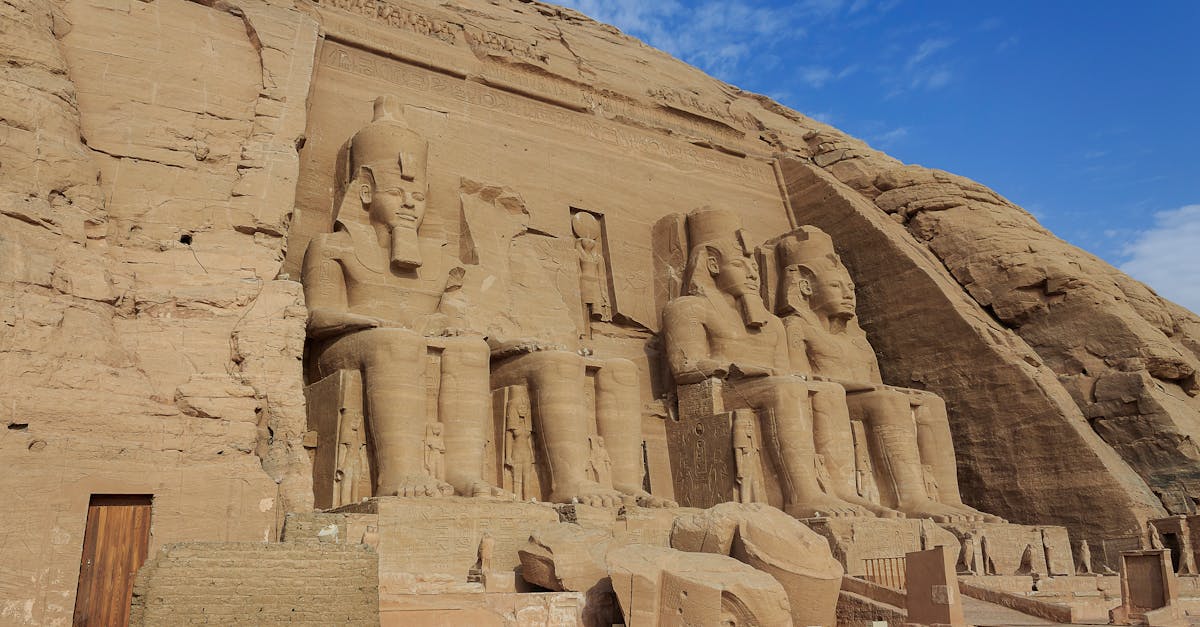
Four colossal statues of Ramesses flank the entrance, each one twenty meters tall, seated with the serene confidence of a ruler who fought the Hittites to a draw at Kadesh and then declared it a victory anyway. The faces are identical — the same slight smile, the same calm gaze directed across the water — and at their feet, carved at a fraction of the scale, stand his wives, his children, and his mother, their relative size a frank statement of how Ramesses viewed the hierarchy. Smaller figures of bound captives and Nile gods decorate the base, the entire facade functioning as a single, overwhelming declaration of power.
The interior penetrates sixty meters into the cliff, a succession of halls and chambers whose walls are covered with carved and painted scenes of the Battle of Kadesh — Ramesses in his chariot, arrows flying, enemies falling, the whole narrative rendered with a cinematic energy that feels remarkably modern. The colors have faded but not disappeared, and in the dim light of the inner halls, the carvings seem to move.
The Sun Festival Alignment
Twice a year — on February 22 and October 22 — the rising sun performs a feat of ancient engineering that still draws crowds from across the world. At dawn on these dates, sunlight enters the temple’s narrow entrance and travels the full sixty meters to the inner sanctuary, illuminating three of the four statues seated at the rear: Ramesses himself, Amun-Ra, and Ra-Horakhty. The fourth statue, Ptah, god of the underworld, remains in shadow — by design. The alignment was calibrated over three thousand years ago with a precision that modern architects find humbling, and the fact that it still works (shifted by a single day due to the temple’s relocation) is a testament to how seriously the ancients took the relationship between architecture and astronomy.
The event lasts roughly twenty minutes. For those twenty minutes, the inner sanctuary glows with a light it receives on no other day of the year, and the faces of the statues — normally lost in darkness — emerge with an expression that looks, in that fleeting illumination, almost alive.
The Engineering Miracle of Relocation
The modern story of Abu Simbel is almost as extraordinary as the ancient one. In the 1960s, the construction of the Aswan High Dam threatened to submerge the temples permanently beneath the rising waters of Lake Nasser. What followed was one of the greatest feats of archaeological preservation ever attempted. Under a UNESCO-led international campaign involving fifty countries and twenty million dollars (in 1960s money), the entire temple complex was cut into 1,036 blocks — some weighing as much as thirty tons — and reassembled sixty-five meters higher and two hundred meters further from the river, on an artificial hill engineered to replicate the original site.
The work took four years, employed thousands, and was carried out with a precision that ensured the sun alignment was preserved to within a day of its original calibration. An artificial dome, hidden inside the reconstructed hill, supports the weight of the relocated cliff face. From the outside, the deception is total — nothing about the site suggests it has been moved. It is, in its own way, a monument as impressive as the one Ramesses built, a testament to what the twentieth century could achieve when it decided that something was worth saving.
The Temple of Nefertari
Beside the Great Temple stands the smaller but equally beautiful Temple of Nefertari, dedicated to Ramesses’ principal wife and to the goddess Hathor. Its facade is remarkable for a reason that would have been obvious to any ancient Egyptian: Nefertari is depicted at the same scale as the pharaoh, an honor almost without precedent in Egyptian art. Inside, the reliefs show her making offerings to the gods, her figure rendered with a grace and elegance that suggests genuine affection on the part of whoever commissioned them — which is to say, Ramesses himself, a man not known for sharing the spotlight.
Getting There
Abu Simbel sits roughly 280 kilometers south of Aswan, close to the Sudanese border, and the journey is part of the experience. Most visitors take an early-morning convoy across the desert — a three-hour drive through landscape so empty and so flat that the horizon becomes a perfectly straight line dividing sand from sky. Flights from Aswan take thirty minutes and offer aerial views of Lake Nasser, one of the largest artificial lakes in the world, its blue expanse carved into the tawny desert like something that should not exist. Either way, the arrival is dramatic: the temples appear suddenly against the lakeshore, smaller than you expected from a distance, then growing as you approach until the scale hits you and the photographs you have seen your entire life become, at last, real.
When to go: October to February for cooler temperatures and manageable desert heat. The sun alignment dates of February 22 and October 22 draw large crowds but are genuinely spectacular — arrive before dawn to secure a spot near the entrance. The site opens early and is best experienced in the first light of morning, when the facade catches the sun and the lake behind glows copper.