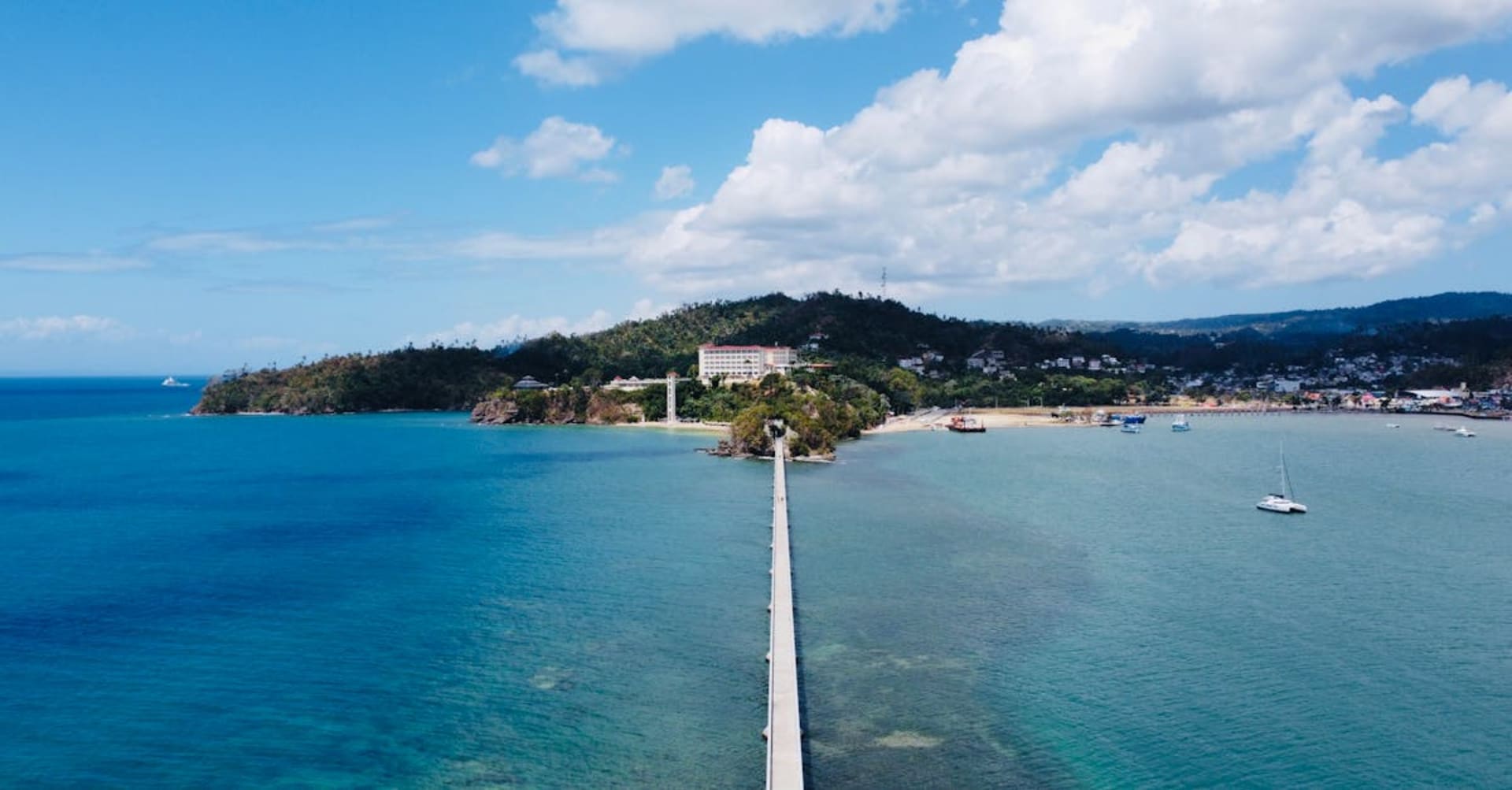
Samaná
"A humpback breach in Samana Bay is the kind of thing that makes travel feel necessary."
Every January humpback whales arrive in Samana Bay to court and calve in spectacular displays offshore.
The boat left the dock at Malecón de Santa Bárbara de Samaná before seven, while the bay was still flat and grey and smelling of salt and diesel. I was wearing too many layers for the latitude. Lia had the right instinct — light linen, a hat she’d bought from a vendor near the ferry terminal the evening before. By the time we cleared the inner harbor and the engines dropped to idle, the sun was cutting through the clouds in long amber columns and I had already peeled off my jacket.
The Bay Before the Whales
Nobody talks about how beautiful the wait is. The mangrove coast sliding past, the green hills of the Samaná Peninsula stacked behind it like a theater curtain, frigate birds hanging motionless on thermals. Our guide, a compact man named Domingo who seemed to communicate mostly through hand gestures and sudden laughter, cut the engine at the edge of a thermal zone and we sat in the rocking silence. The water here is a color I don’t have a French word for — not quite turquoise, not quite green, something warmer, mineral.
Then the first blow. A column of vapor thirty meters off the port side, and then another. The boat did not move. Domingo raised one finger: patience.
What a Breach Actually Does to You
I have seen nature documentaries. I thought I was prepared. I was not. When the humpback came out of the water — and it came fully out, all forty tonnes of it rotating slowly, impossibly, against the sky — my body responded before my brain did. I grabbed the rail. Lia made a sound I’d never heard from her. The whale hung there for what felt like a full second before it fell back with a concussion of white water that rolled under us and kept rolling.
What surprised me: the sound. Not just the impact, but a kind of low frequency before the breach, a pressure in the chest like standing too close to a speaker. The ocean announces them before you see them.
Afterward, we ate sancocho at a roadside place near the turnoff to Las Galeras — a dense, restorative stew of root vegetables and meat that arrived in a clay bowl with a stack of tortillas and a Presidente so cold it hurt to hold. The woman who ran the place pointed at the bay through the window, gestured at us, and smiled like she knew exactly what we’d just seen.
Getting Out on the Water
The whale-watching boats depart from the main malecón in Santa Bárbara de Samaná, and the early departures — before eight — are worth the alarm. The bay gets choppier as the morning progresses and the larger tourist catamarans take over. The smaller pangas stay closer to the action.
When to go: The humpback season runs from mid-January through late March, with peak activity in February when the breeding competitions — called “competitive groups” — fill the bay with multiple whales at once. Avoid the last two weeks of March if you want the whales more to yourself.