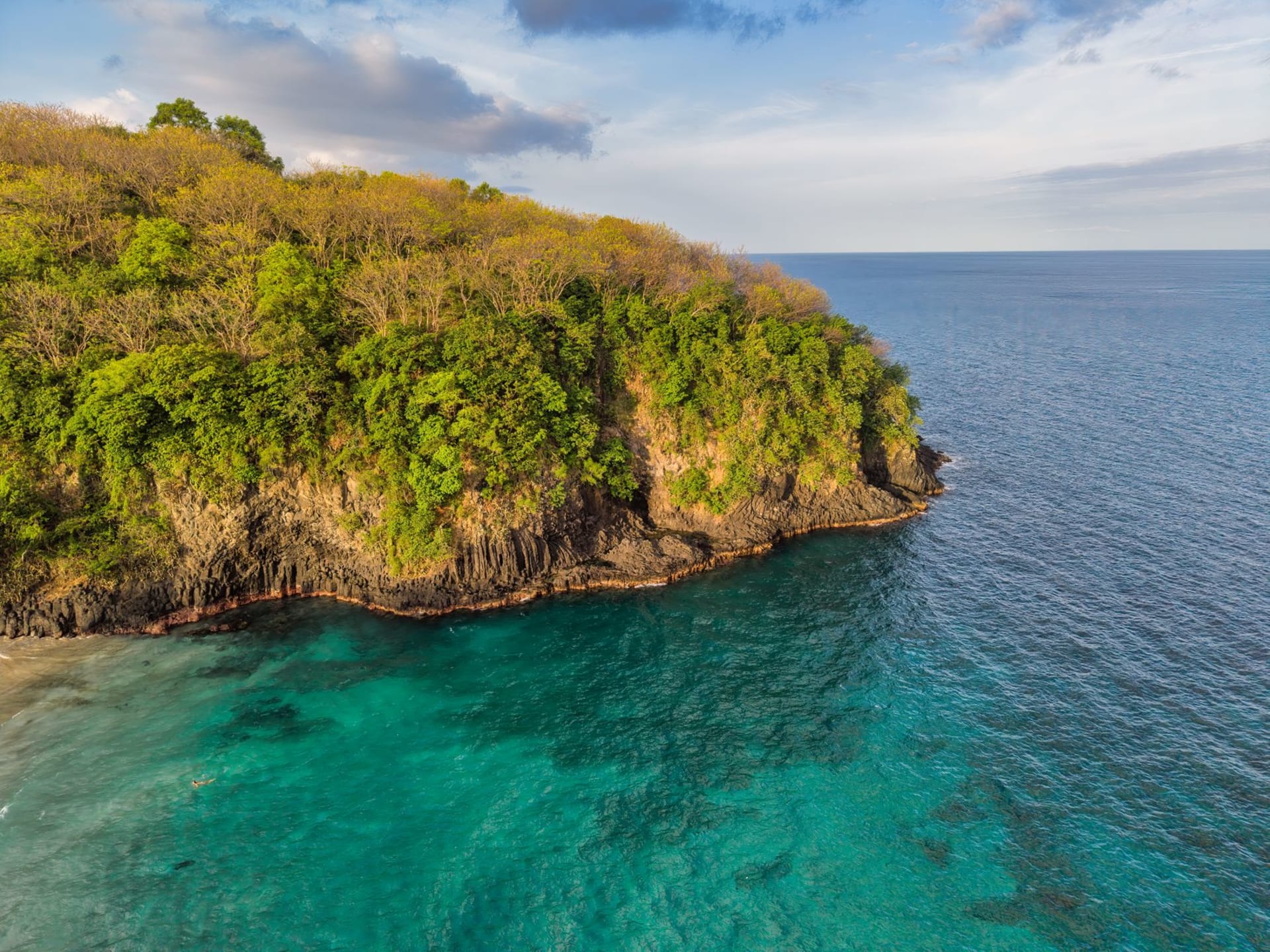
Scott's Head
"Stand at the tip and you can see both seas arguing about which one owns the point."
The road from Soufrière runs out at the tip of the peninsula and deposits you in front of a small car park where a man sells coconut water from a cooler and two women chat across a low wall in a Creole patois I can only partially follow. Beyond them, the land narrows to a point of black volcanic rock no wider than a country road, and then the sea appears on both sides simultaneously — Caribbean blue to the right, Atlantic grey-green to the left, and a line where they meet somewhere out in front of you that is not quite visible but is somehow entirely present. I walked to the end of the point in about four minutes. I stayed for much longer.

The physics of what happens at Scott’s Head are straightforward enough — the Atlantic and Caribbean have different temperatures, salinities, and wave energies, and they do not immediately blend where they meet — but the visual effect is more affecting than physics usually manages. The water on the Caribbean side is calm and clear and catches the afternoon light. The Atlantic side is restless, running in long swells that have crossed open ocean from Africa. Where the two meet at the point, the sea churns in a way that has no orderly direction. I watched a fisherman launch a boat from the Caribbean side and motor toward the mixing zone, then turn back, apparently having decided the conditions were wrong. The whole negotiation happened in about two minutes and was entirely silent from where I stood on the rocks above.
The village of Scott’s Head itself is a working fishing settlement — boats painted in bright colours pulled onto a black sand beach, nets strung between poles, the smell of engine oil and recent catches. There is nothing tourist-oriented about the village and this feels correct; it is simply a community that has existed at this productive coastal junction for generations. The dive operators who work the submarine walls off the peninsula bring people through, but they come for the water and leave for the same reason, and the village continues its own rhythms around them.

I ate fried bakes and smoked herring at the small village shop at the entrance to the peninsula. The herring was intensely salty and smoky in a way that required the bake’s softness as counterbalance, and I drank two Kubuli beers watching the light on the water change from noon white to afternoon gold. There is no particular itinerary for Scott’s Head. You arrive, you walk to the point, you sit with the two seas for as long as you have patience for, and then you eat something fried and drive back north. This is entirely sufficient.
When to go: Year-round as a half-day stop from Roseau, which is thirty minutes north. The underwater diving off the western wall — considered some of the best in the Caribbean — requires calm seas and is best January through April. Come in the afternoon for the best light on the water. Sunday mornings the beach fills with local families and the atmosphere shifts into something more festive.