
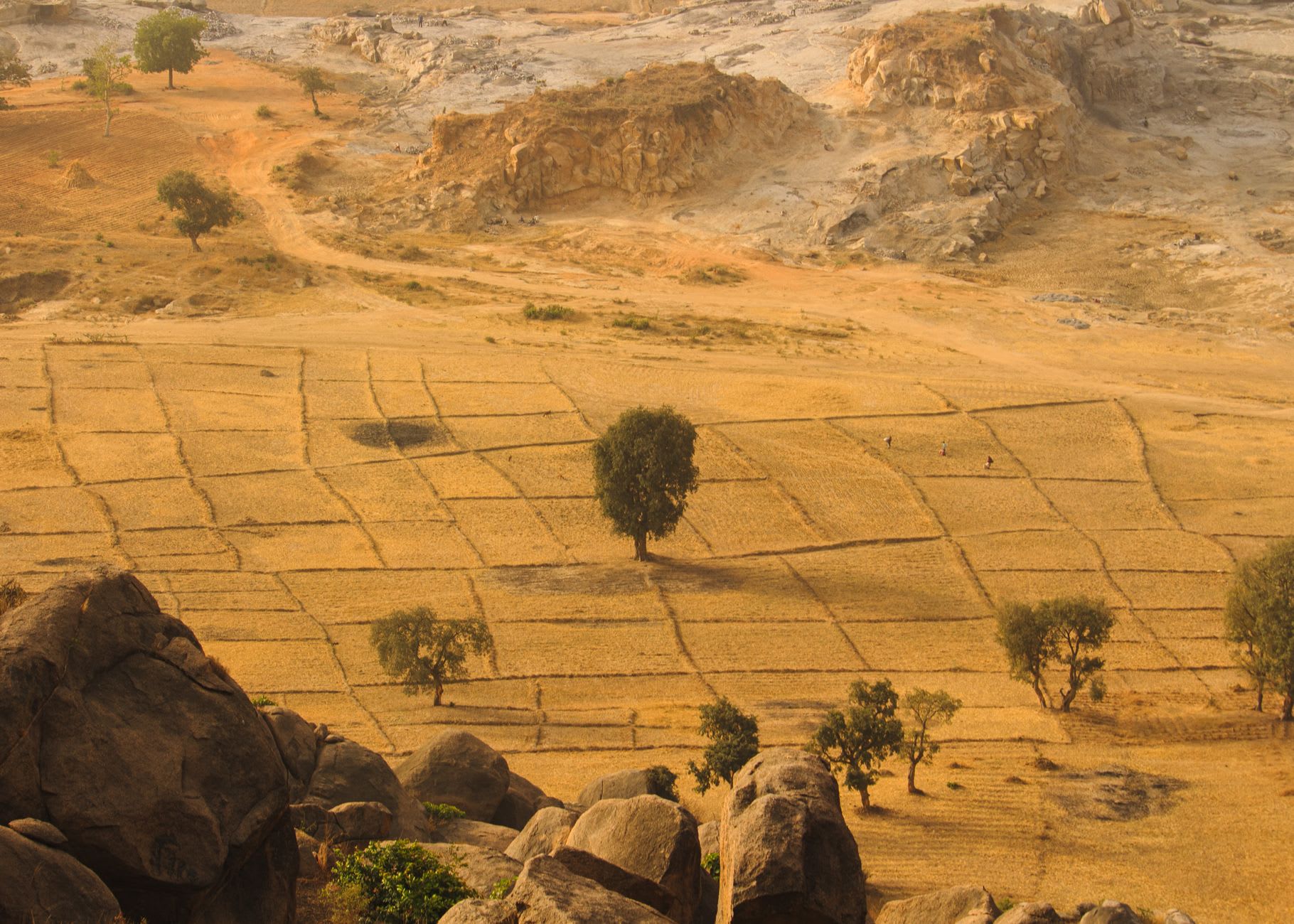
The road east from Douentza toward Hombori runs through a landscape that stops resembling Mali and starts resembling a different planet. The trees thin out, then disappear. The ground becomes a cracked terracotta pan interrupted by thorn scrub and the occasional camel — the first camels I had seen, which meant the Sahara was making its presence felt. And then the inselbergs appeared: sandstone towers rising three hundred, four hundred meters from the flat plain with the kind of vertical drama that engineers would dismiss as geologically unstable. They were not dramatic in the scenic-overlook sense. They were unsettling. They looked placed.
Hombori sits at the base of the most impressive of these massifs — the Hand of Fatima, a cluster of five towers that the light hits differently at every hour of the day. In the morning they are deep orange; by noon they wash out to something pale and shimmering; in the late afternoon they turn red-violet in a way that made me stop the motorcycle I had hired from Douentza and just sit on the roadside looking. The driver sat beside me, patient and entirely unimpressed, as people always are with the views they grew up inside.

The Hombori area is the eastern fringe of the broader Dogon cultural zone, and the town itself is a quieter, sandier, more Sahelian version of Bandiagara. The market sells dried dates alongside dried fish, there are more turbaned Tuareg traders than you see further west, and the architecture is slightly different — more influenced by the northern Saharan vernacular, flatter rooflines, more whitewash. It feels like a border town in the sense that all genuinely border places feel: an accumulation of multiple logics, not entirely committed to any of them.
The climbing community knows Hombori better than the cultural tourism world does — the towers are technically demanding and attract a small steady stream of French and German climbers who give the guesthouse a particular atmosphere. The night I stayed, the courtyard held two Malian herders sheltering from wind, a Belgian couple with chalk on their hands who were leaving the next morning, and a Mauritanian merchant who was not there for either the rocks or the culture but simply because it was on his route to Gao. We shared a meal of rice and mutton around a lantern and the conversation moved between French, Bambara, and something I didn’t follow that the two herders were conducting on their own.
I woke before dawn to watch the towers come back from the dark. At four in the morning they were invisible, just a denser darkness against the star-thick sky. Then, slowly, from the base up, they started to take shape — black shapes, then charcoal, then the first faint orange. It took about forty-five minutes and I stood in the guesthouse courtyard watching all of it while eating a piece of bread left over from the night before. The cold was significant. The beauty was unreasonable. I was very glad to be the only tourist in Hombori that week.
When to go: October through February — beyond that the heat becomes serious and the harmattan makes the visibility poor enough that the towers disappear into haze. Security advice for the Douentza-Hombori corridor changes frequently given regional instability; check current conditions through reliable sources before planning this leg. Hombori rewards commitment.