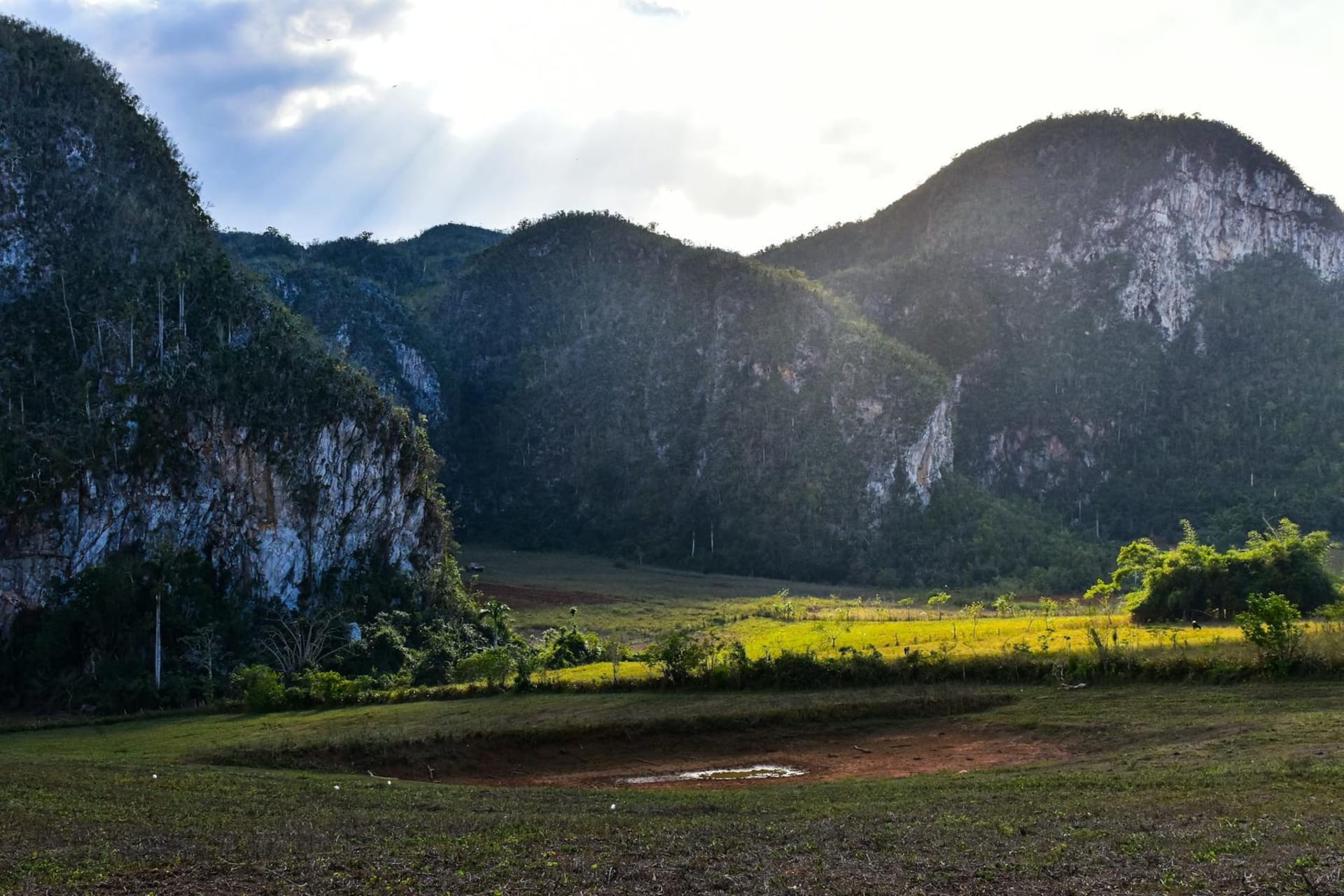
Vinales Valley
"The mogotes of Vinales have been watching farmers work this valley for longer than the revolution."
Limestone mogotes rise from tobacco fields in Cuba's most painterly valley, where time moves at ox-cart speed.
The bus from Havana drops you — drops me — at a single intersection in the village of Viñales town, and for a moment I just stand there with my bag at my feet, recalibrating. The air smells of red earth and woodsmoke and something faintly sweet that takes a day to identify: cured tobacco leaf drying in open-sided casas de tabaco, their wooden slats breathing in the afternoon heat.
Under the Mogotes
The mogotes are the thing everyone comes for, and they still manage to shock. These are not hills. They are limestone towers, blunt and vertical, rising two hundred metres from the valley floor like knuckles pushed up through green felt. The Paleozoic geology is irrelevant; what registers is the scale, and the stillness. I walked out of town along the Carretera a Pons just before six in the morning, light barely breaking over the ridge behind me, and watched the westernmost mogote emerge from mist in slow stages — first a silhouette, then shadow detail, then the full terracotta and grey of its face. A single oxcart moved along the path below it, unhurried, the farmer’s machete catching the new light for a second before he turned into his field.
Tobacco and Small Revelations
The tobacco farms are open to visitors in the most informal sense: you walk past, someone waves you in. I spent an hour inside a vega — a tobacco plot — near the hamlet of El Moncada with a farmer named Orlando who handed me a hand-rolled cigar thick as my thumb and demonstrated, without ceremony, how to read the moisture of a leaf between two fingers. I understood nothing and understood everything. Lia, who doesn’t smoke, photographed the drying shed’s interior until the light failed, then came back talking about the colour of the rope binding the bundles — exactly the same ochre as the valley floor.
The unexpected thing: the cave. I had not taken the Cueva del Indio seriously, expecting a tourist set-piece, but the boat ride through the underground river in near-darkness — ceiling dropping to inches above the waterline in places, the boatman’s headlamp throwing orange arcs across the karst — was genuinely strange and briefly frightening in the best way.
The Evenings on Calle Salvador Cisneros
The main street of Viñales town exists to be sat on. Every casa particular has rocking chairs on the porch and someone willing to open a beer at four in the afternoon. The valley goes gold, then pink, then purple behind the mogotes. Music drifts from somewhere. Nothing is scheduled.
When to go: November through April offers dry weather and the best light for photography. March and early April coincide with the tobacco harvest — the valley is at its most active and aromatic.