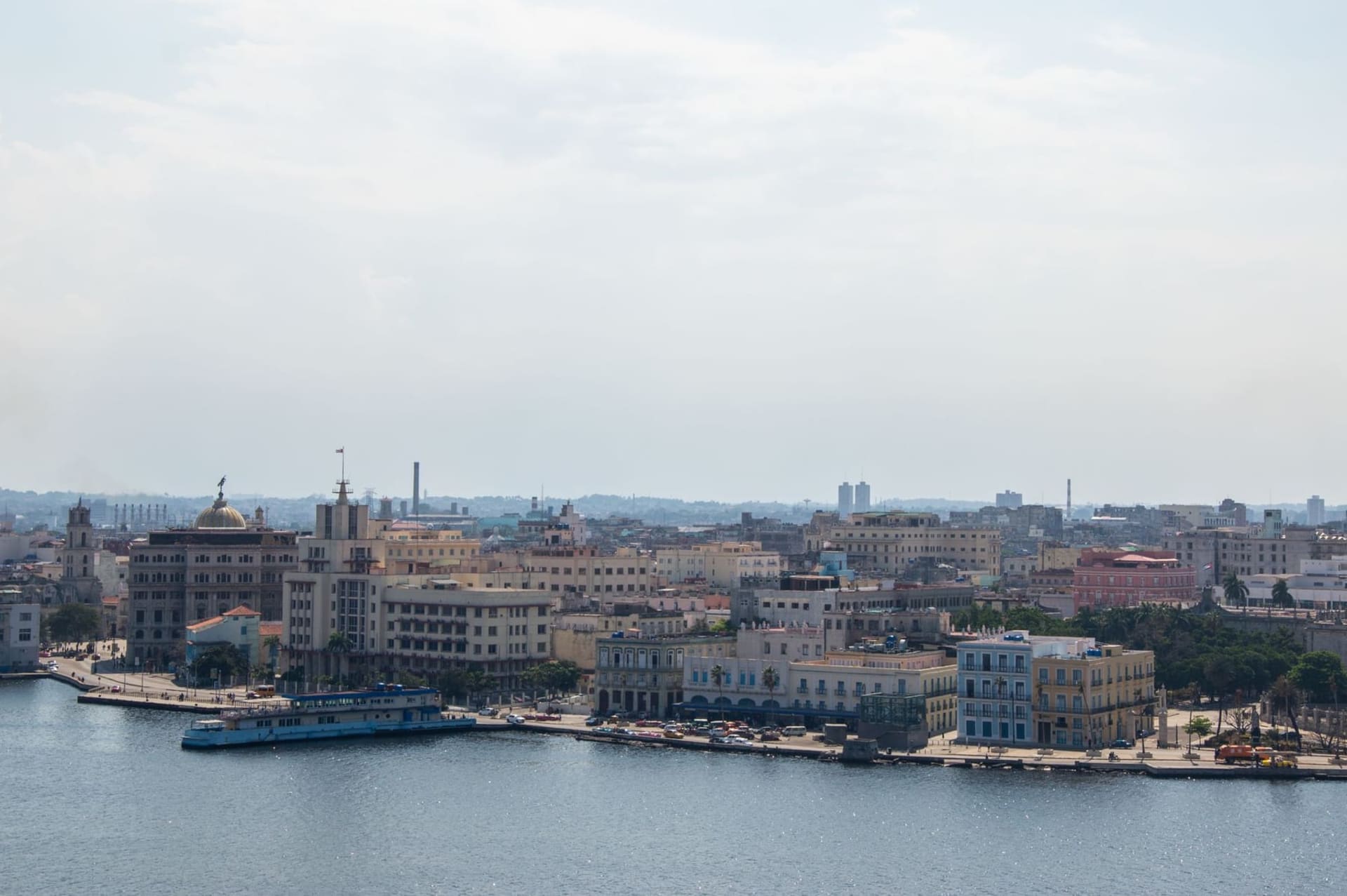
Havana Malecón
"The Malecón is Havana's living room — everyone is welcome, the sea is the only rule."
The five-kilometer sea wall where Habaneros gather at dusk with rum, guitars, and everything they can't say anywhere else.
I arrived at the Malecón for the first time at the worst possible hour — four in the afternoon, the sun white and brutal overhead, the sea wall nearly empty. I walked the length of it anyway, along the Avenida de Maceo from the mouth of Havana Bay all the way past the Hotel Nacional to where the wall curves toward Vedado, and I understood nothing yet. You have to come back at dusk.
The Hour Everything Changes
The transformation happens somewhere around six. The light goes amber, then copper. The spray off the Atlantic reaches the road and catches it. Families appear from the crumbling buildings behind the wall — the ones with balconies that have been losing plaster since the 1960s — and claim their sections of limestone like living rooms. Men lay out dominoes on the low concrete ledge. Teenagers pass a bottle of Havana Club in a paper bag. A woman in house slippers sets up a folding chair and stares at the water as if waiting for someone who left a long time ago.
Lia and I bought a split of rum from a man with a cooler near the corner of Calle 23 — a few pesos convertibles, no label, cold — and sat with our backs against the wall as the sea came in sideways. The smell is salt and diesel and something faintly floral I never identified. The sound is everything at once: cumbia from a phone speaker, the slap of a wave, an argument two groups down that dissolved into laughter before I could follow what it was about.
What Nobody Talks About in Guidebooks
The Malecón has a reputation as a place to see. What the books don’t tell you is that it is primarily a place to hear. On a weekend night, the wall becomes a continuous, overlapping concert — not organised, not performed for visitors, just people who happen to own guitars and happen to know the same songs. I heard a pair of old men play a bolero so slowly it seemed to have no beginning and no end, just a state of existing.
The surprise came later, near Parque Antonio Maceo, when a man in his seventies stopped next to me and asked — in careful, grammatical French — whether I was enjoying the evening. We talked for twenty minutes. He was a retired schoolteacher who had never left Cuba and had spent forty years teaching French literature. He quoted Camus. He had never read him outside of Cuba. He said the Malecón was where he came when he needed to think in French, because the sea, at least, had no language at all.
A Living Room With No Roof
By ten o’clock the wall was shoulder to shoulder from the Paseo del Prado to the edge of Vedado. The facades of the buildings behind us — apricot, ochre, pale green — were lit orange by the last streetlamps that still worked. The road, the broad six-lane Avenida de Maceo, was still moving: the Ladas, the Chevrolets from 1955 with their improbable survival, the bicycle taxis weaving through.
What makes the Malecón different from every other famous waterfront I have sat on is the absence of transaction. Nobody is selling anything. Nobody is performing for tips. The sea wall belongs entirely to the people who live behind it, and they allow you to sit among them the way you might allow a stranger to sit on a public bench — with indifference that is its own form of welcome.
When to go: November through April, when the northern swell is calm enough that the waves do not spray the road. Avoid hurricane season (September–October), when the Malecón floods and the city turns inward.