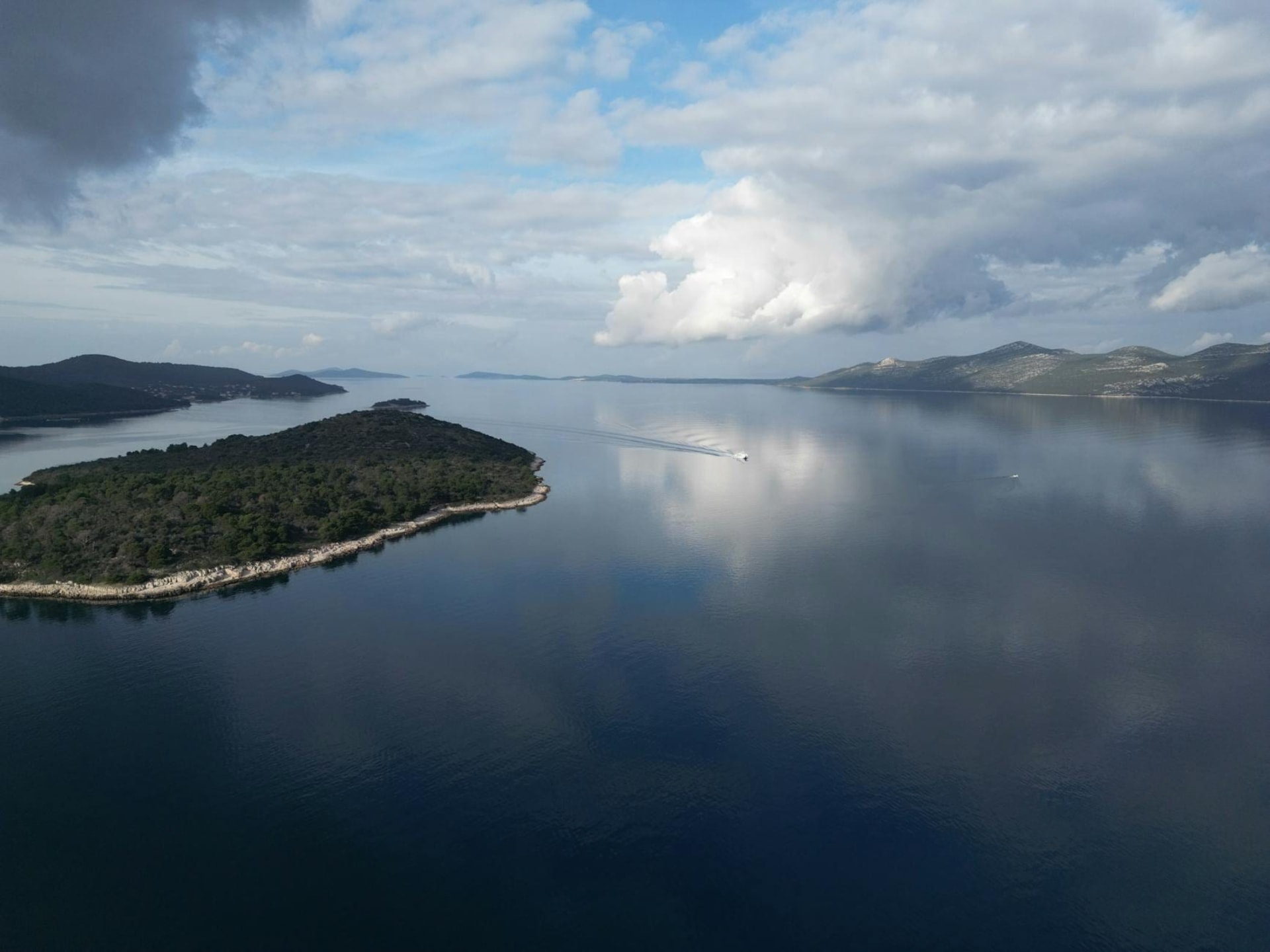
Croatia's most remote island accessible only by ferry or catamaran, with a medieval village facing away from the sea.
The ferry from Split takes five hours and drops you at a dock that feels like the end of a sentence. No souvenir stands, no transfer minibuses idling with their hazard lights on. Just a narrow road curving uphill into pines, and the faint smell of rosemary cut with diesel from the departing boat.
Lastovo Town sits at the island’s centre, its back deliberately, architecturally turned away from the sea. The Venetians decreed it in the fifteenth century — they didn’t want the islanders signalling to rival fleets — and the village never quite unlearned the posture. Walking up through Ul. Vladimira Nazora, the main artery that threads between stone houses, I kept expecting a harbour view that never came. What I got instead were chimneys. Lastovo’s chimneys are famous among people who notice such things: ornate, stacked, each one different, some mimicking miniature churches, some spiralling like soft-serve ice cream. Lia photographed seventeen of them before we’d reached the square.
The Quiet the Island Keeps
There are no banks on Lastovo. There is one ATM and it is sometimes empty. The island has been a nature park since 2006, which means the surrounding waters are some of the clearest in the Adriatic and also means that very little has been built in the decades since tourism began rewiring the rest of the Croatian coast. At night, the darkness is complete enough to disorient. The Milky Way showed up above the Skrivena Luka bay — Hidden Harbour, the name admits what it is — like something I’d only seen in photographs.
I ate grilled dentex at a konoba so small it had no signage, just a handwritten menu pinned inside the door with a thumbtack. The fish had been caught that morning. The owner brought out a carafe of local prošek without being asked and sat down with us for ten minutes while the kitchen handled itself.
What I Didn’t Expect
The carnival. Every February, Lastovo holds the Poklad festival — one of the oldest carnival traditions in Croatia — where an effigy is paraded through the village on a donkey, accused of bringing misfortune, then tried, sentenced, and burned. Nobody told me about it before I arrived. I found a photograph of it in the small community centre near the church of Sveti Kuzma i Damjan, framed between a nautical chart and a faded postcard. The image of the burning effigy mid-procession, torches lit, the whole village watching, made the quiet of the island feel temporarily borrowed.
When to go: Late May through June offers the best balance of warm water, manageable ferry schedules, and a village that hasn’t yet shifted into high season mode. September is equally good — the pines smell different after a summer of heat, drier and sharper, and you’ll likely have Skrivena Luka almost entirely to yourself.