Heraklion
"The coffee arrived without asking — thick, sweet, and black. Heraklion was already making its case."
The ferry from Piraeus deposits you at Heraklion at dawn. I stumbled off the boat into air that smelled of diesel, salt, and something faintly floral — maybe the cargo of a neighboring freighter — and found the port half-awake, a single kafeneio already open with its plastic chairs angled toward the water and its owner moving between tables with the deliberate pace of a man who has opened at five in the morning every day for thirty years. The coffee arrived in a small cup, thick and black and sweet without asking, and I sat there watching the city emerge from the dark. Heraklion does not make a seductive first impression. The main port area is industrial, the seafront road loud with trucks, the blocks around the market unremarkable in the way of a working city that never had time to arrange itself for tourism. I liked it immediately for that.

The Archaeological Museum, which sits just back from the harbor behind Eleftherias Square, is reason enough to come here first and stay a while. It holds the most significant Minoan collection in existence — the bull-leaping fresco, the Snake Goddess figurines, the mysterious Phaistos Disc — and I spent an entire morning moving between its rooms trying to arrange what I was seeing into something coherent. Three and a half thousand years ago, people were making art this refined and this strange on this specific island. The civilization that built Knossos predated classical Athens by a millennium. The museum makes that fact unavoidable in a way that no textbook can.
Outside the museum, the city unfolds on its own terms. The 1866 Street market cuts through the center in a long narrow corridor of stalls: barrels of olives gleaming in their brine, wheels of graviera cheese, dried herbs in paper bags, honey in various gradations from pale gold to almost mahogany. I bought a small jar of thyme honey and ate it with a sesame ring from a street vendor, standing in the middle of the crush. By noon the market was so full I could barely move, but the vendors worked around and through the crowd with practiced ease, calling to each other in a dialect that felt distinctly Cretan — rougher and more musical than mainland Greek, with its own rhythm and its own sense of time.

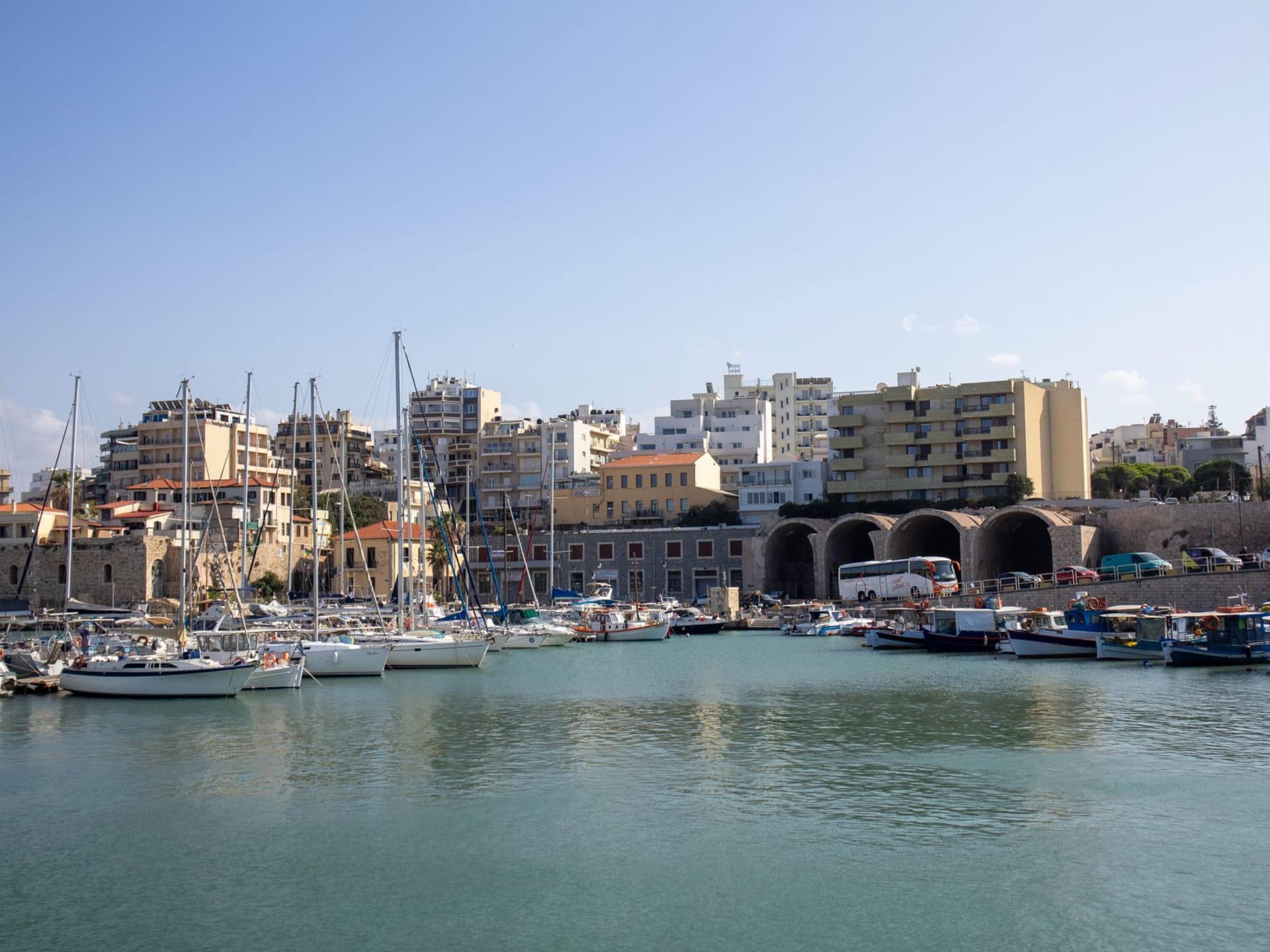
The Koules, the Venetian sea fortress that guards the harbor entrance, is best seen at the hour when the light goes golden and the fishing boats rock gently in the water below its walls. The Venetian lion of Saint Mark carved into the stone has watched this harbor since 1540 and looks entirely unimpressed by the restaurant terraces that have grown up in its shadow. Walk the walls in the late afternoon and you get the whole harbor laid out below: the ferry boats, the fishing fleet, the mountains of central Crete rising inland, the Aegean flat and blue to the north. The food here is unshowy and serious in the way of a city that eats for nutrition and pleasure in equal measure: boureki layered with zucchini and cheese, kalitsounia sweet with fresh mizithra, and every variation of grilled meat served with a carafe of local wine that costs almost nothing and tastes better than it has any right to. Restaurants around the market fill with locals late, which is always the right sign.
When to go: Heraklion works year-round as a transit hub, but if you are spending real time here, May and October are ideal — the museum crowds thin, the market feels more local, and the light on the Koules at dusk is something you won’t soon shake.