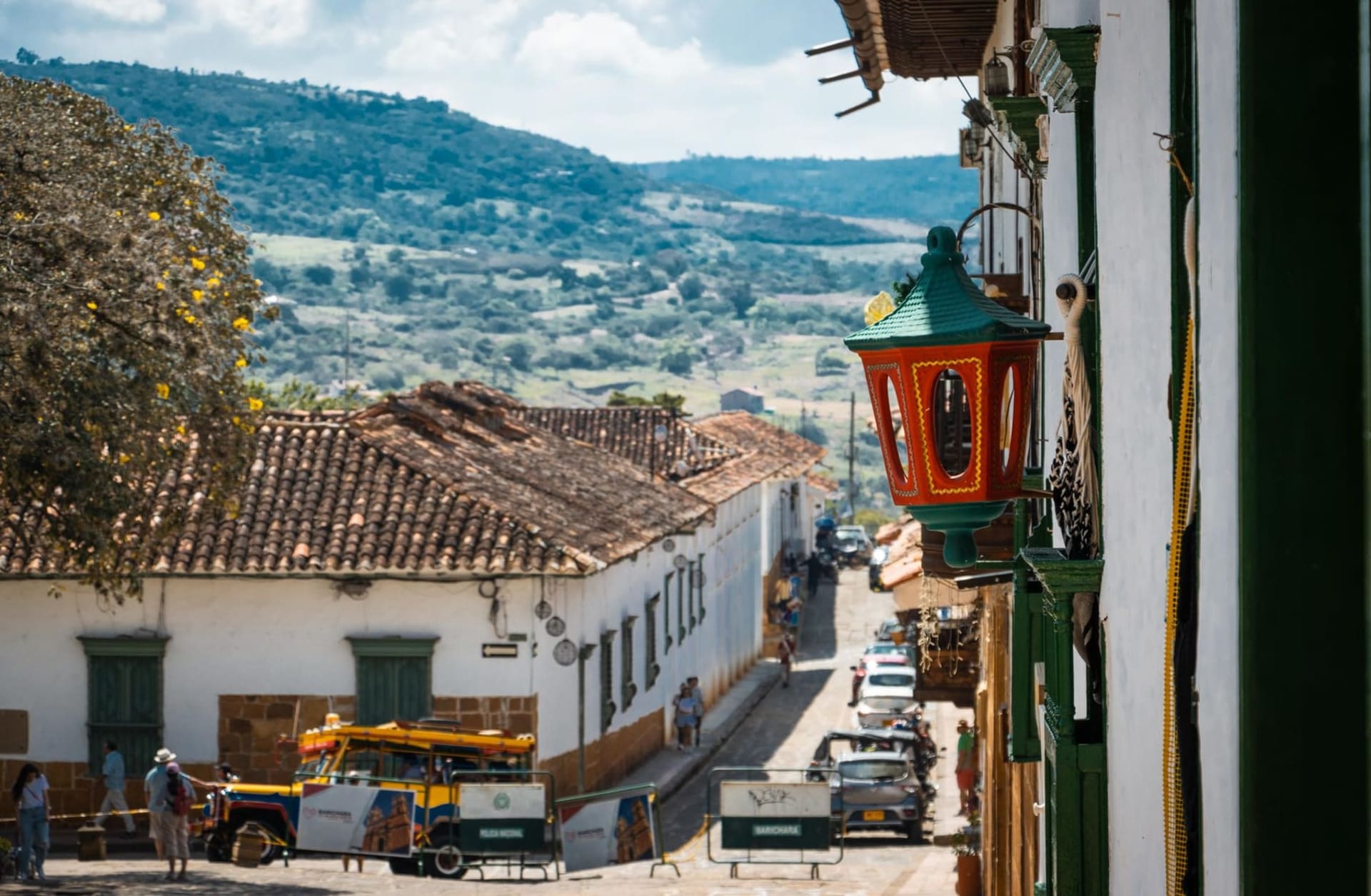
A UNESCO colonial town on a river island in the Magdalena where García Márquez set scenes and egrets perch on balconies.
There is a particular quality to the light on the Magdalena at five in the afternoon — thick, amber, almost edible — that makes you understand why García Márquez kept returning to this town in his prose even after he’d physically left it behind. Mompox does not feel like somewhere you arrive at. It feels like somewhere you remember.
The River and the Streets
The town sits on an island formed by a bifurcation of the Magdalena, and that isolation is not incidental — it is everything. The road that finally reached Mompox in the twentieth century came too late to change what the centuries of river-only access had already made. Walking Calle de la Albarrada along the waterfront at dusk, past the convents of San Agustín and Santa Bárbara with their baroque towers going peach in the failing light, I had the sensation of moving through a city that had simply decided to stop. Not to decay — to stop. The filigree ironwork on the balconies is colonial. The egrets on the docks are presumably eternal.
Lia found the silence more unsettling than I did. After Cartagena’s tourist machinery, the quiet in Mompox felt almost aggressive. No one was selling anything. A man was rocking in a hammock in an open doorway on Calle Real del Medio. He nodded at us. That was the interaction.
What You Eat and What You Notice
I ate sancocho de bagre twice — a thick catfish stew they make here with yuca and green plantain — at a place near the Plaza de la Concepción where the owner seemed genuinely puzzled that we had come from Mexico to eat her food. The bagre comes from the river. It tastes like the river smells: dark, slightly mineral, alive. I also ate a lot of bollo de mazorca from women who carried them in cloth bags and who were not particularly interested in explaining what they were. Corn, pork fat, wrapped in corn husk. You eat them standing up.
The unexpected thing was the goldsmithing. I had not anticipated that Mompox would be the filigree capital of Colombia, that families here have been bending gold wire into flowers and fish and hummingbirds for three hundred years by the same methods. I watched a man on Calle de Medio work under a bare bulb and a magnifying glass. He did not look up. The piece he was making — a small egret, which felt appropriate — was no larger than my thumbnail.
Getting There and Getting Oriented
Mompox is reached by a combination of land and river from Cartagena or Barranquilla — a journey that takes most of a day and involves at least one chalupa crossing. That friction is a feature, not a flaw. The town is small enough to walk entirely. The three main plazas — Concepción, Santa Bárbara, San Francisco — form the spine. Everything else radiates from the river.
When to go: The dry season runs December through March, when the Magdalena is lower, roads are passable, and the heat is bearable before noon. Semana Santa brings processions that are among the most extraordinary in South America — but book accommodation months in advance.