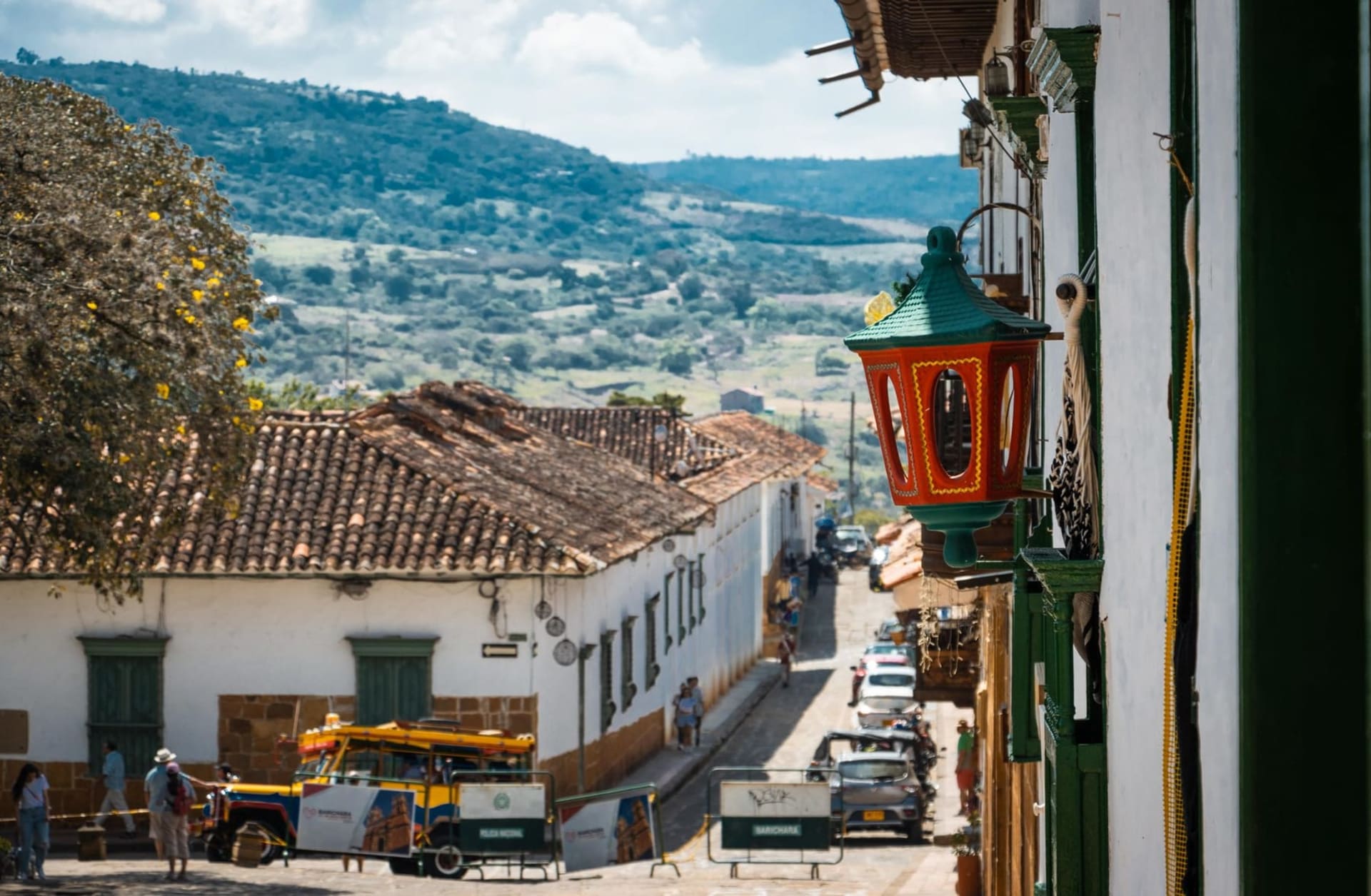
Barichara
"Barichara is so perfectly preserved you half-expect to see conquistadors turning the corner."
Colombia's most beautiful village of stone streets and whitewashed colonial homes above a canyon in Santander.
There is a particular quality of silence in Barichara that I did not expect from Colombia. Not the silence of emptiness — the village has its life, its dogs crossing the Calle 6, its women carrying canastas up from the market — but a silence of depth, as though the stone itself absorbs noise and returns something slower in its place.
We arrived from San Gil on a bus that dropped us at the edge of town, and the first thing I noticed was the light. At 1,300 meters above the Río Suárez canyon, the sun hits Barichara at an angle that turns every whitewashed facade into something approaching luminescence. The streets are paved with the region’s rust-colored sandstone — the same material used for the cathedral, the cemetery walls, the low doorways — and in the late afternoon everything takes on this warm, amber coherence, as though the entire village were carved from a single block.
Stone and Cathedral
The Catedral de la Inmaculada Concepción anchors the Plaza Principal the way cathedrals are supposed to but rarely manage. It does not compete with its surroundings — it simply belongs. I spent an hour on a bench across from it doing nothing, which is, I have come to understand, the correct activity in Barichara. The streets radiate outward in a grid the Spanish laid in 1741, and walking them feels less like tourism than like moving through an argument for a particular way of organizing life.
The Capilla de Santa Bárbara, at the edge of town where the canyon opens up, stopped us both cold. Lia grabbed my arm when we rounded the corner — the chapel sits at the lip of the gorge, and behind it the land simply falls away into green nothing for a thousand meters. We stood there longer than we meant to.
The Camino Real and a Discovery
The old Camino Real to Guane is nine kilometers of flagstone threading down into the canyon, and I walked it alone one morning while Lia slept in. What I did not expect: a local man named Edilberto who farms the terraces just below town, who stopped me to offer a piece of raw sugarcane from his machete and then, unprompted, recited a poem about the river. He knew Aurelio Arturo by heart. I did not.
Back in the village, I ate a bowl of mute santandereano — the region’s thick corn and pork stew — at a place on Calle 5 with four plastic tables and no sign, the kind of restaurant that exists for people who already know it exists.
When to go: December through March brings dry, sunny skies and the sharpest light for photography. Semana Santa draws visitors but adds a layer of ceremony to the streets that earns the crowds.