
Valle de Cocora
"Trees that tall have no right to be that graceful. The valley makes a strong case for existence."
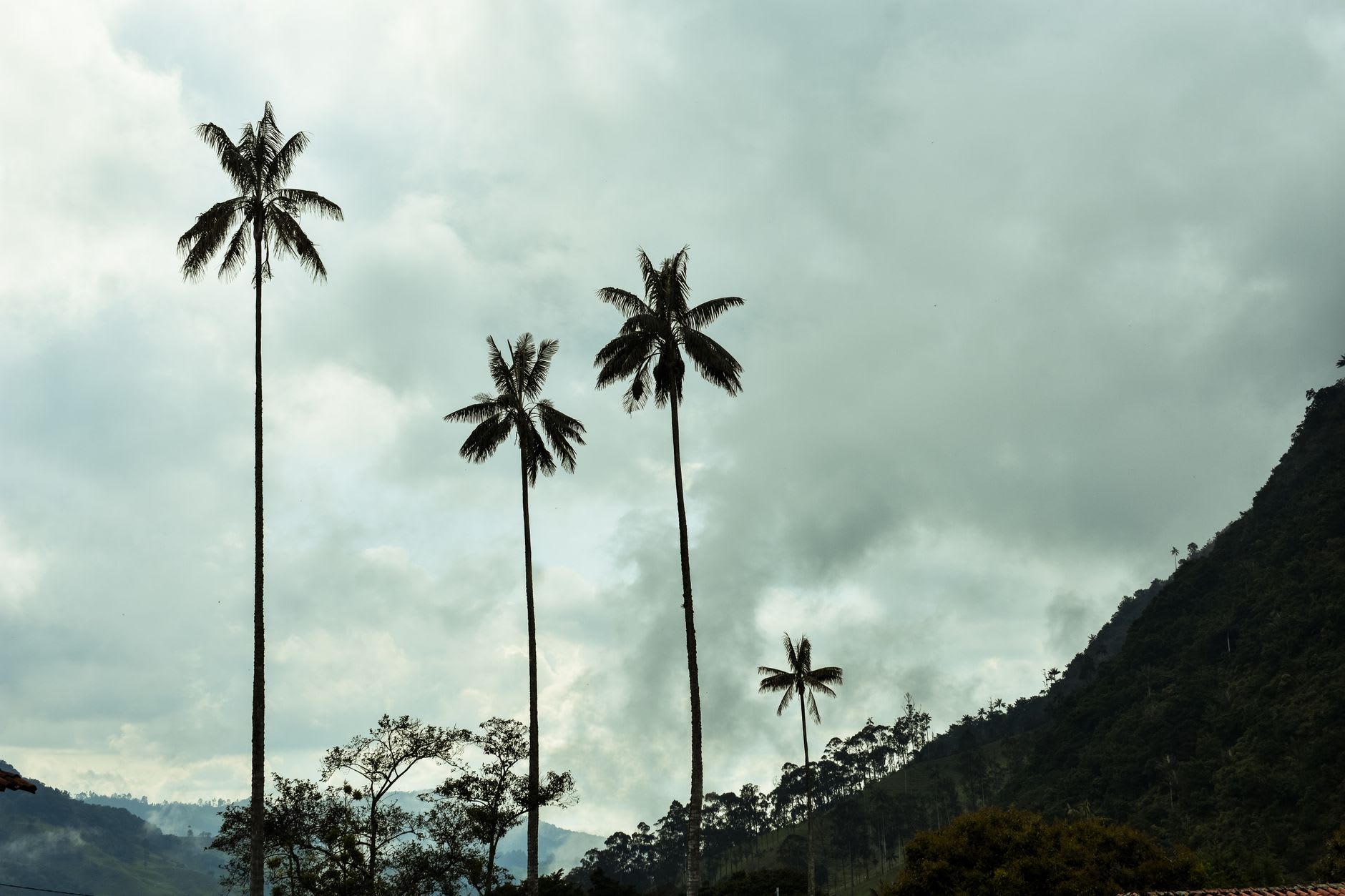
The jeep drops you at a wire bridge over a green river, and from there everything is up. The Valle de Cocora begins as a wide pastoral bowl — horses in the meadow, a pair of wooden restaurants serving changua and tinto — and then, above the grass line, it becomes something else entirely. The wax palms rise from the cloud so gradually that you do not register how tall they are until you are standing beneath one, neck bent, looking up at a trunk that does not end so much as disappear. Colombia’s national tree. Up to sixty metres. They look designed by a committee that had never agreed on scale.
I did the loop trail clockwise — through the cloud forest first, then out across the open valley floor. The cloud-forest section is where the hike earns its reputation: a narrow path through dense vegetation so wet it drips from the leaves even when it is not raining, hummingbirds moving through the understory with a mechanical urgency, the sound of the river always somewhere below. The fog comes and goes in sheets. At one point I was standing in a clearing with about ten metres of visibility and then the cloud lifted for two minutes and I could see the whole valley laid out below, the palms in the meadow like a grove from a children’s book, and then it closed again.
The hummingbird station near the top of the cloud-forest section is not on most maps but every guide knows it: a small farm where the owners have hung dozens of feeders and the birds arrive in a sustained blur of iridescence. I counted seven species in twenty minutes, which means nothing in ornithological terms but felt like a private miracle. The owner charges a small fee, offers tinto, and seems genuinely unimpressed by the spectacle happening five metres from his porch.
Coming down through the open valley in the afternoon, with the cloud lifted and the palms standing clear against a blue sky, is the payoff. The grass is the green that only exists at altitude, the river runs fast over red gravel, and the whole composition resolves into something that looks curated but isn’t. It is just geology and climate doing what they do, and the wax palms doing what they do, which is grow unreasonably tall in the middle of all of it.

The last hour of the walk returns you to the restaurant strip at the entrance. The trout places are basic and good — large fish, good sauces, cold beer if you want it, juice from tree tomatoes and lulo if you do not. I sat at a table with a view down the valley for an hour after finishing, which I mention because sitting down and looking at a thing for an hour is the correct response to a place like this.
When to go: The dry seasons — December through February, June through August — give the best chance of views between cloud gaps. But the cloud forest is arguably better when it is wet: denser, wilder, the fog more theatrical. Go in the dry season if you want the wide valley views; go in the green season if you want the hike to feel more serious. Either way, start by 8am before the tour groups arrive from Salento.