Chefchaouen of the East – Fenghuang
"Fenghuang's stilted houses lean over the river as if listening for something the water said centuries ago."
A perfectly preserved Ming-Qing town of stilted houses on the Tuojiang River in rural Hunan.
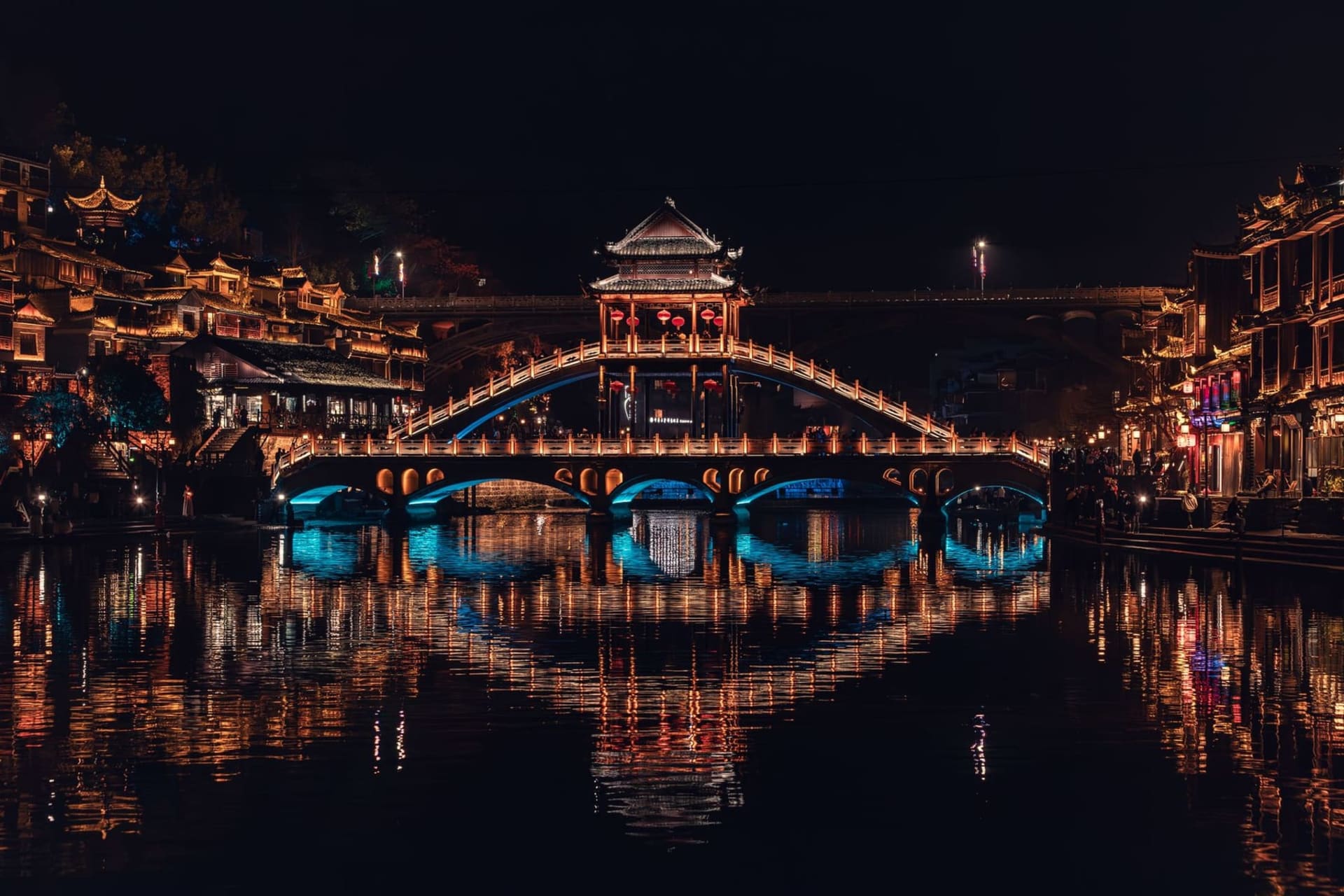
There is a moment, crossing the Hong Qiao covered bridge for the first time, when the whole town reveals itself at once — the diaojiaolou stilted houses stacking up along the bank, their dark timber legs planted in the Tuojiang like herons, the stone embankment of Laoying Street glowing faintly amber under lantern light. I stood there longer than I meant to, Lia pulling at my sleeve because we still had no guesthouse and the light was failing fast.
The River Is the Town
Fenghuang makes no sense without the Tuojiang. The river is not a backdrop — it is the organizing principle, the reason the Ming-dynasty builders drove posts into silt rather than stone. Walking along the embankment from Dongmen Gate toward the old ferry crossing, the smell is particular: river mud and osmanthus wood oil, incense drifting from a small Miao temple tucked between two guest houses, and somewhere, always, the sweet-sharp funk of chengjiao — Hunan pickled vegetables fermenting in clay crocks set out on doorsteps. It is not a pretty smell. It makes the place real.
The water in the Tuojiang runs green where it is deep and copper-brown in the shallows where women still beat laundry against the stepping stones at dawn. I woke early my second morning just to watch that: the methodical rhythm of it, the sound carrying up through the wooden floor of our room.
What the Guidebooks Do Not Say
Everyone photographs Fenghuang from the north bank looking south, the row of stilted houses perfectly composed. What I did not expect was the back country west of Chaoyang Gate — narrow lanes that smell of charcoal and wet stone, old men playing xiangqi outside a tea house on Jianshe Road, a woman selling biang biang-style mochi from a bamboo tray that she balanced entirely on her forearm. No English menu, no QR code. We pointed, she laughed, and the mochi was filled with black sesame and so glutinous it pulled like taffy between our teeth.
The genuine surprise came at the Shen Congwen Memorial Hall, dedicated to the Miao novelist who set much of his fiction in these mountains. I had packed a translation of his novel Border Town and found his actual wooden writing desk behind glass, a half-finished manuscript page still visible in the photograph mounted beside it. I had not expected to feel moved by a desk in rural Hunan. I was.
Eating Along Laoying Street
The cooking is uncompromisingly Hunan — numbing dried chilies in everything, sour fish stew called suanyu that arrives in a clay pot still spitting, and blood tofu that looks frightening and tastes like the best thing you have eaten all week. Skip the tourist-facing restaurants at the north bank and follow Laoying Street west past the red-lantern corridor until the signage drops to hand-painted characters. The places with no photographs on the menu are the ones worth finding.
When to go: April through early June for mild temperatures and the river at its most photogenic level — high enough to reflect the lanterns, low enough to walk the stepping stones. Avoid the Golden Week holidays in early October when the narrow lanes become impassable.