Dunhuang
"Dunhuang is where the desert ends and a thousand-year-old library of Buddhist art begins underground."
Oasis city at the edge of the Gobi, gateway to Silk Road Buddhist cave art and singing sand dunes.
There is a moment, driving east out of the city center on Yangguan Dong Lu toward the dunes, when the last concrete block gives way entirely to sand — not a gradual fade but a clean cut, as if someone drew a line with a ruler. On one side: Dunhuang, its noodle shops and melon vendors and karaoke signs glowing pink. On the other: the Gobi, enormous and absolutely indifferent to the fact that you exist.
I stood at that edge for longer than I should have admitted at the time.
The Caves Before Words
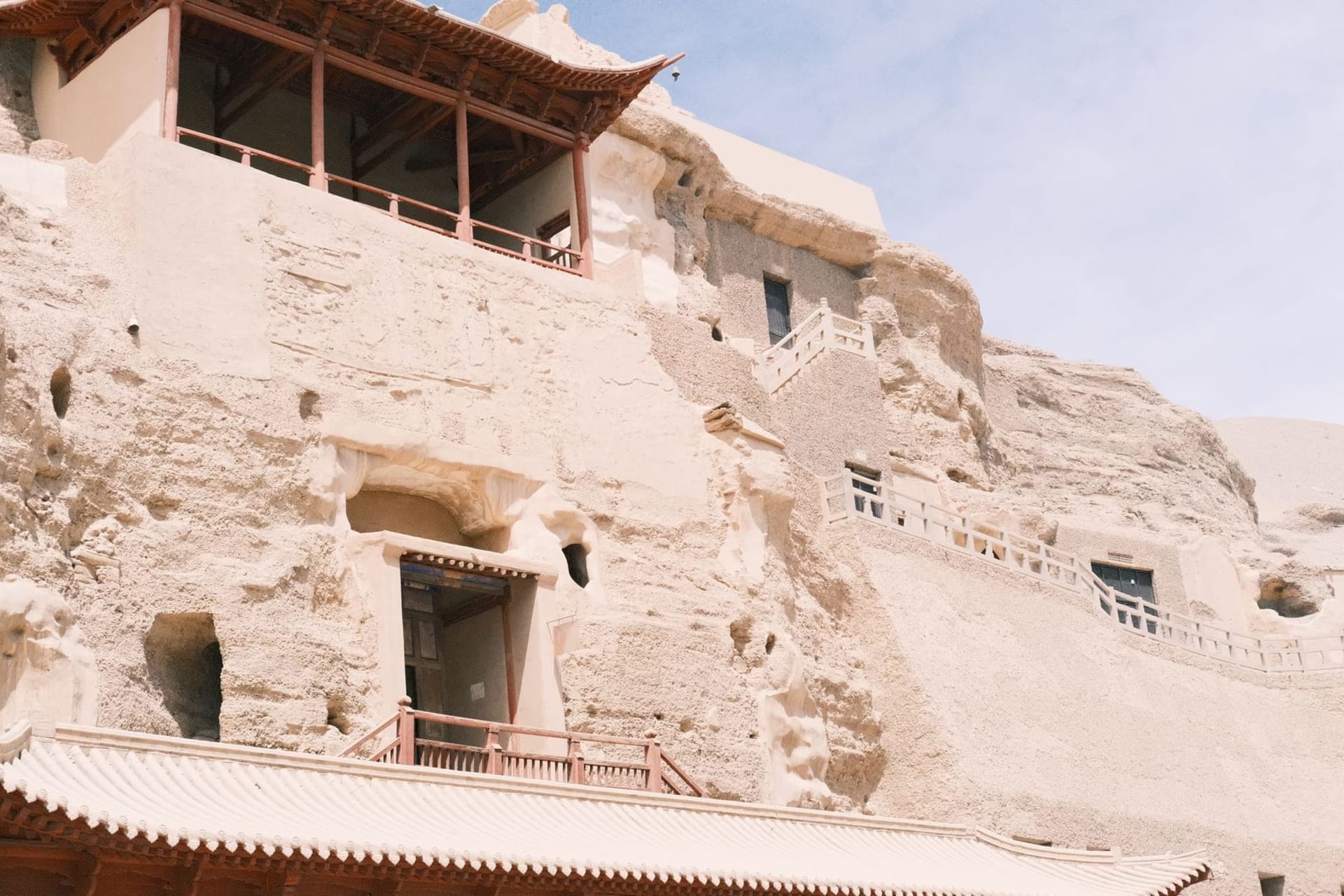
The Mogao Grottoes are twelve kilometers southeast of town, carved into a desert cliff face that starts the color of dried apricot and shifts toward rust as the afternoon light moves. I had read about them. Reading prepares you for nothing.
Inside Cave 96, the main Buddha rises nine stories through the dark, gold-leafed and faintly lit by a single bulb, the face serene in a way that feels less like sculpture and more like something overheard. The frescoes in the smaller caves — particularly the Tang Dynasty panels in Cave 45, with their musicians floating above lotus clouds — are so vivid after a thousand years that my first thought was that someone had repainted them recently. They had not. The sealed desert air did that, and the monks who bricked the library cave shut around 1000 CE, leaving forty thousand manuscripts behind to wait.
That library cave, Cave 17, was the detail that undid me. It is barely the size of a small bathroom. The manuscripts stacked inside mapped Buddhist texts, Taoist documents, commercial contracts, calendars in Tibetan, Sogdian, Sanskrit. Someone hid them. Someone never came back.
Mingsha Shan at Dusk
Lia rented a camel near the base of the singing dunes and rode it with the skeptical posture of someone who had been promised a cultural experience and was now reconsidering. The dunes are enormous — some crests reach 250 meters — and they do sing, a low resonant hum when the wind moves across the ridgeline that I initially mistook for a distant engine. It is the sand. It is just the sand.
We climbed without camels. The effort is considerable and immediately worth it. From the top, the Crescent Moon Spring sits below like a parenthesis, its water still clear despite the surrounding desert. The light at that hour was everything warm: amber, copper, the particular orange that deserts save for the last twenty minutes before dark.
In the market on Shazhou Ye Shi afterward, I ate hand-pulled noodles with donkey meat and a bowl of something called xingpian — apricot paste, cool and faintly sweet — and felt, briefly, like I had eaten my way onto a Silk Road caravan.
When to go: Late April to early June or September to October, when the heat is bearable and the dunes are not packed with summer tour groups. Avoid the July–August peak unless heat and crowds don’t bother you.