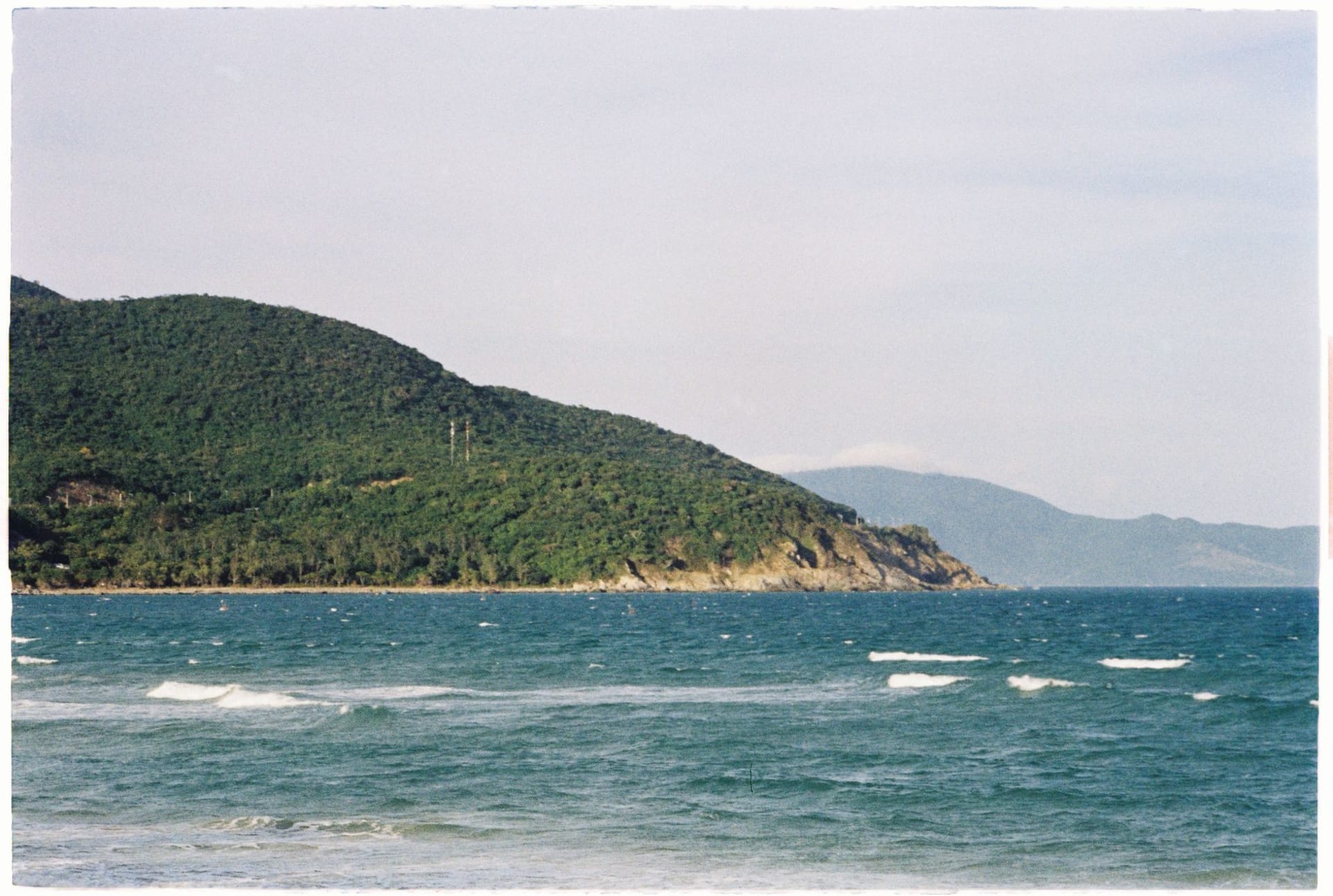
Lăng Cô
"Most people pass Lăng Cô at speed. I stopped once and couldn't work out how to leave."
The train from Đà Nẵng climbs the Hải Vân Pass on a track cut into the cliff face above the sea, and just before it descends through the tunnel on the northern side, there is a curve where the full panorama opens: the lagoon of Lăng Cô below, lying between the mountains and the barrier beach like something a mapmaker drew to make the landscape more plausible, the water changing colour in bands from the bridge to the open sea — brown, then green, then a blue so particular it doesn’t have a convincing name. I had planned to stay one night. I stayed three.

Lăng Cô is a town that occupies a narrow peninsula between the lagoon on the west and the beach on the east, connected to the mainland by a single road that crosses the water and immediately loses itself in the few dozen streets of the village. The beach on the eastern side — a long, largely undeveloped stretch of white sand facing the open South China Sea — is the kind of Vietnamese beach that existed everywhere before the resort hotels arrived, and which exists here because the Hải Vân Pass and the tunnel that bypasses it have conspired to keep Lăng Cô just inconvenient enough to stay underdeveloped. The fishing boats still moor in the lagoon every morning. The women still sort the catch on the bridge. The restaurants are still run by families who have been cooking the same fish soups for thirty years.
The seafood here is caught in the lagoon and the sea simultaneously, which produces a menu of unusual range for a village this small. The lagoon’s brackish water grows a local prawn called tôm hùm đất that I have not found anywhere else — not quite a rock lobster, not quite a langoustine, cooked with lemongrass and served whole. The fishermen’s restaurants on the lagoon side serve it with thin white rice noodles and a broth that is mostly the sea itself, with a plate of herbs on the side and the instruction that you add them yourself. I ate this for two consecutive breakfasts and felt no need to apologize.

What Lăng Cô gives you that nowhere else in central Vietnam quite does is the sense of being between things — between mountain and sea, between north and south, between the weather systems the Hải Vân divides. The mornings here often start in mist because the warm air off the sea meets the cold air coming down the mountain, and for an hour or two after dawn the lagoon disappears into white, the fishing boats appearing and disappearing as they move, the mountains invisible. Then the mist burns off and everything returns: the blue water, the green cliffs, the white beach, the particular brightness of a coast that faces east and gets the full force of the morning light.
When to go: March through August is the optimal window. The Hải Vân Pass funnels the worst of the autumn rains onto the Lăng Cô side of the divide, and October through December can be wet and rough. April and May are the most reliably pleasant — warm water, clear skies most days, and few enough visitors that the restaurants still behave like they’re cooking for people they know.