Huế
"Every city has its centre of gravity. In Huế, it's grief — and the soup that learned to carry it."
The xe ôm driver dropped me outside the moat at five-forty in the morning, when the Citadel walls were still dark and the street vendors were only just arriving with their carts. I had asked him to stop at whatever bún bò Huế stall opened earliest, and he laughed and pointed me toward a woman stirring a pot the size of a small bathtub over charcoal, the broth already glowing amber and releasing a column of steam into the pre-dawn air. I sat at a plastic table on the pavement, the bowl in front of me holding thick round noodles, a trembling cube of congealed pork blood, lemongrass and fermented shrimp paste lending the broth a depth that made phở taste polite by comparison. This was how Huế introduced itself to me: not with the Imperial Citadel or the royal tombs or the Perfume River, but with a soup that has five hundred years of stubbornness in it.

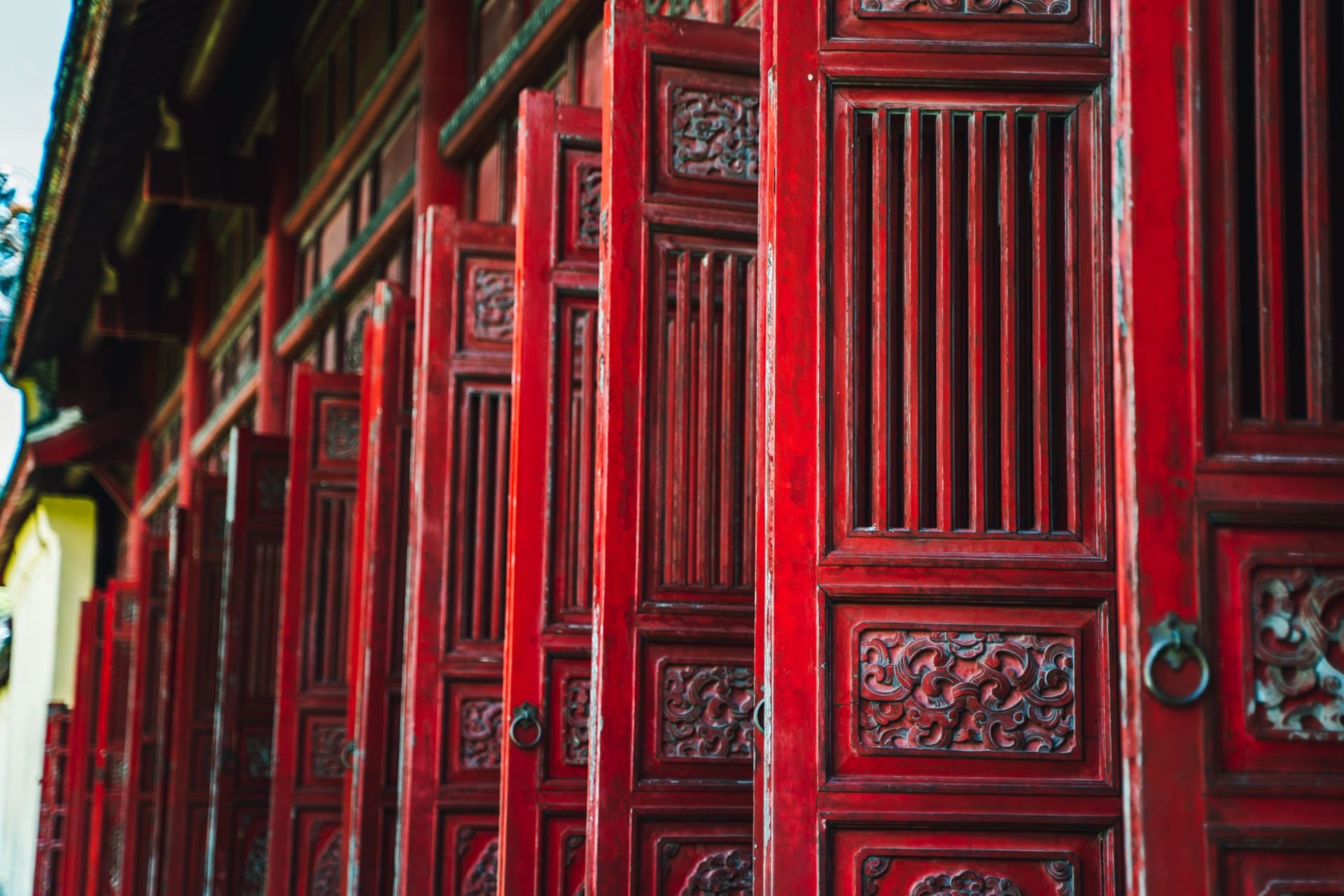
The Citadel, when I finally walked through its gates later that morning, was a thing of considered grandeur and visible decay. The Nguyễn dynasty built it in the early nineteenth century on the northern bank of the Perfume River, modeling it partly on Beijing’s Forbidden City but giving it a Vietnamese temperament — lower, more intimate, planted with frangipani and banyan trees whose roots are slowly prying apart the flagstones. The Forbidden Purple City at its heart was bombed into rubble during the 1968 Tết Offensive and much of it remains that way, fragments of carved stone and broken wall among overgrown courtyards. The emptiness is not a failure of restoration — it is the most honest thing about the place. Huế has been subjected to too much violence to pretend otherwise, and it doesn’t try.
The royal tombs scattered along the Perfume River, a fifteen-minute motorbike ride south of the city, are where Huế reveals its more layered character. Each emperor commissioned his own, and each is a distinct architectural argument. Minh Mạng’s is formal and symmetrical, laid out along a central axis of lakes and courtyards, radiating the self-assurance of a man who expected permanence. Tự Đức’s is more wistful — a garden pavilion over a lotus pond where the emperor reportedly came to write poetry, his reign disrupted by French encroachment and his funeral kept secret for months. I spent a whole afternoon moving between them by motorbike through pine forests, arriving into a different quality of silence at each one.

The city itself — the part that isn’t curated — rewards aimless wandering. Cross the Tràng Tiền Bridge to the south bank and you enter a neighbourhood of garden houses surrounded by walls draped in bougainvillea, where old mandarin families still live behind iron gates. The covered market at Đông Ba is enormous and completely unstageable: stalls selling rice crackers and dried shrimp beside bolts of fabric and stacks of incense, the noise and smell compressed under a vaulted roof. In the late afternoon, students come out on their bicycles, and the riverfront fills with the specific energy of a city that refuses to position itself as a relic, even while the Citadel watches from across the water with its moats still full and its gates still standing.
When to go: January through April is the optimal window — dry, warm without being punishing, and the light on the Perfume River in February carries a softness particular to this latitude. Huế gets hammered by rain from September through December, with serious flooding common in October and November. The summer months are intensely hot but the tombs are emptier, and they have a parched, austere quality that suits them.