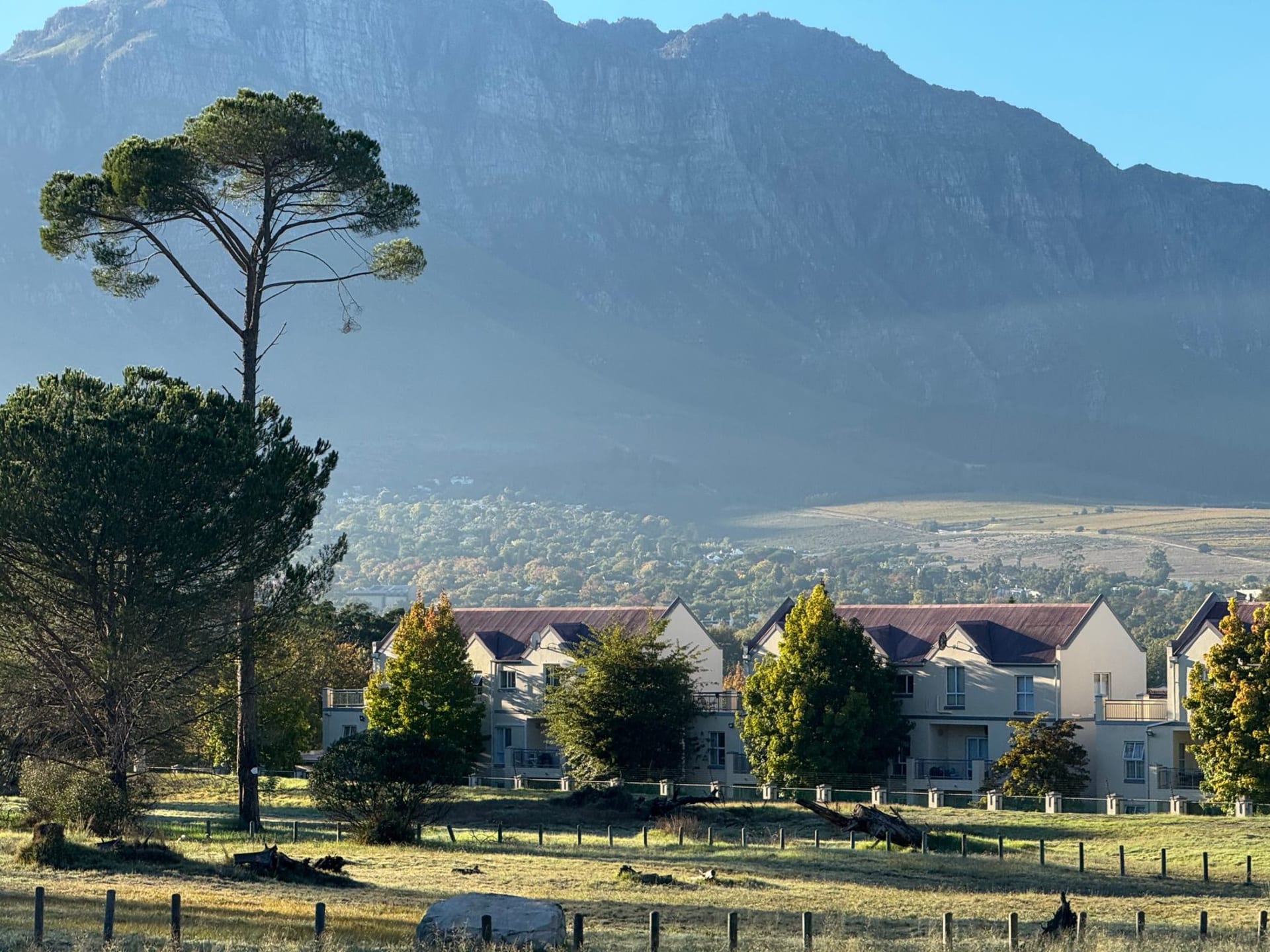
Stellenbosch
"You go for the wine. You stay because of the light through the oaks at five o'clock."
I arrived in Stellenbosch on a Sunday afternoon when the town was doing its quietest impression. The university crowd had thinned out, the tasting rooms along Dorp Street were closing early, and the only people moving with purpose were an old man cycling toward the farmers’ market and a pair of winemakers arguing in Afrikaans outside a cellar door. The oak trees that line almost every main street in town cast that particular green-filtered light — the kind that makes even parking lots look like they belong in a film. I found a bench outside the Braak, the old village green, and sat long enough to understand that Stellenbosch is one of those places where the architecture is doing work that the landscape started.
The white Cape Dutch gables — curved and symmetrical, almost theatrically formal — began appearing in the late seventeenth century when the Dutch East India Company needed a breadbasket, and the farmers who built those homesteads were under no illusions about their permanence. The buildings have that quality: they look like they intend to outlast whatever century they’re in. Dorp Street preserves the longest continuous stretch of pre-Victorian architecture in southern Africa, and walking its length on a quiet morning, past the whitewashed facades and teak shutters, feels more archaeological than touristic.

The wine, of course, is the reason most people come. The R44 wine route stretches south through the Helderberg toward Somerset West, passing estates whose Cabernets and Bordeaux blends can genuinely surprise you — not because South African wine is obscure, but because the best of it is still underpriced relative to what the French or Californians charge for the same quality. Vergelegen, Rust en Vrede, Meerlust — these names carry weight, and the cellars attached to them are unhurried, particular places where a pouring often comes with geological explanation. Which is exactly the right kind of conversation to be having with a glass of Merlot in your hand.
What I didn’t expect was how good the food had become. The restaurant scene in Stellenbosch is not as theatrical as Franschhoek, but it’s more honest. A long lunch at Overture in the Schaapenberg hills, looking out over vines and fynbos with plates of duck and seasonal vegetables arriving in a logical progression — this is cooking that takes its location seriously. The market at Oude Libertas on Friday mornings has charcuterie, cheese, and seasonal preserves from farms I couldn’t find on any map.

The students save the town from becoming a museum. Stellenbosch University is one of the oldest in South Africa, and during term time its presence keeps the coffee shops busy and the bookshops alive. There’s a particular energy in the evenings when the campus empties into De Wet Street — a low hum of people who have not yet decided whether to open another bottle or call it a night. It is the right kind of unresolved tension for a wine town.
When to go: February and March during harvest are the most atmospheric months — the estates are working at full tilt and the air smells faintly of fermentation for weeks. Spring (September–November) brings wildflowers to the mountain slopes and new vine growth. The Christmas school holidays bring crowds and prices up together; the first two weeks of January are best avoided entirely.