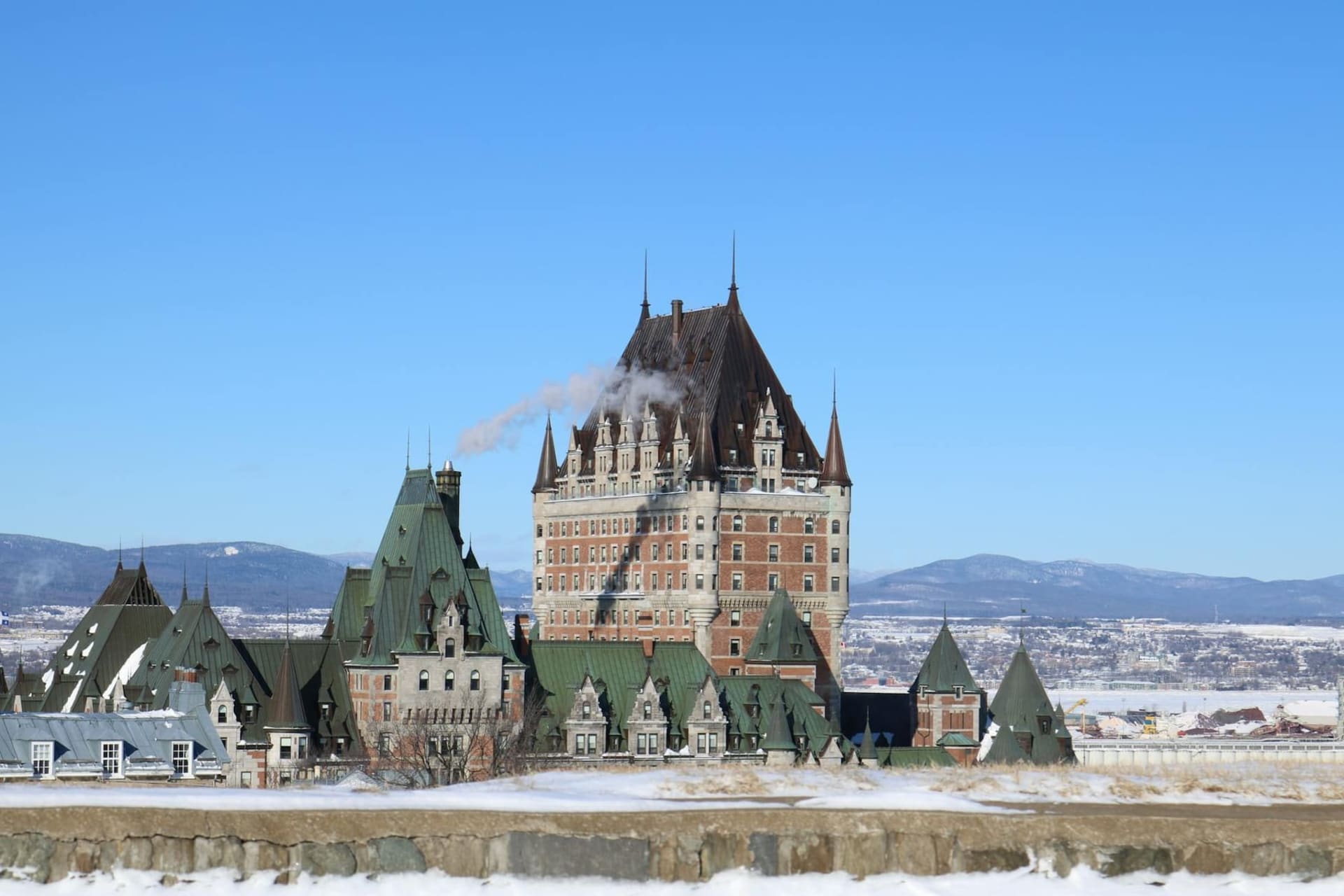
Quebec Winter
"Quebec transforms its coldest season into its most festive — Carnival is proof the cold can be won over."
Ice sculpture festivals, toboggan runs, and warming cabanes à sucre make Quebec a winter destination like no other.
I had always associated winter with something to be endured. Mexico had cured me of the reflex to brace. So when Lia booked flights to Quebec City in February — February, the cruelest month of the Canadian calendar — I thought she had briefly lost her mind. She had not. She had simply done her research.
The City That Invented the Winter Carnival
Rue Saint-Louis in the Upper Town is ankle-deep in packed snow that has been walked on so many times it has taken on the texture of old marble. The cold here is not the damp grey cold of Paris in November — it is dry and precise, a cold that clarifies rather than suffocates. At minus eighteen you feel the inside of your nose with every breath, and it is somehow not unpleasant.
The Carnaval de Québec runs for seventeen days in late January and February, and the city leans into it with a conviction that borders on theological. Bonhomme, the round white mascot with his red tuque and sash, appears on every corner. Ice sculptors from across the world work their chainsaw-and-chisel liturgy in the Parc de la Francophonie, and the results — a two-metre phoenix, a chess set with life-size pieces — glow blue-green under floodlights at night. I stood in front of an ice replica of the Château Frontenac for longer than I will admit, watching the steam rise off a stranger’s hot chocolate.
The Surprise on the Plains of Abraham
I had not expected the toboggan runs. The slides descend from the terrace behind the Château Frontenac down toward the St. Lawrence in a way that feels genuinely reckless — you lie flat on a four-person wooden sled and the city becomes a smear of lights and cold air and the screams of the person in front of you. Lia went twice. I went four times and lost a glove.
What I had also not expected was the quiet. By nine in the evening, after the slide queues emptied and the ice bars closed, the Plains of Abraham stretched out under a sky that was too clear and too vast for a city. The snow held the light from somewhere — the Château, the stars, I could not say which — and the silence was the specific silence of cold places, which is not quite silence at all but the absence of everything soft.
Cabane à Sucre and the Logic of Warmth
The cabane à sucre is the answer to winter that Quebec arrived at centuries ago: fill a wooden cabin with people, set iron pots of maple syrup to boil, and eat until the cold outside becomes theoretical. The one we visited outside the city served cipaille, tourtière, fèves au lard, and tire sur la neige — maple taffy poured hot onto a bed of snow and wound onto a stick before it hardens. It is the most straightforward form of pleasure I have encountered.
When to go: Late January through mid-February for Carnaval proper, when the ice sculptures are freshest and the slide runs are in full operation. The cold is severe but the city is built for it — dress in real layers and it becomes part of the experience rather than an obstacle to it.