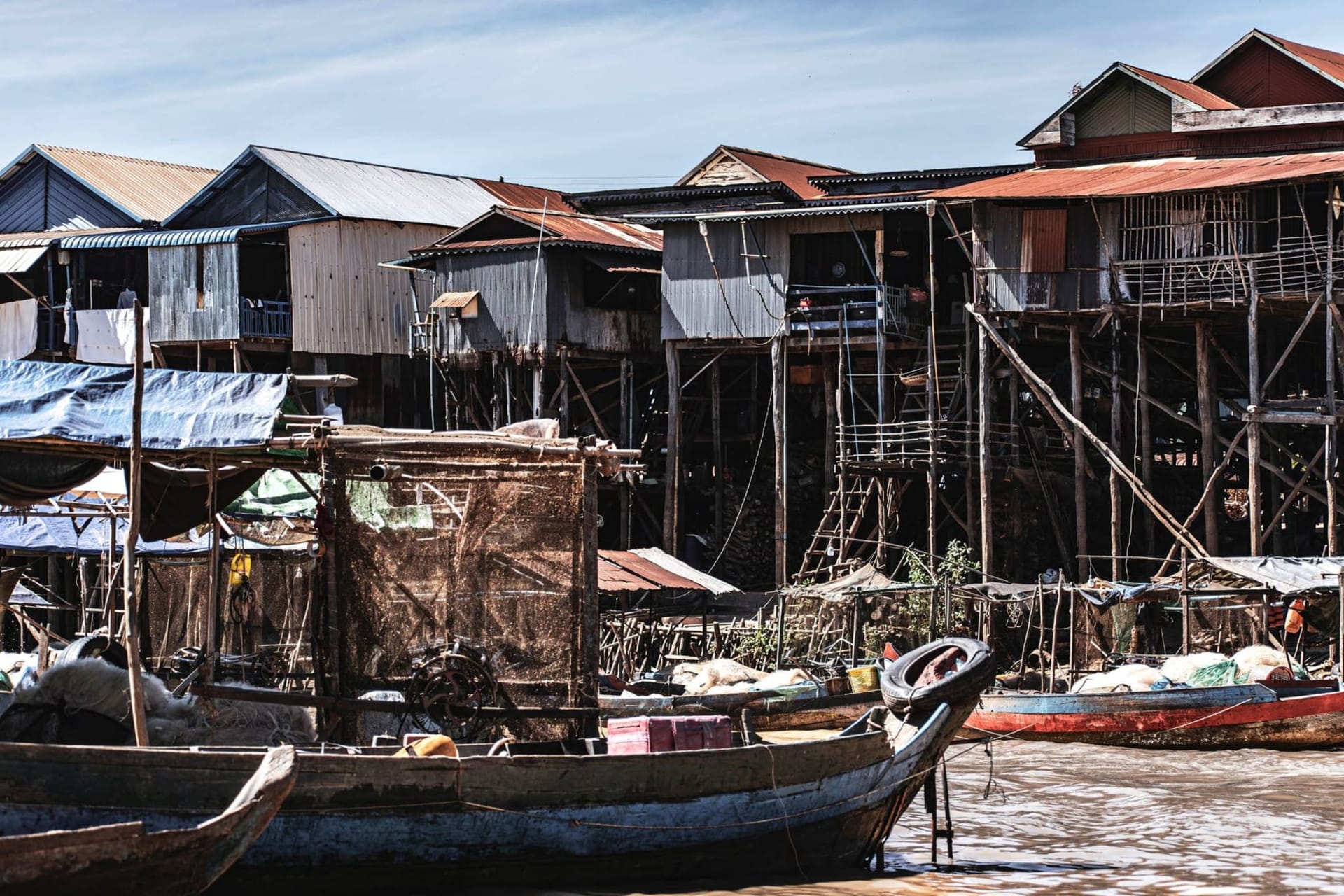
Siem Reap Villages
"Ten minutes by bicycle from Angkor, a farmer is planting rice and the temples might as well be a rumor."
Cycling out from the temple city into stilt-house villages where daily life happens at rice-paddy level.
The guesthouses on Sivutha Boulevard will rent you a bicycle for two dollars. Nobody tells you where to go. That is the point.
I rented two — one for me, one for Lia — and we headed north on National Road 6 before turning off onto a laterite track that crumbled at the edges and left our tires coated in red dust. Within ten minutes the souvenir stalls had vanished. Within fifteen, the temples had too. What remained was the flat, enormous countryside of Siem Reap province: paddy fields divided by narrow earthen bunds, the air smelling of water and woodsmoke and the particular green rot of vegetation doing what vegetation does in thirty-degree heat.
Life at Paddy Level
The villages north and west of town — Kdei Ruessei, Damdek, the clusters of houses along the road toward Angkor Thom’s north gate that never appear on any map — are built on stilts for a reason. Between June and October, the water comes up. The ground floor becomes the water floor. Pigs and chickens relocate to higher ground. Daily life migrates upward and continues more or less unchanged.
We arrived in the dry season, so the paddies were at their least dramatic: cracked mud, stubble, a few egrets picking through what was left. But the houses were still elevated, and underneath them was where everything happened. Men repaired engines in the shade. Women sorted dried fish on woven mats. A monk in saffron robes walked the bund between two fields with the unhurried confidence of someone who owns nothing and therefore has nothing to lose.
The Unexpected Kitchen
The discovery I didn’t expect was the roadside cooking. Not restaurants — just women with clay braziers set up beside their front steps, selling food to the village rather than to tourists. I stopped at one near the small pagoda at Wat Athvear and pointed at what looked like a banana leaf parcel. It was nem ansom — sticky rice packed with pork and banana blossom, steamed until the leaf had gone dark and fragrant. It cost five hundred riel. I ate it sitting on a low plastic stool while a child stared at me from behind a wooden post with the focused intensity only children manage.
Lia found the sugarcane press two houses further on. We stood there drinking cloudy green juice from plastic bags while a dog slept in the dust at our feet, indifferent to everything.
Getting the Distance Right
The villages are not a destination in the usual sense. There is nothing to see and therefore everything to notice. The light at six in the morning, when the mist is still low over the paddies and the roosters are competing with the monks’ chanting from the nearest wat, is the light I came to Cambodia for without knowing it.
When to go: November through February, when the rains have finished and the paddies are either freshly flooded or bright with new growth, and the heat is almost bearable before noon. Avoid April and May unless you cycle only at dawn.