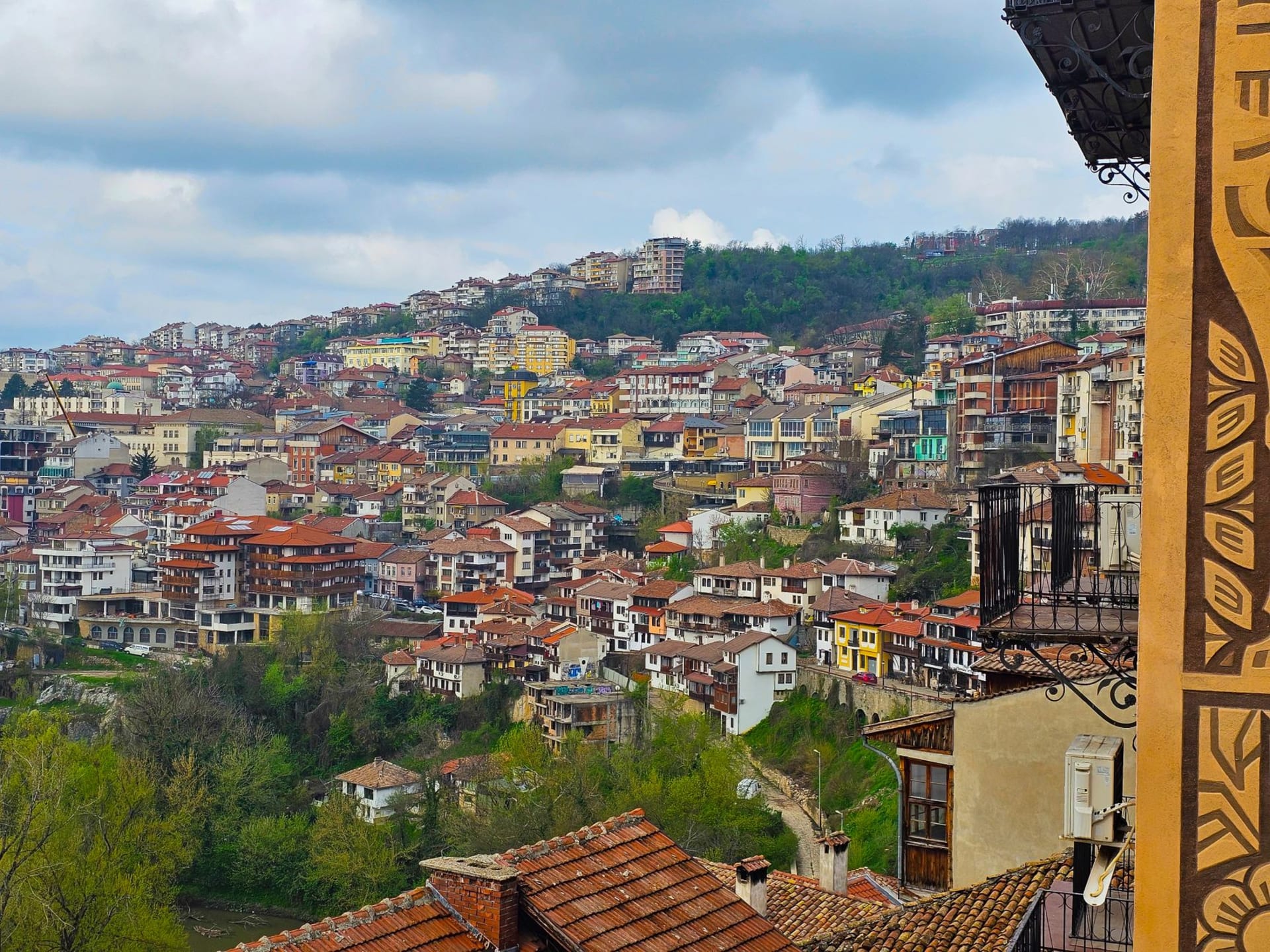
Veliko Tarnovo
"You round a corner and suddenly the whole medieval city is just there, perched on a rock above a river bend like something invented for a novel."
I came in from the south, on a bus from Plovdiv that dropped me at the bottom of a hill with no ceremony. Then I walked up into the old town and stopped. The Yantra River makes a near-complete loop here, and the hill it encircles holds Tsarevets — the fortress that anchored the Second Bulgarian Empire for nearly two centuries. From the right angle on the opposite ridge, the whole composition looks deliberately theatrical: walls following the cliff edge, a single tower standing at the summit, the river glinting far below. I stood there longer than I meant to.
The Fortress That Earns the Climb
Tsarevets is not a ruin you peer at through a fence. You walk straight into it and keep climbing — through the ruins of the medieval palace, past the restored Patriarchal Cathedral at the very top, where frescoes in deliberately crude Byzantine style cover every surface. Outside, the view in every direction is the kind that makes you rethink your relationship with altitude. The crows are constant company. They nest in the old towers and ride the thermals above the gorge with what looks like pure satisfaction.
The hill itself takes about an hour to explore properly. Go in the morning, before the tour groups arrive. The light comes in from the east at a low angle and turns the stone walls a warm amber that photographs can’t fully capture — though you’ll try anyway.
The Craftsmen’s Street and the Evenings
Below the fortress, Samovodska Charshia is the old craftsmen’s quarter — a row of workshops where woodcarvers, potters, and jewelers have been working in the same small storefronts since the National Revival period. It’s not a performance. The potter I watched was making something, not demonstrating for tourists. Lia bought a small piece of painted ceramics that survived the rest of the trip in her jacket pocket wrapped in a scarf.
Evenings in Veliko Tarnovo are genuinely pleasant. The restaurants along Gurko Street lean over the gorge on wooden terraces, and the local wine — mostly from the Danube Plain to the north — is serviceable and cheap. On certain nights, the fortress runs a sound and light show that projects colored light across the walls. It’s hokey and magnificent at the same time. We watched it from a terrace bar with a carafe between us, which is probably the ideal viewing arrangement.
Getting the Angles
The city has several viewpoints that reward the walk. The Asenova quarter across the river holds a cluster of medieval churches, small and unrestored, sitting in meadow grass with no interpretation panels. The Church of the Forty Martyrs has Cyrillic inscriptions that predate the standardization of the alphabet by centuries. The whole quarter feels unmanaged in the best way — like history that hasn’t been tidied up for visitors yet.
This is Bulgaria’s most historically dense city after Sofia, but it moves at a different pace. Students from the university fill the cafes. The old town is walkable. The views require almost no effort to find.
When to go: Late April through early June offers mild weather, spring wildflowers on the hillsides, and crowds that are present but not overwhelming. September is equally good — harvest light, warm evenings, and the summer tourists largely gone. Avoid July and August if you can; the heat in the gorge concentrates and the fortress becomes a pilgrimage in direct sun.