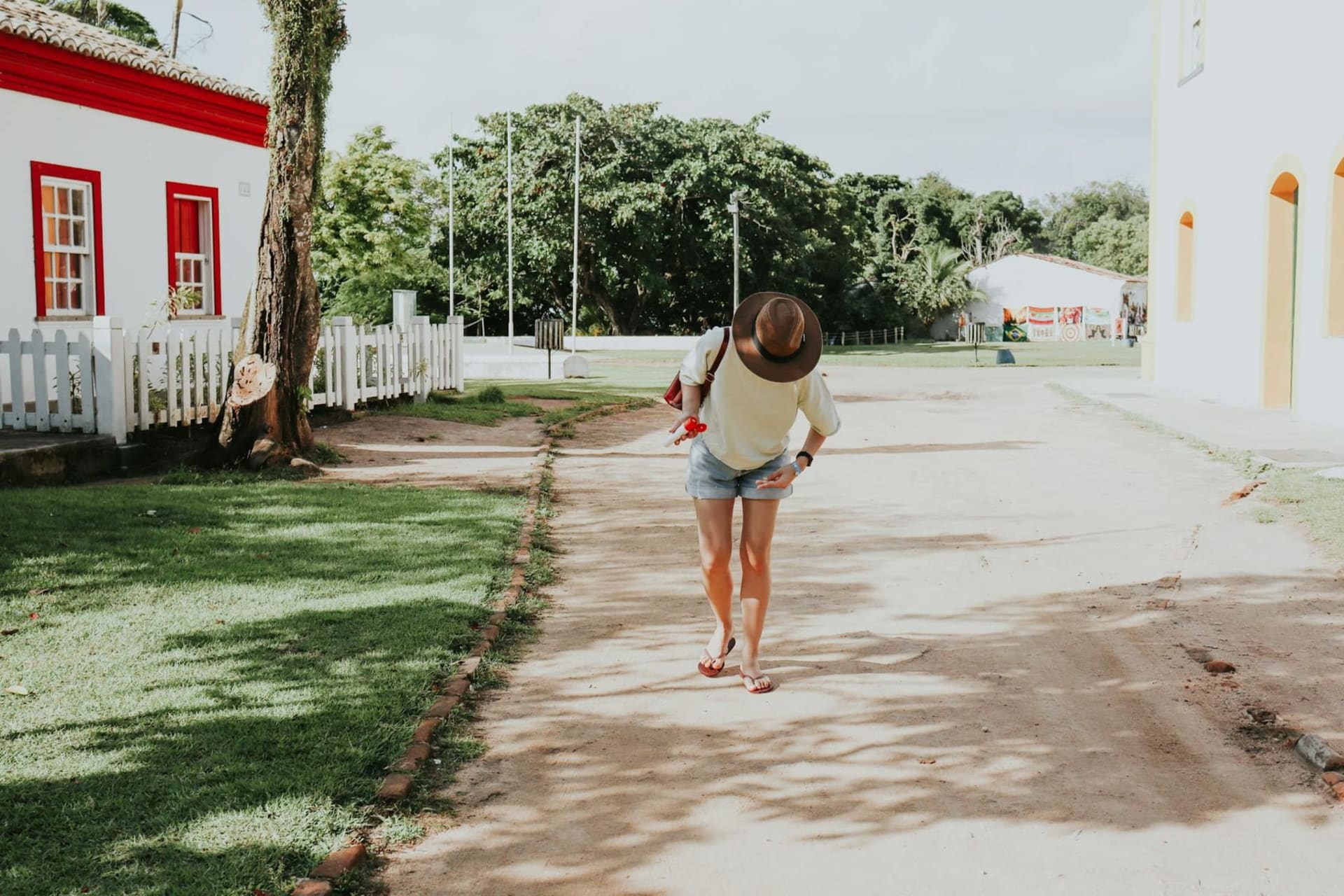
A Bahian village founded by Jesuits in 1586 around a grassy quadrado of colored beach houses above red-cliffed beaches.
There is a particular quality of afternoon light in southern Bahia that I had not encountered anywhere else in Brazil — amber and thick, the kind that turns the white church at the far end of the Quadrado into something almost molten. I arrived in Trancoso on a Tuesday in late November, stepping off a battered taxi from Porto Seguro into a silence I did not expect. No cars on the grass. No rush. Just a rectangle of vivid painted facades and the low murmur of someone strumming a viola caipira two porches away.
The Quadrado
The Jesuits laid out the Quadrado in 1586 as a kind of ordered counterpoint to the Atlantic wilderness pressing in from every side. They are long gone, and what remains is something more alive than anything doctrine could have built. The houses — cobalt blue, mango yellow, the green of a shallow reef — run along all four sides of a large lawn that the village simply calls “the square.” At the eastern end, Igreja de São João Batista sits in cheerful, whitewashed modesty, a church that looks more surprised to be there than anything else.
Lia sat at a table outside Capim Santo on the northern edge and ordered a moqueca de camarão that arrived in a clay pot still exhaling steam, smelling of dendê oil and coconut milk and the sea below the cliff. We ate slowly. It seemed the only appropriate pace.
The Cliffs and Praia dos Nativos
A short path drops from the Quadrado’s eastern rim down red laterite cliffs to the beaches below. The iron oxide in the rock gives everything an almost Martian blush in the low sun. Praia dos Nativos is the quietest of the beaches — a long curved sweep of pale sand with kiosks that have not changed their menus in fifteen years. I swam out further than I should have, let the Atlantic push me back toward shore, and floated for a while looking up at that red clay edge against blue sky. The unexpected thing: from the water, the village disappears entirely. There is only cliff and forest and the feeling of being somewhere genuinely remote, even though dinner and a cold Brahma are fifteen minutes’ walk away.
Finding the Slower Version
Trancoso draws the international set — there are boutique pousadas on Rua do Pontal that charge São Paulo prices and serve ceviche to people in linen. That layer is real and it is not why I was there. The version I preferred revealed itself early in the morning, before the restaurants opened, when old men played dominoes on the Quadrado benches and the smell of fresh tapioca drifted from a window on the western side. That Trancoso is still there, just underneath.
When to go: December through March is high season — warm, festive, and crowded. Arriving in late November or April catches the full heat and color with noticeably fewer people and more honest prices.