Hammershus
"Some ruins are evocative. Hammershus is something else — it sits on that headland the way power used to sit, not asking for your admiration."
I rode north from Hasle on a morning when the sky was undecided about itself — grey and white in alternating patches, the wind coming off the Baltic in irregular gusts that required small adjustments of direction to counter. The road climbs toward the northwestern tip of Bornholm through heathland that opens up the sky in all directions, and then, on a bend, the headland appears with the castle on it, and you feel immediately the specific quality of a building that was designed to be seen from a long way off. Hammershus is not a ruin that sneaks up on you. It announces itself from two kilometers.
The castle was built in the thirteenth century — construction began around 1255 under the Archbishop of Lund — on a granite outcrop that rises forty-two meters directly from the sea on three sides, leaving only the landward approach as a line of possible attack. It was Scandinavia’s largest medieval fortification, a bishops’ castle and later a royal stronghold, and it was inhabited and defended in one form or another for four centuries before being abandoned in 1743 and left to the elements. What makes Hammershus extraordinary is the scale of what remains — not a low foundation or a single standing wall but towers, gate buildings, cisterns, and curtain walls standing to their full or near-full height, all in Baltic granite that has taken on a colour somewhere between honey and ash in the particular light of the northwest coast.

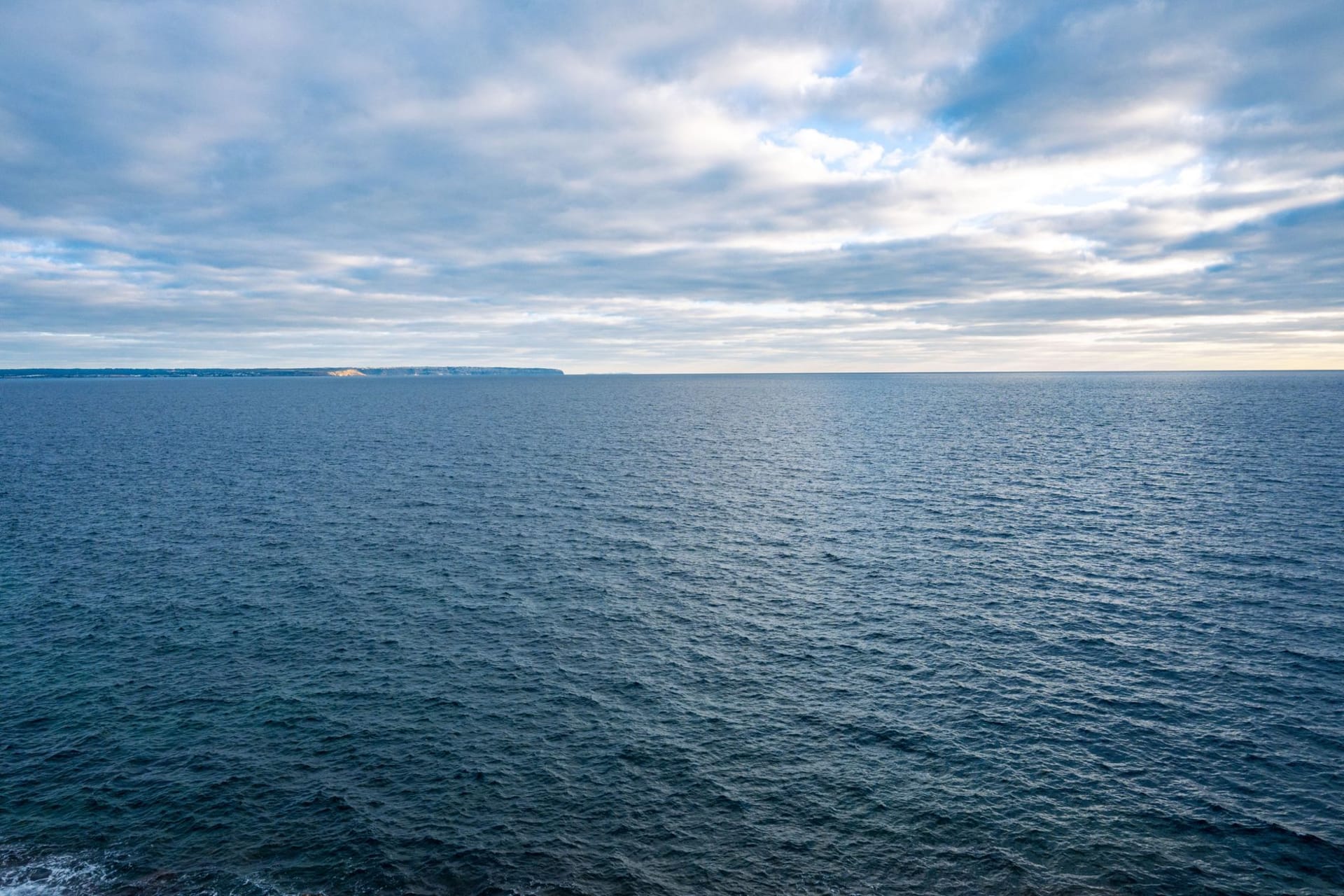
The walk through the castle takes an hour if you are moving deliberately and two if you are stopping to understand what you are looking at. The inner ward, the square tower called Manteltårnet, the eastern round tower with its arrow loops — each element adds to the accumulative impression of a place that was built by people who understood that permanence required not just stone but the right stone in the right place. The granite here is the island’s own, quarried from outcroppings nearby, and it gives the castle a sense of having grown from the headland rather than being placed on it. From the highest standing point you can see Sweden on clear days, and on the day I was there, a grey Tuesday in June, you could see the rain sweeping across the Øresund in columns, one system finishing as another began, and the Baltic between them steel-grey and entirely serious.
The visitor center at the base of the headland is tasteful and well-considered — Denmark is good at this — with an exhibition on the castle’s history that contextualizes it within the geopolitical complexity of medieval Scandinavian power without oversimplifying. There is a café that serves open sandwiches and good coffee. But the castle itself requires no interpretation once you are inside it. The ruin explains itself in the weight and scale of its stones.

The heathland surrounding Hammershus — Hammeren, the northernmost tip of Bornholm — is a distinct landscape from the rest of the island: low scrub of heather and juniper and wind-bent birch covering granite outcroppings that run to the edge of the sea in a series of small cliffs. In late summer the heather turns purple and the landscape becomes something entirely itself, bearing no resemblance to the cherry-orchard and fishing-harbor Bornholm of the tourist imagination. Walking here in the evening after the day visitors have left the castle, you can feel the weight of the granite under your boots and hear the sea working at the base of the headland in a sound that has probably not changed since the thirteenth century.
When to go: The castle is accessible year-round and free to enter. Summer brings the most visitors but the headland is large enough to absorb them. I would choose late May or September — the light in the north of the island in those months is extraordinary, and the castle at dawn or dusk, when the angle of light picks out the texture of the granite, rewards any inconvenient timing it requires.