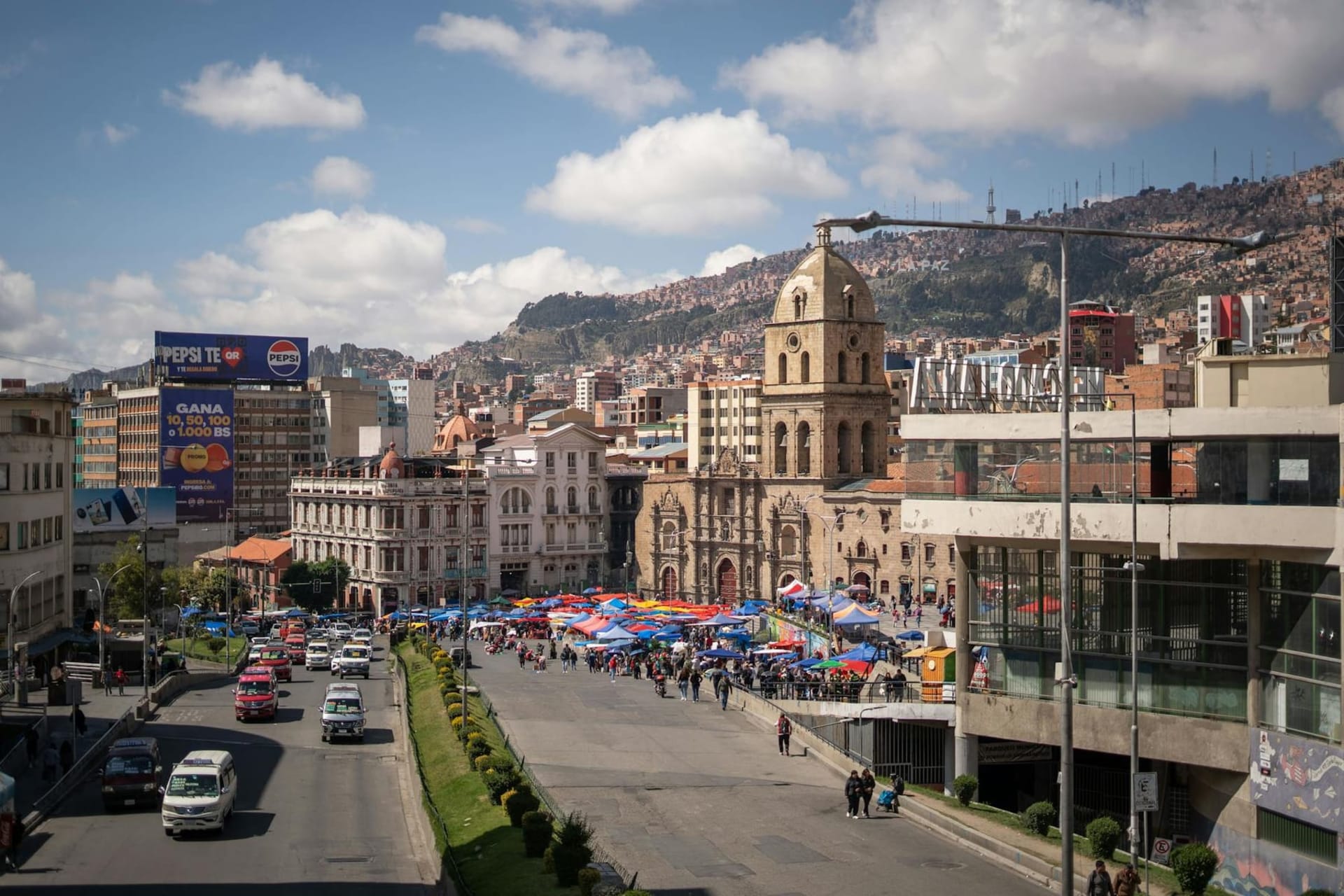
Bolivia's white city of whitewashed colonial architecture and Bolivia's most approachable, student-filled capital.
There is a particular quality of light at four thousand meters that has no equivalent I know of. In Sucre, it arrives in the late morning at a low angle, strikes every wall on the Plaza 25 de Mayo, and turns the whole square into something just short of blinding — a white so absolute it feels like an argument. I stood there with my sunglasses doing almost nothing and understood, within the first hour, why they call this place La Ciudad Blanca.
A City That Knows What It Is
Sucre was the colonial administrative center before La Paz swallowed the political machinery, and it kept that identity intact — not as nostalgia, but as architecture. The facades along Calle Nicolás Ortiz and around the Plaza de Armas are not restored; they have simply been maintained with a religious consistency. The law here requires exterior walls to be whitewashed, and the result is a city with a uniform skin that still somehow manages to feel lived in. Laundry hangs above doorways painted that exact white. A pharmacy shares a colonial courtyard with a chicharronería. The Catedral Metropolitana stands at one end of the plaza not as a relic but as a fixture — students cut through its shadow on the way to the Universidad San Francisco Xavier, one of the oldest universities in the Americas, and nobody looks up.
Salteñas at Seven in the Morning
Lia found the salteña stall on our second day, tucked into the market corridor off Calle Ravelo before the main hall opens. Salteñas in Sucre are different from those in La Paz — the dough is slightly sweeter, the filling wetter, and eating one without spilling the broth is a skill the locals acquire in childhood and tourists never quite master. We ate standing up, dripping, watching a man in a pressed shirt manage the whole thing without a single drop on his tie. I ordered a second one and accepted defeat.
The surprise came later that same morning: the Museo Textil Etnográfico on Calle España, which I had walked past twice assuming it was closed, turned out to contain the finest collection of Jalq’a and Tarabuco weavings I have ever seen anywhere. Not the cleaned-up souvenir versions — the ceremonial pieces, with their black grounds and animal figures that seem to move as the light shifts. I spent two hours in there while Lia photographed doorways outside. The museum is chronically underfunded and perpetually empty, which is either a shame or a gift depending on how you feel about having a masterpiece to yourself.
The Slow Hours
By three in the afternoon, the plazas empty and the light flattens. The city enters a quiet that feels deliberate rather than drowsy. This is when I walked up to the Recoleta neighborhood, past the white convent and the lookout terrace, and looked down at the city spreading below — all those white rooftops catching the sun like a field of salt.
When to go: April through October is the dry season, when the sky over Sucre is that impossible shade of Andean blue and the whitewashed walls do their best work. May and June offer the clearest days with temperatures mild enough to walk for hours without thinking about it.