Paro
"The descent into Paro is the first message Bhutan sends you: nothing ordinary will happen here."
The approach into Paro is not like other landings. The aircraft banks so sharply through the mountain corridor that you can see pine needles through the porthole at what feels like arm’s reach, and the runway appears below you only at the last possible moment — a strip of tarmac in a valley floor that seems barely wide enough for the purpose. I had read about it beforehand, knew it was coming, and still my hands tightened on the armrests. The pilot executed it as casually as parking a car. Only a handful of certified pilots in the world can fly this approach, and that fact tells you something essential about Bhutan before you’ve even collected your bag: the country operates on different terms than the one you just left.
Paro town itself is modest — a single commercial street of painted timber facades, shops selling butter lamps and dried yak cheese, a few restaurants serving ema datshi in steel bowls. What the town lacks in scale it compensates with unhurriedness. I walked the main street the morning after I arrived and nobody was trying to sell me anything. A monk in burgundy robes was reading a phone screen with the focused attention of a man checking cricket scores. An old woman strung prayer flags across an alley while a dog slept below her ladder.

The Rinpung Dzong — the fortress-monastery that commands the valley from a low hill above the river — is the kind of building that makes you recalibrate your sense of what architecture can do. It is simultaneously military and sacred, massive and graceful, four or five centuries old and immaculately maintained. I crossed the wooden cantilever bridge below it just as a group of monks finished their morning prayers, their chanting dissolving into the sound of the Paro Chhu river. Inside the dzong’s central courtyard, butter lamps burned in rows inside an open shrine room, and the smell of juniper smoke was so thick it felt like weather. On the hill directly above, the Ta Dzong — a former watchtower, now the National Museum — holds painted scroll thangkas and ceremonial armour that look like they belong in a dream about medieval Asia.
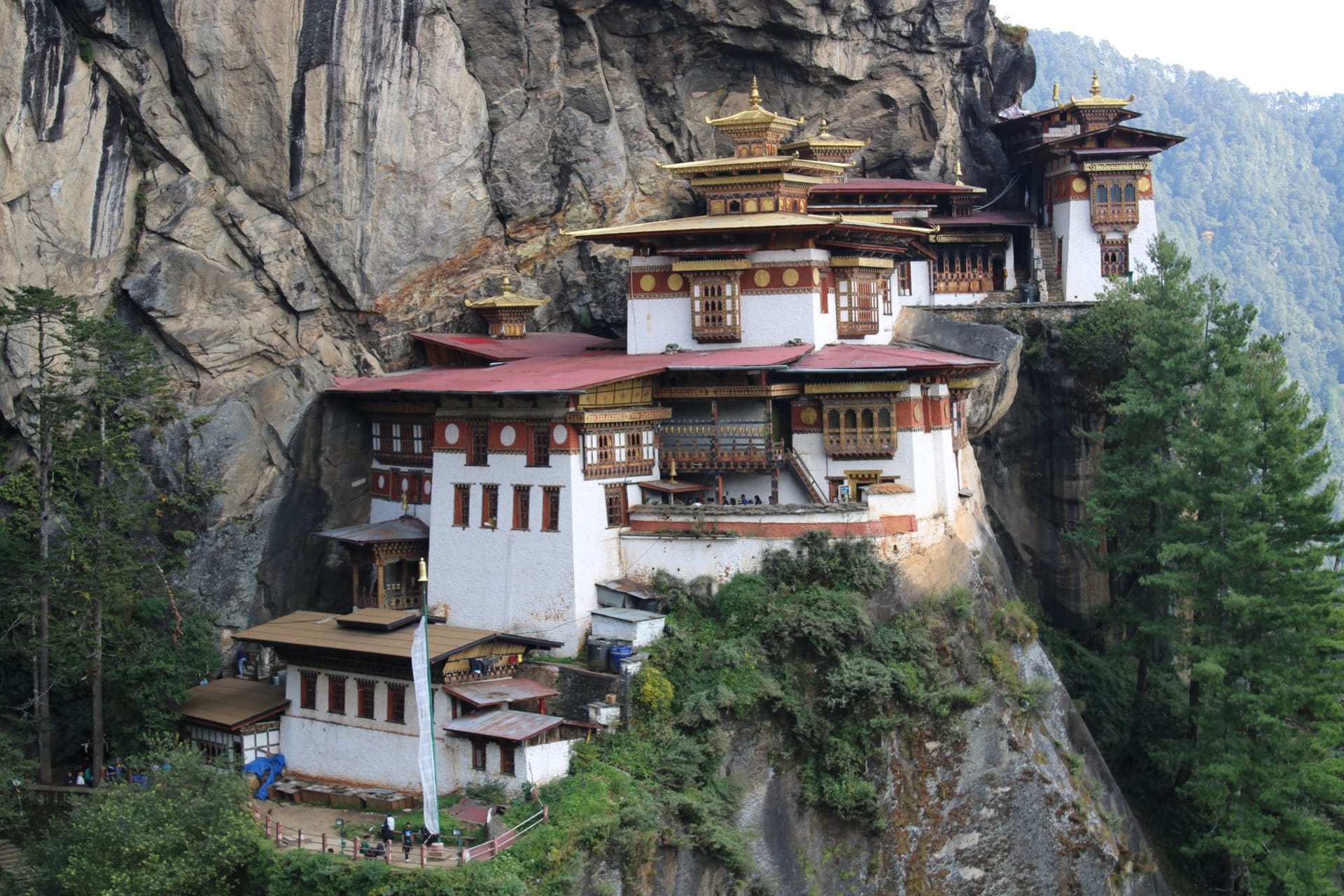
Taktsang Monastery, the Tiger’s Nest, requires its own morning. I set out before five in the near-dark, when the trail through the rhododendron forest was lit only by my headlamp and the faint blue of the pre-dawn sky. The gompa appears once from a viewpoint about halfway up — a cluster of white and ochre buildings cemented into a sheer cliff nine hundred metres above the valley floor, connected by wooden walkways and accessible only by a staircase cut into the rock. When I finally stood inside its innermost prayer hall, the monks were already chanting. Butter lamps flickered in dozens of niches. The floor was warm wood underfoot and the cave at the heart of the complex — where Guru Rinpoche is said to have meditated — was barely large enough for three people. The Tiger’s Nest does not need your presence to justify its existence. That is exactly what makes it extraordinary.

Kyichu Lhakhang, in the valley below, is quieter and older — one of the 108 temples said to have been built in a single day by the Tibetan king Songtsen Gampo in the seventh century to pin down a giant demoness obstructing the spread of Buddhism across the Himalayas. You enter through a courtyard of prayer wheels and orange marigold offerings. The interior is dim and thick with incense. A caretaker monk appeared, gestured that I could sit, and left me alone with the butter lamps for half an hour. Outside, a pear orchard ran behind the temple wall, the fruit still hard and green in October.
When to go: The Paro Tsechu festival in spring — usually March or April — draws mask dancers into the dzong courtyard and is worth building a trip around. October and November give clear mountain air and reliable views of the Himalayan peaks from the Chele La pass above town. Avoid July and August when the monsoon soaks the trails and shrouds the mountains.