Seminyak
"Seminyak taught me that a sunset can be both commercial and sincere — the sky doesn't care who's watching."
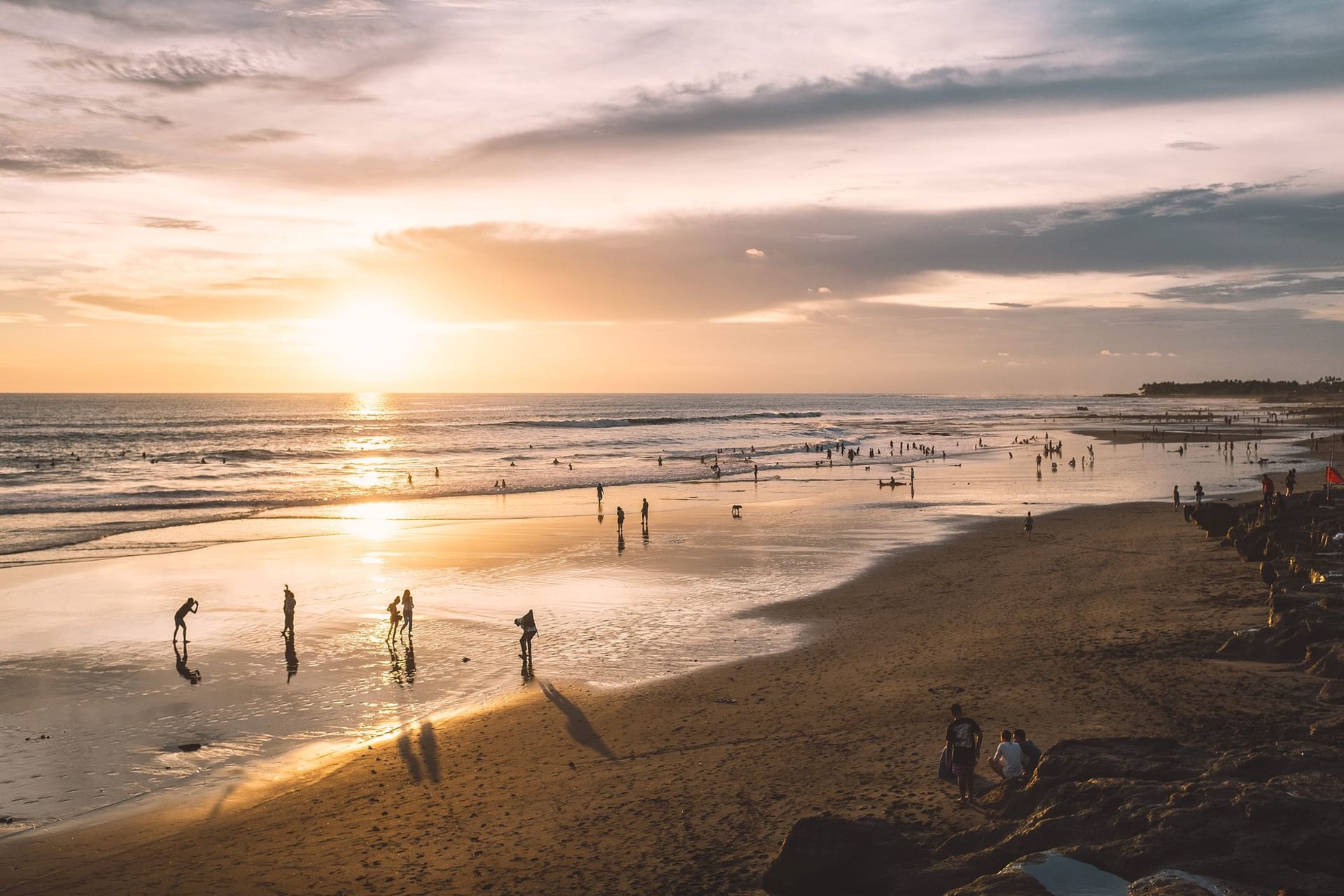
I arrived in Seminyak suspicious of it. My notes from previous travellers described it as Kuta with better taste, which is a low bar, and the approach on the main road — a corridor of villas with branded signage and beach club entry arches — did nothing to improve my confidence. Then I turned down one of the narrow gang lanes that lead to the beach and walked out onto the sand just as the sun reached the horizon, and the sky did the thing it does over the Indian Ocean in those last twenty minutes of light, and every doubt dissolved in about thirty seconds. Some places earn their reputation the hard way. Seminyak earns it every evening, reliably, without effort.
The beach here runs long and relatively uncrowded compared to Kuta to the south. The sand is pale grey rather than white, the surf strong enough to be beautiful and too powerful for casual swimming without knowing what you are doing. In the early morning before the beach clubs set up their loungers, Balinese families walk the waterline, women carry offerings toward the sea, and the fishermen who still use this coast pull their boats in through the break with practiced violence, the hull hitting the sand hard while the engine cuts. By ten AM the same stretch will be lined with sunbeds and Bintang umbrellas, but those first two hours belong to something older.

The food in Seminyak is genuinely sophisticated without being pretentious about it, which is harder to achieve than it sounds. Merah Putih, a restaurant housed in a soaring bamboo and glass pavilion just off Jalan Petitenget, presented a tasting menu of Indonesian dishes reimagined with French technique — a beef rendang deconstructed into its component flavours, a clear prawn broth with depth that took a long time to achieve. It was the kind of meal that makes you rethink what regional cuisine can do when it takes itself seriously. I ate there twice, which I rarely do anywhere.
The streets behind the beach — Jalan Kayu Aya, Jalan Oberoi, the network of lanes threading between them — hold an interesting ecology of shops. Locally designed resort wear sits next to established Indonesian fashion labels, galleries showing contemporary Balinese painters next to antique dealers with colonial-era furniture piled against the walls. I bought nothing and wanted everything. The shopping is unhurried in a way that feels genuinely Balinese even when the prices are clearly not.

The beach clubs at sunset are a spectacle worth attending at least once, with the self-awareness that you are attending a spectacle. Ku De Ta and Potato Head and the newer entries along the waterfront each have their own version of the same ritual: cocktails, music calibrated to the hour, the crowd collectively orienting toward the west. There is something simultaneously manufactured and genuinely moving about three hundred people going quiet as the sun drops below the horizon. The sky earns the attention it gets.
When to go: Seminyak’s dry season runs April through October, with the southwest breeze keeping evenings cool and the beach at its most photogenic. July and August are the peak of the peak — beach clubs at capacity, restaurants booked solid, villa prices at their highest. May and September hit the same weather with noticeably fewer people. The wet season brings occasional dramatic storm light over the ocean that makes the beach beautiful in a different way.