Uluru
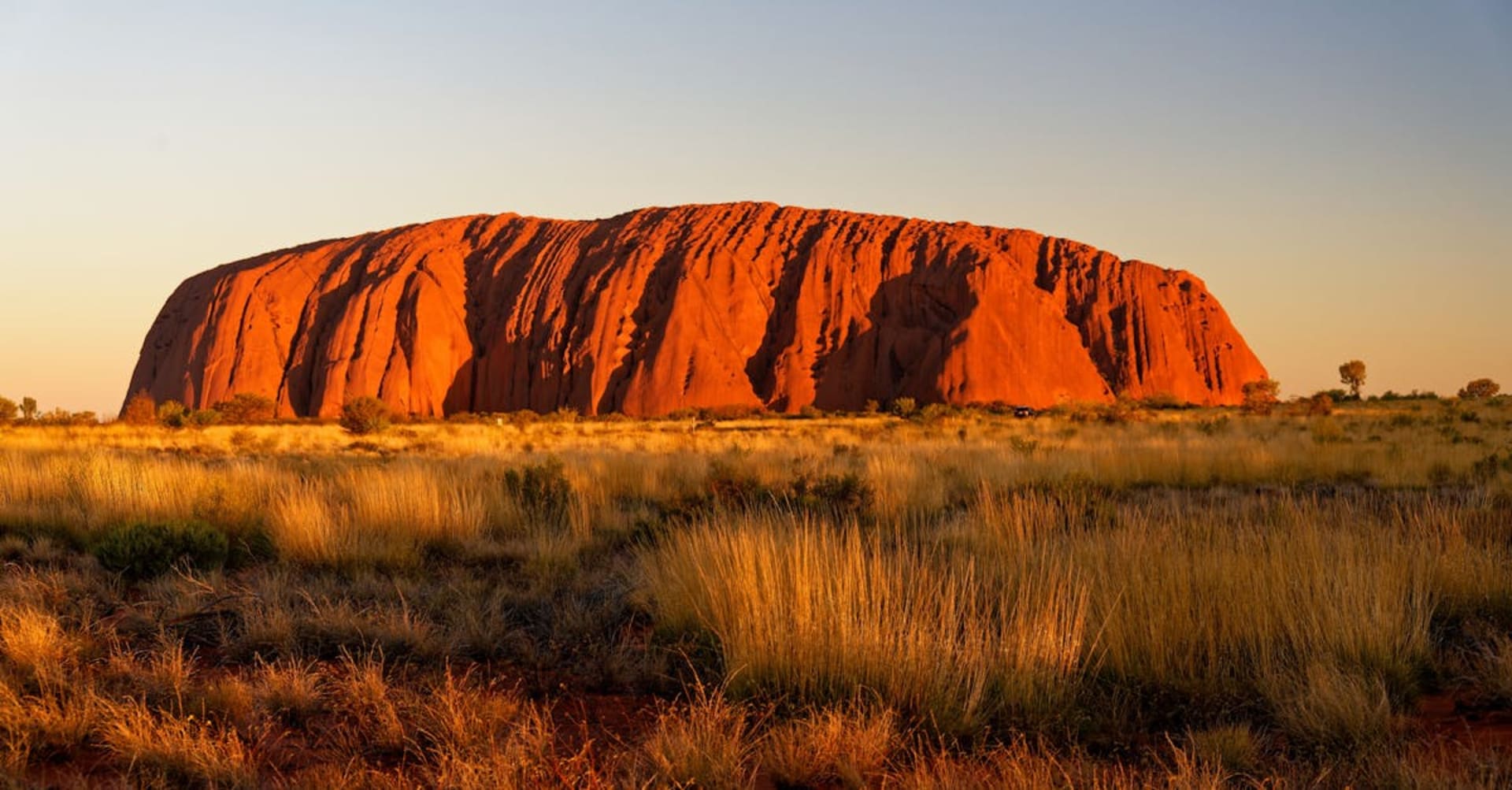
"Uluru at sunset is not a single colour. It is every colour red has ever been, delivered in sequence."
Uluru rises from the flat red earth of central Australia with a presence that resists easy description. It is 348 metres tall and nearly ten kilometres in circumference, an arkose sandstone monolith that has stood here for an estimated 550 million years, but none of those numbers capture the experience of seeing it. The rock does not so much dominate the landscape as anchor it — a fixed point in a terrain so vast and horizontal that the eye has nowhere else to rest. The desert around it is not empty but spare: spinifex grass, desert oaks, the occasional raptor riding a thermal. And in the centre of all that flatness, Uluru sits with the gravity of something that has always been there and intends to remain.
For the Anangu people, the traditional custodians of this land, Uluru is not a geological curiosity or a tourist attraction. It is a living cultural landscape, inseparable from the Tjukurpa — the complex system of law, knowledge, and belief that governs Anangu life and connects the present to the ancestral creation period. The rock’s caves, waterholes, and surface markings each carry specific stories that have been transmitted across hundreds of generations. Some of these stories are shared with visitors at the Cultural Centre near the base; others are sacred and not for outside knowledge. The decision to permanently close the climb in 2019 was an act of cultural sovereignty that the Anangu had sought for decades, and the site is richer for it — the base walk, which circles the entire monolith, offers a far deeper encounter than any ascent ever could.
That base walk — ten kilometres of flat, well-maintained trail — reveals a rock that is anything but uniform. The surface is textured with ridges, hollows, overhangs, and water-streaked channels that catch the rain and direct it into pools where desert life congregates. Caves at the base hold rock art that dates back thousands of years. The scale shifts constantly: from a distance, Uluru appears smooth and monolithic; up close, the sandstone grain becomes visible, and the surface undulates with folds and crevices that suggest the rock is still in the process of becoming itself.
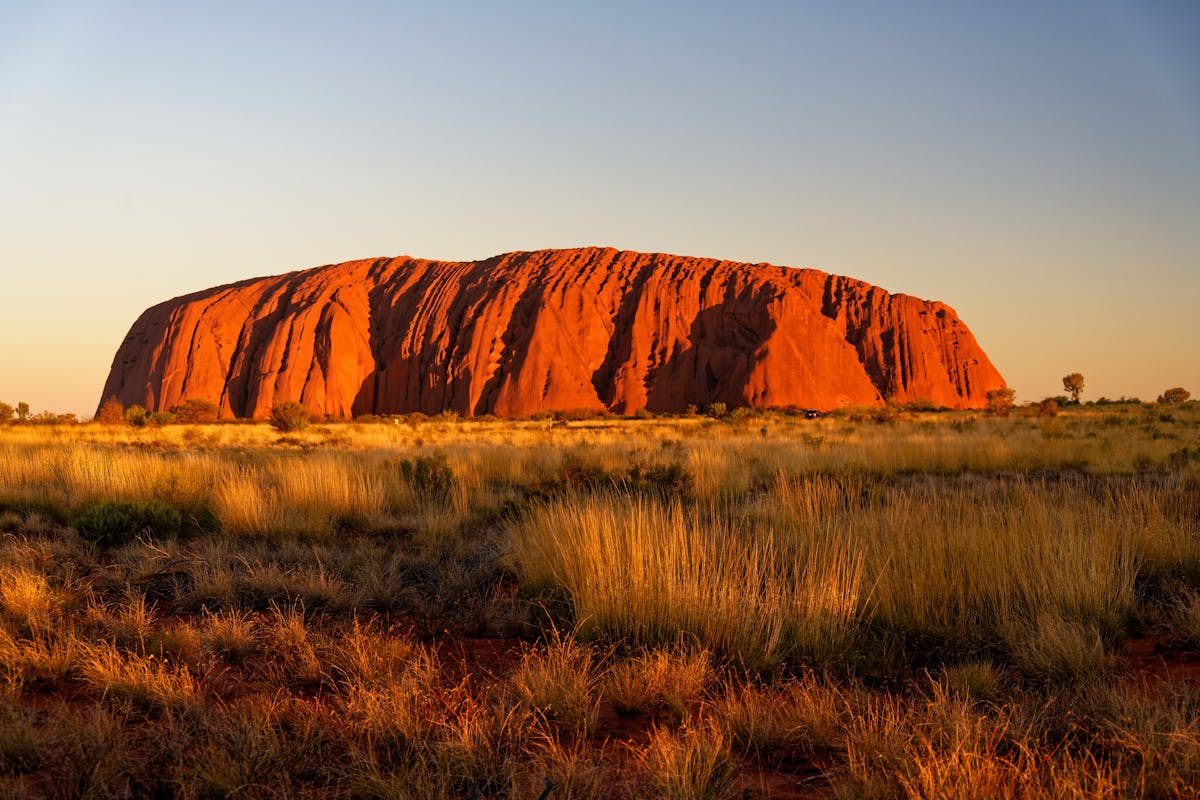
The colours are the thing that photographs cannot hold. At midday, Uluru is a burnt orange, solid and unremarkable in the overhead sun. But as the afternoon deepens, the transformation begins. The rock moves through shades of ochre, rust, and terracotta before entering, at sunset, a sequence of reds so intense and varied — crimson, scarlet, vermillion, a deep wine-dark hue at the very end — that the gathered viewers tend to fall silent, as though speech would be an intrusion. Sunrise reverses the palette, beginning in cool violets and greys and warming into gold. The desert sky, unobstructed by trees or buildings, amplifies everything — the colours are not just on the rock but in the air around it.
Twenty-five kilometres to the west, Kata Tjuta — a cluster of thirty-six domed rock formations — offers a different but equally compelling landscape. The Valley of the Winds walk threads between the domes through narrow passages where the air funnels and cools, and the walls rise high enough to block the sky. Where Uluru is singular and monumental, Kata Tjuta is multiple and intimate, its rounded forms suggesting a gathering rather than a solitary statement. Many visitors find it the more moving of the two sites.
After dark, the desert becomes a theatre for stars. The absence of light pollution is near-total, and the Milky Way appears not as a faint band but as a dense, three-dimensional river of light that stretches from horizon to horizon. The Southern Cross hangs low and bright. Bruce Munro’s Field of Light installation — 50,000 slender stems topped with frosted glass spheres, planted across the desert floor — adds an earthbound echo to the celestial display, glowing in slowly shifting colours that turn the ground into a field of quiet fire.
And then there is the silence. The Red Centre is one of the quietest inhabited places on Earth, and at Uluru the silence has a quality that is not merely the absence of noise but the presence of something older and more deliberate. It is the kind of silence that makes you aware of your own breathing, your own heartbeat, and the vast indifference of geological time.
When to go: May through September brings mild desert days in the low twenties and cold, clear nights ideal for stargazing. Sunrise and sunset are the essential experiences — arrive at viewing areas early as they draw crowds. Summer (December through February) is punishing, with temperatures regularly exceeding 40 degrees Celsius, and some walks close in extreme heat. The Field of Light operates year-round but is most striking in the winter months when darkness falls early. Climbing Uluru is permanently closed — the base walk and sunset viewing are the way to experience the rock respectfully.