
Tasmania
"An island where the wilderness is the main character and the food is the plot twist nobody expected."
Tasmania sits two hundred kilometres off the southeastern tip of the Australian mainland, separated by the rough waters of Bass Strait and connected to the rest of the country by a one-hour flight that feels, upon landing, like it has delivered you to an entirely different nation. Nearly half the island is protected as national parks and reserves — a proportion unmatched by any Australian state — and the result is a landscape where wilderness is not a feature but the dominant condition. Ancient rainforests, alpine plateaus, deserted coastlines, and rivers that run dark with tannin through valleys where the trees have never been cut — Tasmania is Australia at its most primordial.
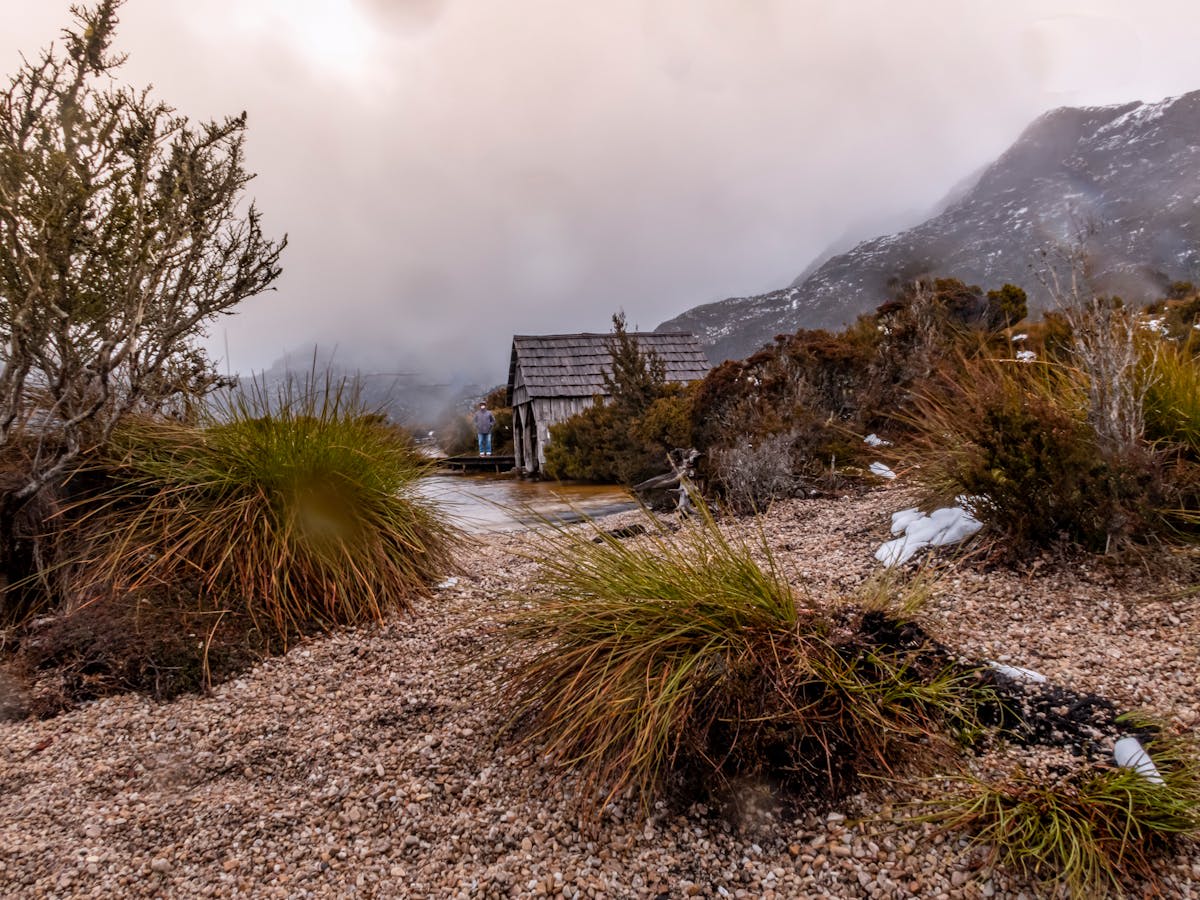
Cradle Mountain, in the island’s northwest, is the emblematic image: a jagged dolerite peak reflected in the still waters of Dove Lake, surrounded by ancient pencil pines that grow at a rate measured in millimetres per year and button grass moorlands that turn gold in autumn. The Dove Lake circuit walk traces the shoreline in a loop that takes roughly two hours and offers the mountain from every angle — brooding under cloud, sharp against blue sky, mirrored in water so still it seems painted. This is also the northern terminus of the Overland Track, Tasmania’s most celebrated multi-day walk, a sixty-five-kilometre traverse through alpine heath, rainforest, and eucalyptus forest to Lake St Clair in the south. The track takes six days and passes through country that feels genuinely remote — no roads, no mobile signal, just the trail and the weather and the ancient landscape unfolding around each bend.
In the south, Hobart anchors the island with a waterfront that manages to be both working port and cultural precinct. The Salamanca Market fills the sandstone warehouses along the harbour every Saturday morning with stalls selling local cheeses, smoked meats, wild honey, handmade ceramics, and the kind of sourdough bread that people queue for in weather that would keep mainlanders indoors. The waterfront stretches along Sullivan’s Cove, where fishing boats unload alongside restaurants serving the morning’s catch, and the mountain — kunanyi/Mount Wellington — rises behind the city to 1,271 metres, its summit often dusted with snow while the harbour below sits in sunshine.
MONA — the Museum of Old and New Art — is built into a cliff face on the banks of the Derwent River and accessed by ferry from the city centre. It is, by design, confrontational: a subterranean labyrinth of art that ranges from ancient Egyptian mummies to contemporary installations exploring death, sex, and the nature of consciousness. The experience is disorienting, occasionally uncomfortable, and entirely unlike any other museum in the country. Its owner, the professional gambler David Walsh, has called it a “subversive adult Disneyland,” which is about as accurate a description as any.
The east coast holds Tasmania’s most celebrated coastal scenery. Freycinet National Park contains Wineglass Bay, a crescent of white sand cupped between pink granite headlands that regularly appears on lists of the world’s most beautiful beaches — and, for once, the accolades are earned. The lookout walk to the saddle above the bay is steep but brief, and the view from the top is the kind that stops conversation. Further north, the Bay of Fires stretches for nearly thirty kilometres — a succession of white sand beaches punctuated by boulders covered in the orange lichen that gives the bay its name, set against water so clear and blue it seems tropical until you wade in and the Southern Ocean temperature corrects that impression.
Off the southeast coast, Bruny Island is reached by a short ferry from Kettering and offers a concentrated version of the Tasmanian experience: a narrow isthmus connecting a pastoral north to a wild, forested south where the coastline drops into sea cliffs and the air smells of kelp and eucalyptus. The oysters from the island’s farms are among the finest in Australia, pulled from the cold, clean waters of the D’Entrecasteaux Channel and eaten on the spot.
The produce, in fact, is Tasmania’s quiet triumph. Cool-climate wines from the Tamar Valley and Coal River, cheeses aged in cellars that rival anything in Europe, Atlantic salmon from the west coast, wasabi grown in the island’s north, truffles harvested from dedicated orchards — the quality is extraordinary for a place with a population smaller than most mainland suburbs. The food scene in Hobart has evolved rapidly from charming to genuinely world-class, with restaurants sourcing almost everything from within the island and menus that change with the season because they have no other choice.
When to go: December through February for the warmest weather and the longest days, with daylight stretching past nine in the evening. March is harvest season — ideal for food and wine, with quieter parks and golden light. The Overland Track is open from October through May and requires booking during the regulated season. Winter is cold but brings Hobart’s Dark Mofo festival in June, a midwinter celebration of art, music, and feasting that has become one of Australia’s most distinctive cultural events. MONA is open year-round and best visited on a weekday to avoid crowds.