Kangaroo Island
"Sea lions sleeping on the beach, koalas in every other tree, and not a fence in sight."
Kangaroo Island sits thirteen kilometres off the South Australian coast, separated by the rough waters of Backstairs Passage, and that narrow stretch of sea has made all the difference. The island’s isolation has preserved a density of wildlife that the mainland lost long ago — no foxes, no rabbits, and a landscape where the animals carry themselves with the particular confidence of creatures that have never learned to be afraid.
The drive from the ferry terminal at Penneshaw moves through rolling farmland and eucalyptus woodland where koalas sit in the forks of trees with a stillness that makes them easy to mistake for part of the branch. They are everywhere on Kangaroo Island, unhurried and abundant in a way that wildlife parks on the mainland attempt to replicate but cannot. Kangaroos graze the roadside verges at dusk. Echidnas waddle across gravel tracks with the methodical determination of animals that have been doing this for fifty million years. Tammar wallabies appear in the headlights at night, and glossy black cockatoos — rare on the mainland — feed in the she-oaks with an unhurried deliberateness.
At Seal Bay, a boardwalk and guided beach walk lead directly among a colony of Australian sea lions. There are no barriers, no glass enclosures — just sand, surf, and sea lions hauled out on the beach in various states of rest, nursing, and play. The pups are curious and unafraid. The bulls are enormous and largely indifferent to human presence. The sound is the ocean and the occasional territorial bark, and the proximity is startling.
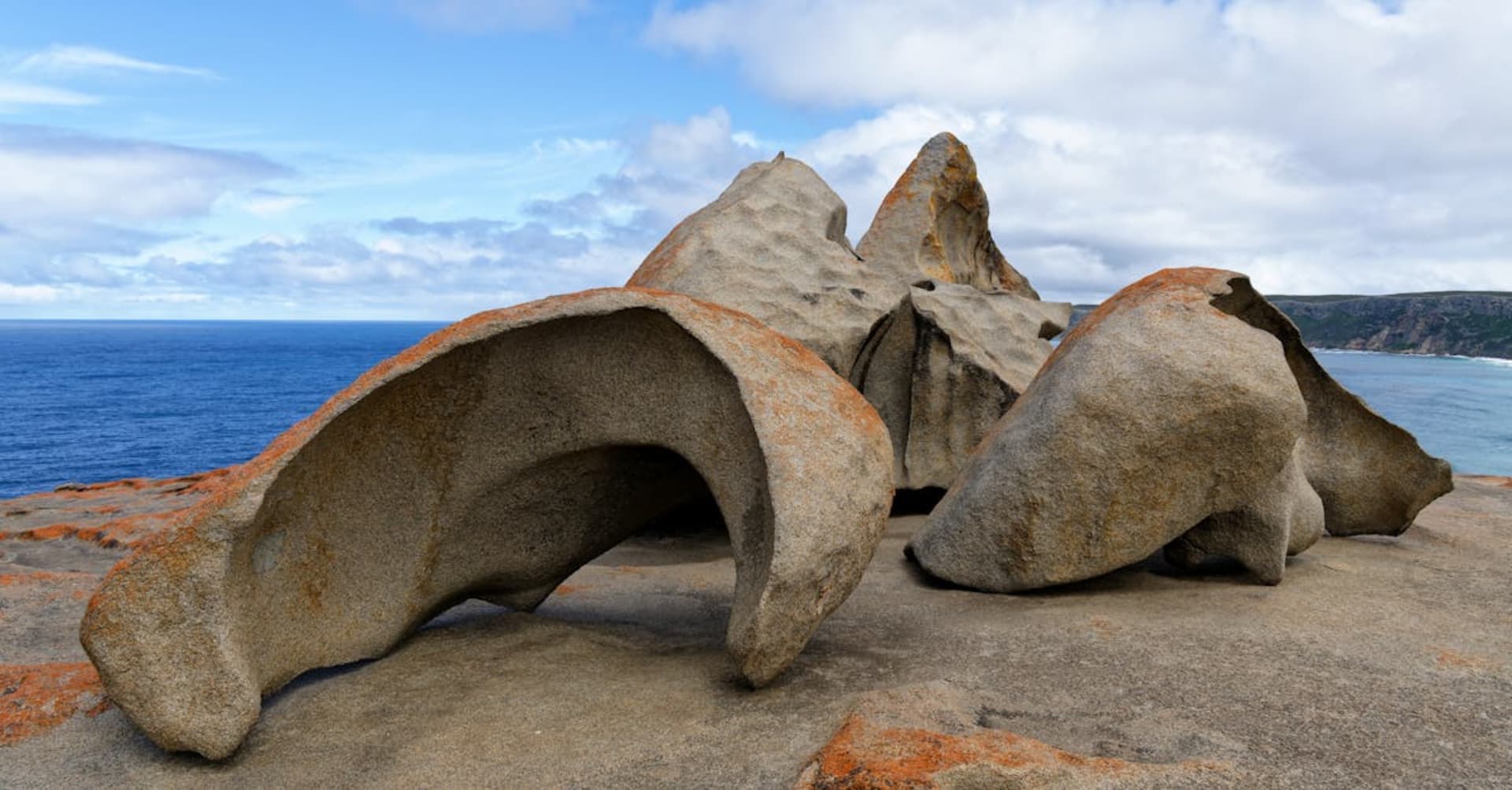
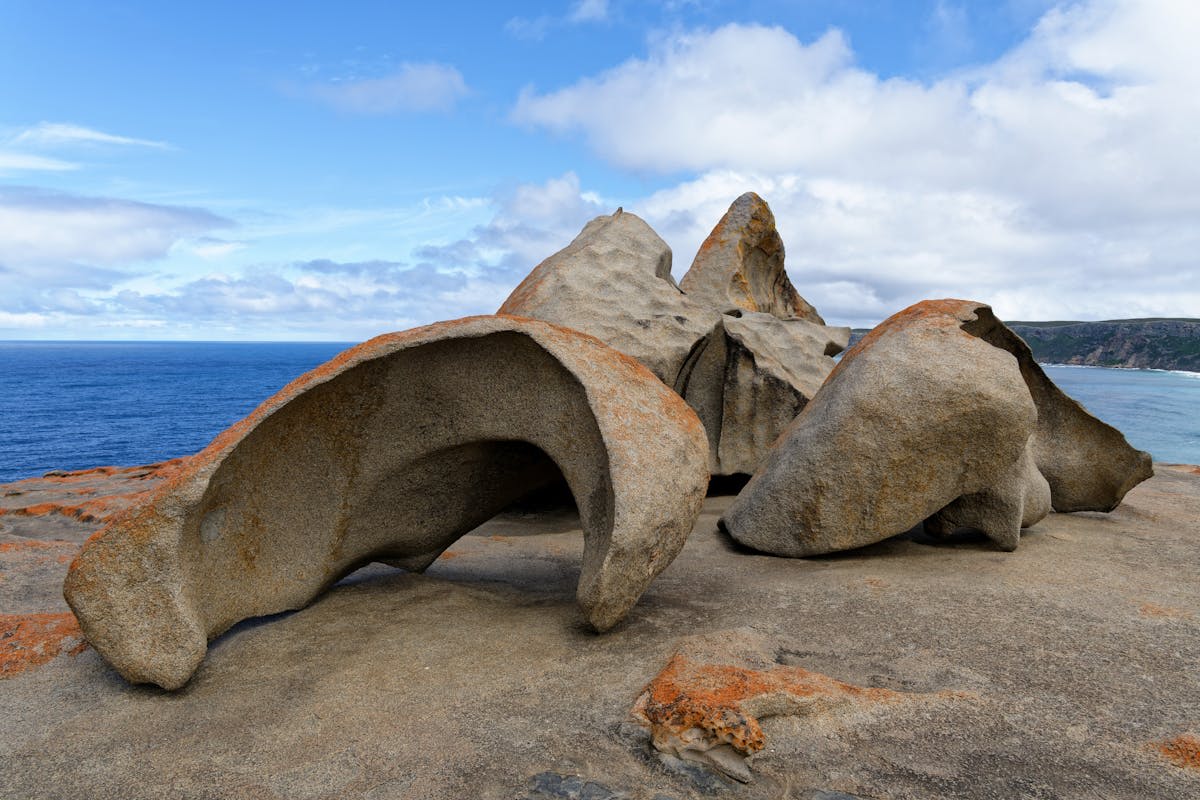
The western end of the island belongs to Flinders Chase National Park, where the landscape takes on a sculptural quality that feels almost arranged. The Remarkable Rocks are the centrepiece — a cluster of enormous granite boulders balanced on a smooth dome of coastal granite, carved by 500 million years of wind, rain, and salt spray into shapes that are simultaneously organic and alien. The orange lichen that coats their surfaces glows against the grey of the Southern Ocean behind them, and the scale shifts depending on where a person stands. From a distance they look like a Henry Moore sculpture. Up close, they are a weathered cathedral.
Nearby, Admirals Arch forms a natural rock bridge over a platform where New Zealand fur seals haul out in the spray. The arch itself is hung with stalactites, and the seals play in the churning water below with a reckless energy that makes the sea lions at Seal Bay look positively dignified. The Southern Ocean throws itself against this coast with an unobstructed force — the next landmass to the south is Antarctica — and the resulting geology is all cliffs, blowholes, and twisted rock.
King George Beach, hidden at the base of steep cliffs on the south coast, is often described as one of Australia’s most beautiful beaches, and the description holds. The sand is white, the water is turquoise and violent, and the surrounding cliffs create a natural amphitheatre that catches the afternoon light in ways that change by the minute. Stokes Bay, on the north coast, requires a scramble through a narrow rock passage to reach its sheltered cove — a natural swimming pool protected from the open ocean and ringed by smooth boulders.
The island produces with a specificity that reflects its isolation. Ligurian bees, brought here in the 1880s and kept pure by the island’s quarantine, produce a honey that is prized by apiarists worldwide. The Kangaroo Island gin distillery uses native botanicals foraged from the island’s bushland. Local sheep’s milk cheese, free-range eggs, marron from freshwater dams, and olive oil from groves that benefit from the maritime climate all appear on restaurant menus and at farmgate stalls. Eating on Kangaroo Island is eating the island itself.
The 2019-2020 bushfires burned roughly half of Kangaroo Island, devastating wildlife populations and destroying sections of Flinders Chase. The recovery has been remarkable. The bush has regenerated with the vigour that Australian flora reserves for exactly these circumstances — epicormic growth bursting from blackened trunks, ground cover returning in waves of green. Wildlife populations have rebuilt. Flinders Chase has reopened. The island carries its scars visibly, but it carries its recovery visibly too, and the combination gives the landscape a quality of persistence that is hard to witness without being moved by it.
The pace on Kangaroo Island is the pace of a place with 5,000 permanent residents and 155 kilometres of length. Roads are quiet. Towns are small. The light in the late afternoon turns the eucalyptus a silver-gold that photographers wait hours for. It is not a place that demands urgency, and it rewards those who match its rhythm.
When to go: September through November brings spring wildflowers, penguin breeding season, and mild weather. December through February is warmest, ideal for swimming at Stokes Bay and the north coast beaches. March through May offers harvest season, autumn colour, and thinning crowds. Winter (June through August) brings whale watching from the south coast and dramatic seas. The island is a year-round destination, but spring and autumn strike the best balance of weather, wildlife, and solitude.