Kakadu
"Art that is 20,000 years old on a rock face overlooking a landscape that has barely changed — time collapsed."
Kakadu is not a park in any domesticated sense of the word. It is nearly 20,000 square kilometres of floodplain, sandstone escarpment, tidal flat, monsoon forest, and savanna woodland — an area roughly the size of Slovenia — and it contains one of the longest continuous records of human habitation on Earth. The Bininj/Mungguy people have lived here for at least 65,000 years, and the evidence of that occupation is written across the rock shelters and cliff faces in one of the greatest outdoor art galleries ever created.
At Ubirr, the rock art spans millennia. The oldest paintings, rendered in red ochre, date back perhaps 20,000 years. Successive generations painted over and alongside earlier work, creating a layered visual history that moves from early hand stencils through depictions of thylacines — animals extinct on the mainland for thousands of years — to the extraordinary X-ray art style that shows the skeletal and organ structures of fish, turtles, and kangaroos. Contact-era paintings depict European sailing ships and figures with hands in pockets, recording the arrival of a world that would change everything. The Ubirr lookout, reached by a short scramble over sandstone, opens onto the Nadab floodplain at sunset — a vast expanse of wetland, paperbark forest, and distant escarpment that turns gold, then copper, then deep violet as the light fades.
Nourlangie Rock, known to the Bininj people as Burrunggui, offers another immersion in rock art within a different landscape setting. The paintings here include depictions of Namondjok, a dangerous spirit, and Namarrgon, the Lightning Man, whose image has become one of Kakadu’s most recognisable symbols. The art is sheltered beneath overhanging rock, in galleries that served as living spaces during the wet season monsoons, and the sense of continuity — people sheltering, painting, telling stories in the same place for thousands of years — is quietly overwhelming.
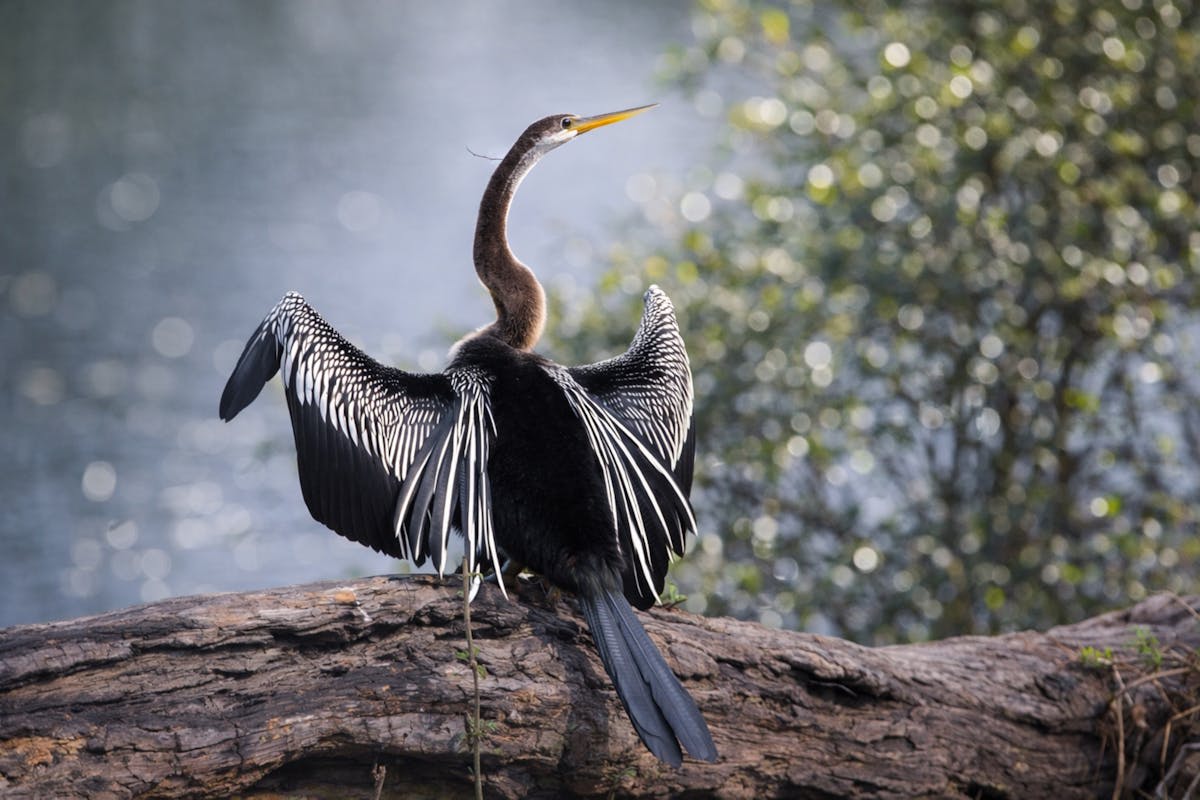
The wetlands are Kakadu’s other great spectacle. A Yellow Water cruise at dawn is one of Australia’s finest wildlife experiences. The billabong is covered in lotus lilies, and as the light comes up, the water reveals its inhabitants — saltwater crocodiles lying motionless at the surface, jabiru storks stalking the shallows on improbable legs, magpie geese in vast flocks, whistling ducks, azure kingfishers, and white-bellied sea eagles hunting from the skeletal branches of drowned trees. In the dry season, as the floodwaters recede, animals concentrate around the shrinking billabongs in extraordinary density, and the birdlife becomes almost absurdly abundant. Kakadu is home to more than 280 bird species — roughly one-third of all Australian bird species in a single park.
The crocodiles deserve particular mention. Both saltwater and freshwater crocodiles inhabit Kakadu’s waterways, and the saltwater variety — the largest living reptile — commands a primal respect. They bask on riverbanks, glide through lily-covered billabongs, and occasionally remind visitors, via warning signs and ranger briefings, that this is their territory, managed on their terms.
Jim Jim Falls is Kakadu at its most dramatic. Accessible only during the dry season via a corrugated 4WD track followed by a boulder scramble through monsoon vine forest, the falls drop more than 200 metres over the Arnhem Land escarpment into a dark plunge pool ringed by orange sandstone cliffs. In the early dry season, when the falls still carry wet-season water, the sight is thundering. By late dry, the falls may be reduced to a trickle, but the pool and the amphitheatre of rock remain magnificent. Nearby Twin Falls requires a swim through a narrow gorge with a flotation device — a passage that feels both adventurous and earned.
The difference between wet and dry season in Kakadu is not subtle. The wet, from November through April, transforms the landscape with monsoonal storms of extraordinary power — waterfalls multiply, floodplains become inland seas, and many roads close entirely. The dry, from May through October, brings clear skies, accessible tracks, and the slow concentration of wildlife around remaining water. Both seasons have their own grandeur, but they are essentially different parks.
What stays, beyond any single image or encounter, is the scale — of the landscape, of the time represented, of the living culture that has maintained its connection to this country through ice ages and monsoons and the full sweep of human history. Kakadu does not offer easy consumption. It demands effort, time, and a willingness to sit with the weight of what it holds.
When to go: May through October is the dry season — roads are open, wildlife concentrates around billabongs, and conditions are ideal for hiking and cruises. June through August is peak season; book ahead. November through April brings the wet — spectacular electrical storms, powerful waterfalls, and flooded roads that close access to major sites. Jim Jim Falls is best visited in May and June when water levels are high but the track is passable. The shoulder months of May and October offer a balance of access and fewer crowds.