Daintree
"A 180-million-year-old forest that ends at the beach — two World Heritage sites touching at the waterline."
The numbers alone are staggering. One hundred and eighty million years. The Daintree Rainforest has been growing, dying, regenerating, and evolving since the Jurassic period, tens of millions of years before the Amazon began to form. It is the oldest continuously surviving tropical rainforest on the planet, a living archive of evolutionary history where primitive flowering plants first emerged and where species exist that are found nowhere else on Earth. The canopy here is not merely dense — it is layered, stratified, a vertical world of epiphytes, ferns, fan palms, and strangler figs that filter the light into something green and aqueous and ancient.
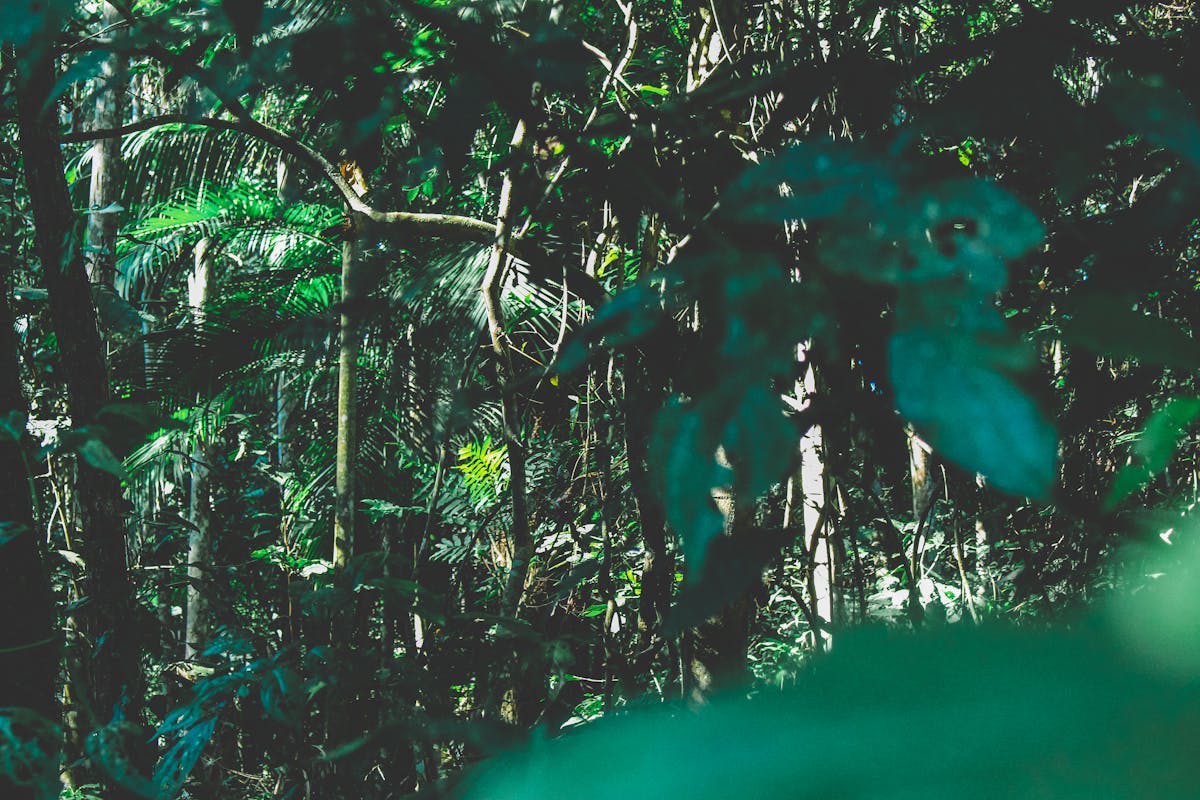
The crossing into Daintree country begins at the river. The cable ferry carries vehicles across the tea-coloured water where saltwater crocodiles patrol with a patience that predates most of the forest’s current residents. On the far side, the road narrows and the canopy closes overhead, and the world shifts into something older and wilder than anything the coastal highway suggested was possible.
Mossman Gorge is where many first encounter the forest at close range. The river runs clear over granite boulders, the water cold enough to shock, and the surrounding rainforest presses in from every side. The Kuku Yalanji people, the traditional custodians of this country, offer guided Dreamtime walks through the gorge — an experience that reframes the forest entirely. What appears to a visitor as undifferentiated green reveals itself through Indigenous knowledge as a pharmacy, a supermarket, a spiritual landscape. Bark used for medicine, leaves that serve as natural insect repellent, stories embedded in the shape of the land. The Kuku Yalanji have lived in continuous relationship with this forest for tens of thousands of years, and their guided walks offer a depth of understanding that no interpretive sign can replicate.
Further north, the road pushes toward Cape Tribulation, where the forest does something remarkable — it walks directly into the sea. Two World Heritage sites, the Daintree and the Great Barrier Reef, meet at the waterline. The beach at Cape Trib is golden sand backed by coconut palms and rainforest, the water warm and turquoise, and the whole scene carries a wildness that more manicured tropical destinations cannot touch. Signs warn of crocodiles and marine stingers, which is the Daintree’s way of reminding visitors that beauty and danger have never been mutually exclusive in this part of the world.
The wildlife here operates on its own terms. The southern cassowary — a large, flightless bird with a cobalt-blue neck, a bony casque atop its head, and a reputation for occasional aggression — moves through the forest like a relic from another era, which it essentially is. Cassowaries are critical seed dispersers for the rainforest, and encountering one on a forest track is an experience that falls somewhere between wonder and wariness. Boyd’s forest dragons sit motionless on tree trunks, their camouflage so effective they are nearly invisible until pointed out. At night, the forest transforms again — green tree pythons coil on branches, insects of improbable size move through the leaf litter, and the sound of the canopy shifts from birdsong to the chorus of frogs and the rustle of nocturnal hunters.
The rivers that drain the Daintree into the Coral Sea are crocodile country in the truest sense. Saltwater crocodiles, some exceeding five metres in length, inhabit these waterways year-round. Boat cruises on the Daintree River offer sightings that range from juvenile crocs basking on mudbanks to the unsettling sight of a large adult sliding silently from the bank into opaque water. The mangrove-lined riverbanks also shelter kingfishers, herons, and the occasional tree snake draped across an overhanging branch.
What makes the Daintree extraordinary is not any single element but the accumulation — the age, the biodiversity, the collision of reef and rainforest, the living Indigenous culture, the sense that this landscape has been doing exactly what it is doing for longer than the human mind can comfortably comprehend. It is a place that makes the rest of the world feel young.
When to go: May through September is the dry season — lower humidity, no marine stingers, and all roads accessible. This is the most comfortable time to visit. The wet season from November through April brings torrential rain, occasional road closures, and high humidity, but the forest is at its most vivid and the waterfalls are thundering. Cassowary sightings happen year-round. Swimming is safest in freshwater holes; always heed crocodile warnings regardless of season.