Australia's most liveable city — festival culture, Central Market produce, and the Barossa at its doorstep.
Every city on the east coast of Australia had told me, in its own way, that it was the real Australia. Sydney with its harbour swagger. Melbourne with its laneways and coffee liturgy. Adelaide said nothing. It just waited for us on a Tuesday morning with an open square, a fig-scented breeze off the Torrens, and a pie floater at the Central Market that I’m still thinking about three years later.
The Market and What It Means
The Adelaide Central Market on Gouger Street is the oldest covered produce market in the Southern Hemisphere and the kind of place that makes you understand a city within an hour. Not because it’s dramatic — it isn’t. The iron-lattice ceiling is handsome. The stalls are orderly. But the produce is extraordinary: South Australian goat cheese wrapped in vine leaves, blood sausages from a family butcher who’s been at the same stall since 1978, flat-leaf parsley so fresh it smells like rain. Lia filled a paper bag with stone fruit from a grower who told us which orchard each variety came from. I stood at the pie float cart near the entrance and ate standing up, a beef pie submerged in thick green pea soup, a combination that sounds impossible and tastes like exactly the thing you needed.
Adelaide eats well because it’s surrounded by things worth eating. The Adelaide Hills start twenty minutes from the CBD. The Barossa Valley is an hour’s drive northeast — one of the oldest Shiraz regions on earth, still run mostly by families rather than conglomerates. We drove out on a Wednesday when the cellar doors were quiet, pulled into Henschke on the Barossa floor, and were poured a glass of Mount Edelstone that I hadn’t budgeted for and didn’t regret. The vines there are over a century old, black and gnarled, irrigated by nothing but rain.
A City That Stays Quiet on Purpose
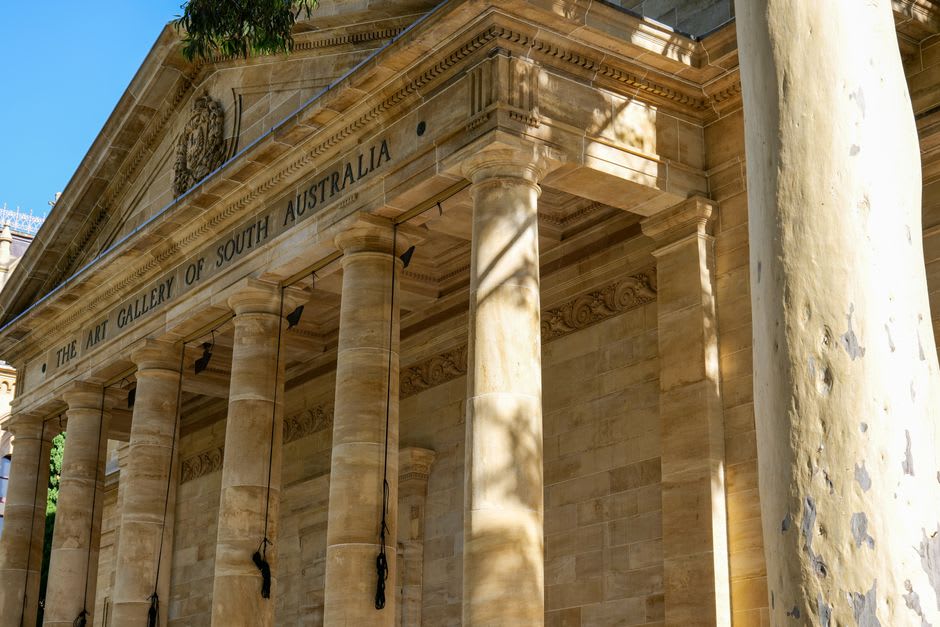
What surprised me most about Adelaide was that it refused to perform. North Terrace — the cultural boulevard running east from the train station — holds the Art Gallery, the South Australian Museum, and the State Library in a dignified row, none of them aggressive about their own importance. The Art Gallery has the most comprehensive collection of Aboriginal Australian art I’ve seen anywhere, displayed without the kind of contextual anxiety that sometimes weighs these things down. We spent two hours inside and came out quieter than we went in.
The city grid is the work of Colonel William Light, who designed it in 1836 with parklands ringing every quadrant — a plan so rational it still functions. Walking from Hutt Street through the parkland belt to the river takes fifteen minutes and feels like a different kind of city entirely. At dusk, the Elder Park rosebushes catch the last light in a way that made Lia stop mid-sentence.
What Comes After Dark
Adelaide’s festival calendar is the city’s real argument. The Adelaide Fringe in February and March is the second-largest arts festival in the world, behind Edinburgh — a statistic that still seems implausible until you watch the streets of the East End fill with every configuration of outdoor performance imaginable. The Adelaide Festival runs simultaneously, bringing the kind of international theatre and opera that Sydney books six months in advance. We arrived outside festival season, which meant we had the Rundle Street East bar strip to ourselves on a Thursday night, sharing a bottle of Clare Valley Riesling at a small wine bar where the owner pulled up a chair and told us where to eat the next day.
He sent us to Chinatown on Moonta Street — a block of Cantonese restaurants so thoroughly embedded in the local food culture that half the tables were white-haired regulars eating in silence, which is always a good sign.
When to go: February to May is ideal — the tail of summer into autumn, when the Fringe fills the city and the Barossa harvest begins. October through November is quieter but the light is perfect.