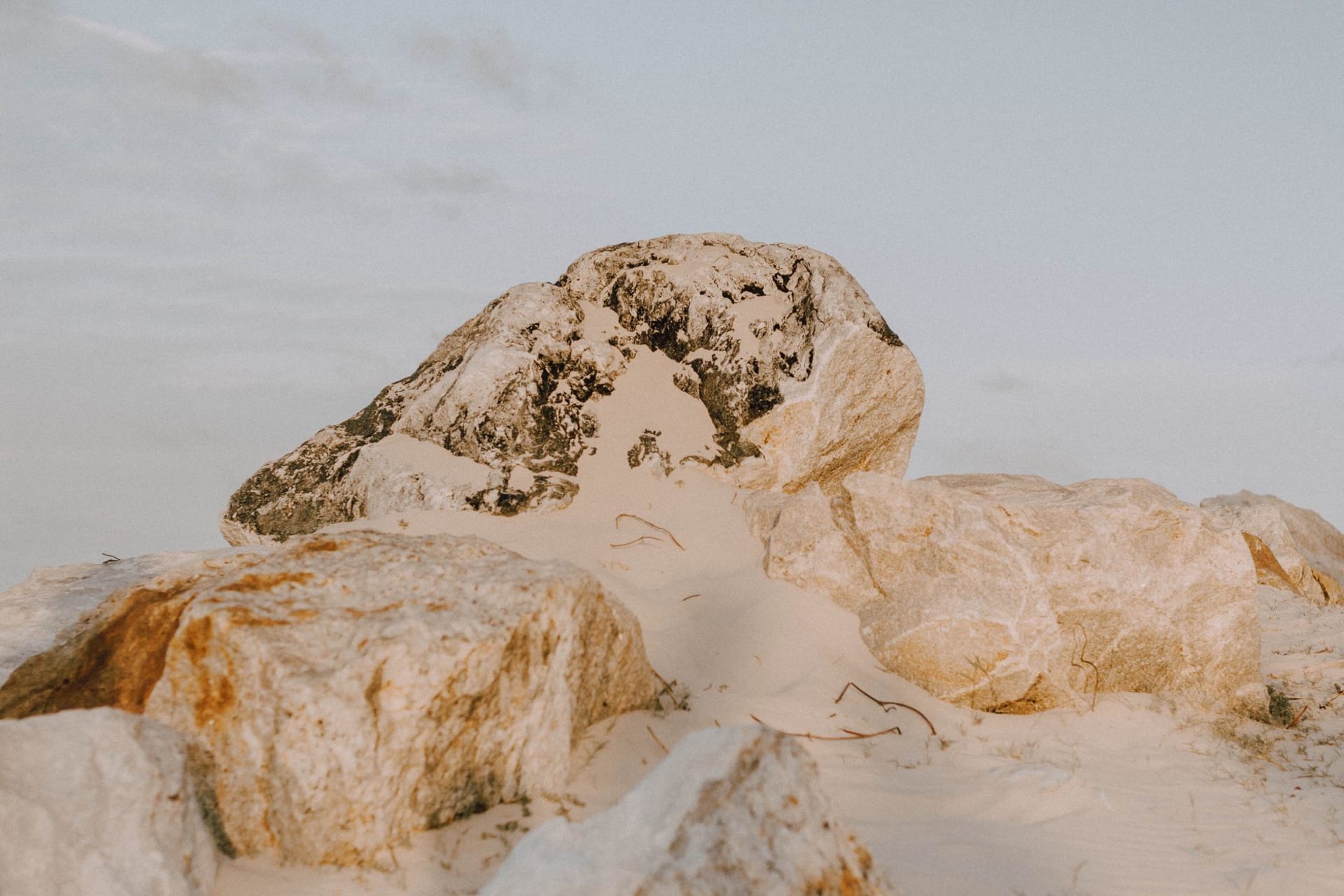
Ayo Rock Formations
"Aruba is sold as a beach. Walk twenty minutes inland and it turns into something far stranger."
The thing nobody tells you about Aruba is that the interior is bizarre. The beaches get all the attention — the postcard sweep of Eagle Beach, the resort strip at Palm Beach — but drive twenty minutes inland and the island turns into an arid, wind-scoured landscape of cactus, divi-divi trees bent permanently sideways by the trade winds, and, at Ayo, a cluster of enormous rounded boulders that look as though they were dropped there by something with a sense of humour.
How the rocks got there
They were not dropped, of course. The Ayo formations, like the better-known Casibari nearby, are tonalite and quartz diorite — igneous rock that formed underground and was exposed and weathered over millions of years into these smooth, stacked, improbable shapes. Some are the size of a house. They sit in clusters in the flat scrubland, and standing among them you get the genuinely disorienting feeling of being somewhere that does not match the rest of the country you arrived in. I kept expecting to turn a corner and find the sea, and there was only more desert.
For the Arawak people who lived on Aruba long before the resorts, these rocks mattered. There are petroglyphs — reddish-brown drawings on the protected undersides of the boulders, abstract figures and symbols whose meaning is now lost. A short, well-made path with steps and railings leads up and around the main cluster, and our guide pointed out the markings with the care of someone who clearly felt their significance more than the average sunburnt visitor passing through.

The climb and the wind
The walk to the top of the formation takes only a few minutes, but it earns you a view across the whole flat centre of the island, all the way to the hill of Hooiberg in one direction and the empty north coast in the other. The wind up there is relentless — Aruba sits in the path of the trade winds and they never let up — and it makes a strange, low sound moving through the gaps in the rock. Lia, who had been skeptical about leaving the beach, stood at the top with her hair whipping sideways and conceded that it was worth the detour, which from her is a substantial endorsement.
What I liked most was how quiet it was. The boulders are a known stop, but they do not draw the crowds the way the beaches do, and we shared the whole site with maybe two other small groups. After the wall-to-wall sun loungers of Palm Beach, standing alone among house-sized rocks in a desert felt like discovering that the island had been hiding its more interesting half the entire time.

When to go
Early morning, before the sun gets directly overhead — there is almost no shade and the rock radiates heat by midday. The site is open daily and entry is free; it pairs naturally with the Casibari formations and the Hooiberg climb if you want a full half-day away from the coast. Wear closed shoes for the path, bring water, and respect the petroglyphs by keeping your hands off the protected surfaces.